
The Music Q&A – Thom Yorke of Radiohead
Radiohead's sixth album is the rock & roll answer to Little Red Riding Hood, according to singer Thom Yorke.
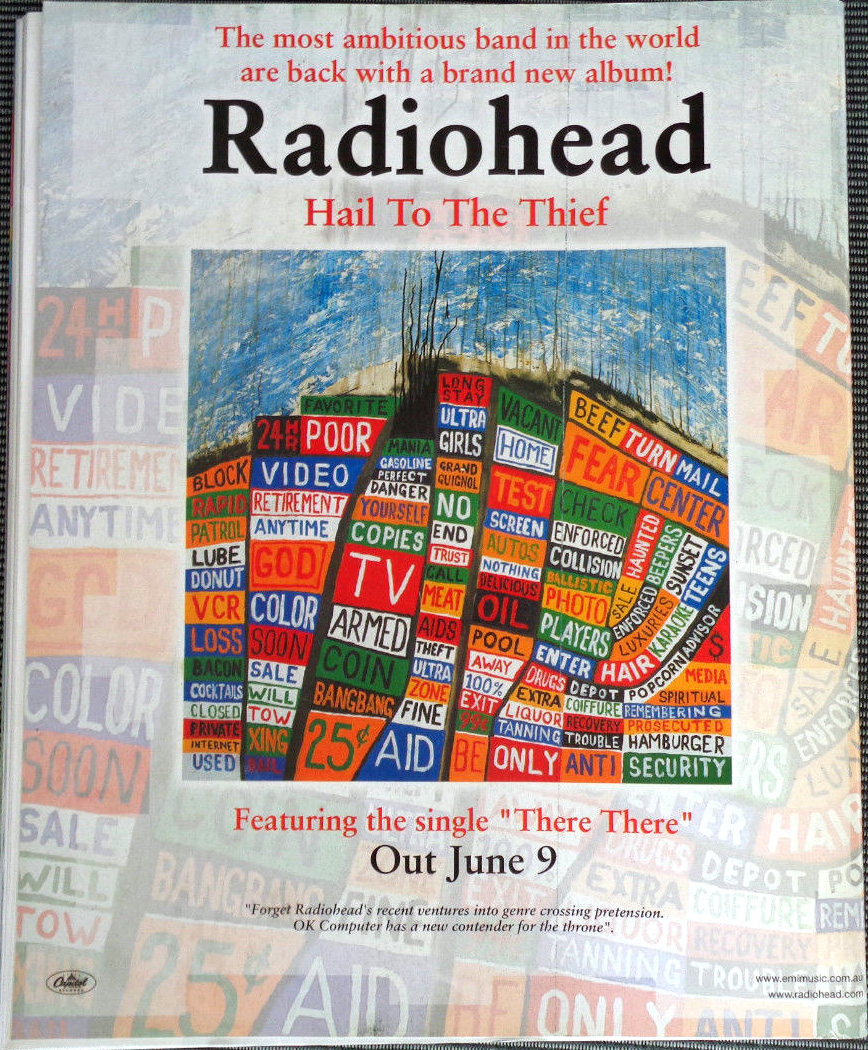
THERE WAS A TIME, THOM Yorke now admits, when the Radiohead songwriting process would involve him thinking, “OK, how am I going to process this through the laptop to make it sound like the most radical thing you’ve ever heard?” The rest of the band would be chatting about what they’d produced and Yorke would be in his own little world, working out how to mess it all up. One day, he woke up and realized that “it was the most stupid possible thing I could do”. The result is Hail to the Thief, the British rock quintet’s sixth album, where the experimentalism of 2000’s Kid A and 2001’s Amnesiac is given room to breathe.
How does Hail to the Thief compare to the band's previous two albums?
It's much less deliberately trying to progress. It’s much more just enjoying what we learnt. And making what we consider to be direct. Not really wanting to make this big fucking leap of faith like we did with the last two. There was this weird pressure in my head. We had this six-month period off and for the first two or three months, I was thinking, “We have to make this great leap now. Where the fuck are we going to leap?” And then I just thought, “Well, that’s silly. Set yourself up for disaster.” I used to think, “Too obvious! Obvious? Fuck that. We don’t do that. Where are the horn players?”
Why did Hail to the Thief seem like a good title?
Because, for me, when we were doing it, end of 2001 going into 2002, it was a really dark winter. There was a terrible sense of foreboding and I felt that it wasn’t down to any particular person or demonized individual, it was just this general consensus or panic and blind fear. This malignant force had taken control, and was stealing our thoughts, in a stupid way. But the title’s also got this daft jubilance about it, which I really like. Hail to the thief! It’s certainly not just [President] Bush thing at all. If that was the only reason, I don’t think we would have chosen it. Hail to the Thief was better because it sounds like a fairy tale.
So the album isn’t a grand political statement?
There was no intention of making a statement or being political at all. I only started to realise when I was typing up the lyrics at the end of it, it was like, “Oh God”. I was making a conscious effort fort that not to happen all the way through because it’s the last fucking thing anybody wants to hear. Especially me. I don’t think it’s political. If we’d sat down and tried to make a political record it would just be god-fucking-awful. You should hear our political jazz.
Do you worry that there might be a Dixies Chicks-style backlash to the title?
Oh I can’t wait for that! Yeah, I’m so in for that. The people who would get upset about that need to get on a plane and go on holiday somewhere other than America. And experience the rest of the world.
The album opens with “2+2=5” which seems to be about hiding in a world where maths is different and everything is safe.
Yes. Welcome to the nonsense. Yes, absolutely. Yes, we have no bananas. A lot of the lyrics were written just listening to the radio a lot. And playing with my little boy and just wondering whether he had a future at all. Where I, as a responsible adult and his father, was leaving him with a world that he really wouldn’t want to live in. And trying to deal with it, trying to get my head round it.
Where were you when “Myxamatosis” [sic] was written?
It was kicking around on the Kid A stuff. It was written as a story. I don’t really write stories, but that was one of the few stories I’ve ever written, and I just took bits of it. It’s not about me. Not at all. There’s lots of kiddy stories on this record, like Little Red Riding Hood stories.
“A Wolf at the Door” feels like a fairy tale.
That was a particularly bad two days, going absolutely out of my bonce. It was just post-OK Computer. I spent a lot of time wandering around Oxford, not really doing anything else except walking around and walking around and walking around and occasionally sitting down to write something and walk around. Round and round and round and round. Watching what's going on.
Who is “Where I End and You Begin” about?
For me, that’s to do with the living and the dead. That they’re not as far apart as I thought. I went through a period of realising that. Lots of people walk the same path and some of them are dead and some of them are living and sometimes you encounter them or encounter something to do with it. Most people do, somehow or other, at some point. When I had that, it totally messed with my head and it ended up in this song.
INSTANT EXPERT
[note by this website: ironically, facts 1, 2 and 4 aren’t actually correct... 1: his LEFT eye, 2: aged 11, 4: never dropped out.]1. Thom Yorke was born in 1968 with his right eye paralysed and closed.
2. Yorke wrote his first song, “Mushroom Cloud”, aged 8.
3. One of Yorke’s first bands went by the name Headless Chicken.
4. Yorke dropped out of university while studying Fine Arts and Literature.
5. The band name Radiohead was “borrowed” from a song on the Talking Heads’ album True Stories.