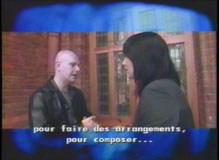
[recording starts here]
Interviewer: You're doing things your own way, which I think is great. You've decided not to release any singles for Kid A.
Thom: Yeah, good point.
Interviewer: Um, do you want people to respond to the album as a whole?
Thom: Um, no, I don't think it's really preciousness like that, sort of thing. I think really, it was just, singles are completely wack. And they smell.
Interviewer: They smell?
Thom: They smell bad.
Interviewer: [laughs] But there's no song on this album that for you would stand out as a single, or, you don't-
Thom: I think you could release most of them, really, but...
Interviewer: Yeah.
Thom: I kind of think there's no point in the "current climate." I'd much rather go off and do twelve inches and stuff like that, which is what we'll do next, I think.
Interviewer: Do you want radio promoters, or people in the radio industry-
Thom: I want them to have a hard time!
Interviewer: Picking a song by themselves!
Thom: They'll do it anyway. Whatever, who cares.
Interviewer: Yeah.
Thom: Whatever. They'll do what they do, you know, but I'm not interested.
Interviewer: Do you wish you could have done that before, like that format of saying, no singles, no this, no that? Or is this the right time to do it now? Or...
Thom: Um...
Interviewer: Do you wish you could have done it before, maybe?
Thom: Um. God knows. It's like a business thing, really. It's like a business decision. I don't we'd ever- We hadn't really uh- I think at the moment like, the whole chart thing is like, it's just not appropriate for us. [laughs] It'll do us no good being up there, with, uh, whatever her... What's her name? I can't remember her name. Strange girl. American. Quite young.
Interviewer: Britney Spears?
Thom: That's it.
Interviewer: Oh yeah!
Thom: Yeah. I'm not about to dress up in my, uh, cheerleader outfit.
Interviewer: I can't imagine!
Thom: No.
Interviewer: In the schoolgirl-
Thom: Uh-uh.
Interviewer: Thom in a schoolgirl outfit!
Thom: No.
Interviewer: No, I don't think that'll work.
Thom: No.
Interviewer: [laughs]
Thom: So there you go.
Interviewer: Let's talk a little bit about the album, then, the songs, how they came together, how they came alive, and how they were maybe transformed a little bit from their original songs. How did that work out, because the sound in this album is so unique?
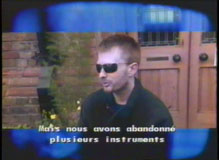
Thom: It was quite weird. I mean, we'd lost interest in playing guitar, which is a fundamental stumbling block for what was essentially a rock band. But, um, we like bought all these different instruments, and I think a lot of it was really working through the night, experimenting a lot, having our own studio, and trying to pursue whatever it was that's up there [taps head] until you hear it. Which took a considerable amount of time, and was extremely frustrating, like these things always are.
Interviewer: I did notice that on the album the guitars are used unconventionally, if I can say, if that makes any sense, or if they're a little buried, or very subtle, uh, you did use them after all, even though you said-
Thom: Yeah, yeah.
Interviewer: -that you lost... Did you have to sort of regain an interest, or rekindle, like, some sort of an interest towards guitar music? How did that...
Thom: Um, well no, I still don't think I'm interested in guitar music anymore. I might get into it again. But I think that I have a problem with playing any instrument for the sake of it. I'm more interested in, um, I think a lot of what changed in the way that we worked is, it became less about standing in a room with 5 people, uh, sort of whipping up, you know what I mean, like you'd do in a live situation, like you- uh, and much more about people going off on their own and experimenting, and bringing things in, and then editing, which is like a new, totally new thing for us.
Interviewer: Right.
Thom: Where you generate material, and then you edit it together, and then you generate some more, and you edit that, and it becomes like editing a film. And depending on how you put a chord with another chord, you totally change the plot. But you don't have to stand in a room and do that, you're doing it like on the computers and things. So it's all about, it was all about like learning how to use all these things that we'd been really anti- before, like samplers and- well not anti-samplers, but anti- like...
Interviewer: Not familiar with, maybe?
Thom: ....yeah.
Phil: We put together our own studio, which we finally got into last September. And I think the idea behind that was so we'd able to go in there, and actually, as Thom said, you know, experiment, and just try out new ways of working together, which we'd never been able to do before, because, you know, we were always, you know, in somebody else's studio, you're always very aware that the clock's ticking away, mounting up these huge costs. And also, you know, you're not in your own... environment, really. I think we've created something that... "Created"? Wah!
[laughs]
Phil: Um, put together something that is, I don't know, somewhere halfway between somewhere you work and somewhere that's quite homely, something a bit more comfortable, working there.
Interviewer: What was the ambiance like in the studio?
Thom: Well it changed a lot. We had like, the first place we went to was Paris, which was a washout, completely.
Interviewer: Really?
Thom: Disaster, yeah. Um...
Interviewer: Why?
Thom: Well, it felt like that at the time. Actually, we produced a couple of things that were really good. But at the time it felt like that. But it's because, uh... you know, we felt like nothing was working, but then, we couldn't judge, because we were all in a really weird head space. And then we went to Copenhagen, and that was pretty freaky as well. [laughs] Just, uh, cause nothing was working, and...
Interviewer: Does the pad [pod? French translation says "ambiance."] change when you change cities, when you're recording, and you're going...
Thom: Well we initially did that because we were supposed to be building a studio, and as usual when you build anything, the builders are 6 months late. So we had to start, so we had to go, you know, sort of... [nods away from the conversation] So uh, oh and then we found this beautiful, enormous mansion that we managed to rent off Lord Somebody-or-Other. Which he hadn't lived in for 20 years. The old boy had died there, and he had inherited it. And it was, uh, it had like 300 rooms.
Interviewer: Wow!
Thom: And 200 of which hadn't been opened for 50 years, since the Second World War.
Interviewer: Did you go have a look?
Thom: Yeah.
Interviewer: Oh really?
Thom: And there were rats everywhere, and we were sleeping there as well. Conscious of the fact- you know, we were only occupying like, a tiny bit of the house.
Interviewer: Wow!
Thom: And uh, conscious of the fact that... 2/3rd of the house had been empty for that long, and there were rats running around, and there was broken furniture, and... uh, it was really peculiar. You know the classic, you know, furniture under the sheets, and cobwebs, like. It was all like that. It was absolutely freaky.
Interviewer: Like horror movie type, or?
Thom: A little bit more sad than that, actually. Like building a very, very large house and never having occupied it.
Interviewer: No life in it.
Thom: Yeah. It was a very sad feeling. A very empty feeling.
Interviewer: Did that affect you, at all, when you were writing there?
Thom: It was kind- it was pretty- it was like... Yeah, it did. Yeah, it did affect us quite badly. But then that's where, actually, at one point, that's where it really started coming together, bizarrely.
Interviewer: Your vocal, uh, style. There's a definite new approach to the vocal style on the album.
Thom: Oh yeah?
Interviewer: Do you think? Uh, the vocals are-
Thom: There's lots of treatment, stuff, there's lots of-
Interviewer: There is, and it's also cut up, it sounds almost like a stream of consciousness, but more...
Thom: It was actually, uh, literally pulling words out of a hat. [laughs]
Interviewer: Really?
Thom: Yeah. I got a friend to buy me one of those top hats where you go, whoosh! [mimes tapping a hat with a magic wand] It opens up!
Interviewer: Yeah!
Thom: And then just cut all- I was going nowhere with my words, so I just cut everything up that I had, and cut bits out of newspapers and just threw it all in. And would just pull it out, and when something works I keep it, again, like the editing thing.
Interviewer: So the lyrics were in the editing. Is there a thematic to the album that required this technique, or this new approach, no?
Thom: Not conscious at all, no.
Interviewer: Not consciously.
Thom: But in retrospect there probably was, and I'm not quite sure what it is.
Interviewer: Um-hm.
Thom: I kind of always end up thinking of the themes or whatever being certain colors, or certain shapes, rather than it's about this, or it's about that. Although I did have a kind of a weird thing at the end where I realized a lot of it was about Kosovo.
Interviewer: Really?
Thom: Yeah.
Interviewer: Only at the end, though, did you realize?
Thom: I think, um, well while we were at this big empty house, we used to get... [laughs] We were quite near one of the air bases where the bombers were flying out every night. So um, like at midnight every night, they'd fly out in a long procession over the house, through the valley. So we'd see them fly out, and then they'd come back, we'd still be up at 6 in the morning, and they'd be coming, flying back.
Interviewer: Wow!
Thom: Having bombed the shit out of...
Interviewer: Yeah.
Thom: Erm...
Interviewer: Anything!
Thom: Kosovo... Yeah. So that was, I think actually-
Interviewer: That's disturbing!
Thom: Yeah, it was, a bit! [laughs]
Interviewer: There's one song on the album I think that stands out, a lot, and is one of my favorites, is Idioteque.
Thom: Yeah, that one.
Interviewer: It seems like-
Thom: Cause I had a big run-in with this journalist about that. Cause he just said, "I don't get it, I don'! What are you trying to say?" I'm not trying to say anything, that's the bloody point.
Thom: The inspiration was really that I'd always wanted to do a disco tune.
Interviewer: Really?
Thom: Yeah. And that's my disco, from my point of view.
Interviewer: Pretty good disco! [laughs]
Thom: My bit of it is, you know, I want to do a disco tune. But I want to sound like houses about to, I want it to sound like skyscrapers falling down.
Interviewer: Oh yeah... Your "I Will Survive"-
Thom: Yeah.
Interviewer: -is Idioteque.
Thom: Absolutely.
Interviewer: That's very good.
Thom: It's definitely my "I Will Survive."
[laughs]
Phil: If there's an expectation on the band, from, say, OK Computer, the band's would be that we would try and push the boat out a bit, push ourselves a bit. And I don't think people will be disappointed from that point of view, with this album. Um, but, you know. Inevitably when you're coming up to release of a record, especially when you haven't released anything for about 3 years.
Interviewer: It's still nerve-wracking?
Phil: Oh yeah!
Interviewer: Really?
Phil: Yeah.
Interviewer: Really? You still have doubts, you think?
Phil: ...Yeah? [laughs]
Interviewer: Where do you think you'll go musically, in like, 10 years?
Thom: Um, I sort of like thinking that any musician has license to go anywhere they want, especially now. Cause I think basically, I hope basically the whole mythology of rock-n-roll stars, and all that sort of self-destruction, thing, is going to stop, because of the way that the music climate is changing. Um, and I think anybody should have access to any form of music that they like, and be able to express themselves, really. And not try and fulfill some sort of bullshit myth that fits with it.
Interviewer: Yeah.
Thom: Uh, and I think that's the thing that's inspired me most about like all of the electronica stuff I've listened to is that there's no sense of personality about it. Um. It is what it is. And that's, you know...
Interviewer: Like a chameleon. almost?
Thom: No-
Interviewer: No.
Thom: Yeah! Yeah, I guess. I guess. It's just like, you know, just I think everybody should have the license to go wherever they feel, rather than, "Oh, I'm a rock star," or, "I do electronic stuff," or, "I'm a jazz musician," or sort of like, it kind of feels like because of the way that recording has changed, and the fact that you can record cheaply, and get it out there easily, and, um, you don't need as much knowledge as maybe you did a few years ago, and you don't have to kiss a record company's arse, you don't have to kiss the music business's arse, you don't have to do all that stuff. In 10 years' time, it'll mean that things are a little bit freer, and less about the myths that portray them.