France 2 'Trafic Musique', probably april or may 2003
[Interviews with the full band]
.
[recording starts here]
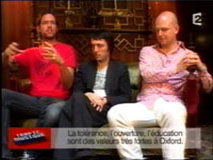
Ed: It's not a town that's solely driven by commerce. It's, you know, it's got an academic institution. And that's, you know, growing up, though, it was an incredibly tolerant place to live, cause you'd have people from all over the world, visiting professors and so, there was never any racism, there was tolerance and interest in education. And that's a really strong part of that whole city.
Ed: We would spend, in pubs and stuff like that, we would spend evenings talking about, "When, WHEN we've done our first tour of America..." We were incredibly rough around the edges, but it felt really, really right. Yeah, I remember thinking we were, in 1987, we were the best band in the world. We hadn't got a record deal, but we were stilll the best band in the world. It wasn't until we made Pablo Honey that we realized we weren't!
Phil: If you look at the touring, towards the end of OK Computer, you know, it should have been about the ideal setup. You know, we were playing good shows, we were traveling around in a very nice way, and, you know, supposedly doing what we loved. And we weren't getting that sense of fulfillment of it, really. And so, from that point of view, I think we all knew that something had to change, at that point. As with a lot of things, you know, Thom does lead the way. And he's very uncompromising, in that respect. You know, he'll come in and just say, "Do not want to return to where we've been."
Jonny: We have these computer programs that give you total freedom to make any kind of sound, and any kind of music. But everybody tends to make the same kind of music. So we've started, um, like, programming computers. Writing software, in a way. And trying to deal with computers in as personal a way as you can.
Phil: We had a real excitement again, about playing as a band. And, you know, we felt that it was, it had gone in a different direction in terms of the performances we were doing. And in turn, that let us go into the making of Hail to the Thief with much more confidence.
Jonny: Other bands get to the stage where one or two members lose interest, and they get more interested in, you know, collecting sports cars, or flying planes, or whatever. And it's like, we were really lucky. In on way, we suffer from it, but in another way we're lucky that we're all so, um, obsessed that we just want to see where it's going to go, and do the next piece of music, really.
French: Pourquoi avoir choisi le rock que mettre d'expression plutôt que de le son real à tu?
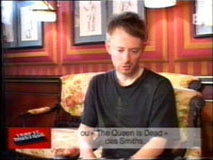
Thom: The reason was, that I was younger, nothing affected me more than music. I mean, nothing affected me more than when I first heard Murmur by REM or, you know, Queen is Dead by The Smiths. When I went to art school I just spent the whole time there having a real problem with the way that art is placed, um, because to me it's pointless. Most "art", in that sense of the word, is utterly irrelevant, whereas rock music is relevant to some people. Because it's a mass produced medium. It's not really, hopefully, it's not precious. There's no aura of the original, like, when you go the the Louvre, you know, when you go past all the incredibly famous paintings, and you go, "Oh wow, isn't it incredibly, wow, the aura!" Fuck it! I can't even see it!
Thom: I did this very random interview with this very, very middle class, middle aged lady who was very uptight. And her opening question was, "I think this record is like, it's your Guernica." And I was like, Wow! That's the best thing that anybody's ever said to me, ever. And I keep thinking about the, you know, I keep thinking about Guernica. And I'm quite sure that if Picasso, as he sort of sat down, staring at that canvas, and thought, "I've really got to! I've really got to do something about this! I've got to make a protest! I've got to!" It would have been shit!
Thom: I really, really didn't want to make a political record or something. I wanted to do something that was really abstract. I wanted to not know about, uh, the world around. I wanted the music to make you forget about absolutely everything that was going on. But then, when it came to writing the words, that's what I had. That, you know, I couldn't make pretty sounds and just leave it at that. But what I was doing I guess, was trying to make things that I considered incredibly ugly and frustrating, into a music that would make it alright, you know. I mean, one of the records that I was listening to a lot, when we first started thinking about doing this record was Uprising, that Bob Marley one. And the lyrics on that, I mean, some of the lyrics on that are, phew... "We no know how we and dem a-go work this out." Um, "We and Dem", isn't it, yeah. The words to that had a really big effect on me, because, er, um, I don't, sort of consider them political or anything, but they're like, well this is, it's, this is um, this is not a love song. This song is really fucking angry.
Thom: One of the best things about Uprising as a record, for me, was you could just listen to it without even thinking at all about the politics or the anger in it at all. You could totally ignore it, and it wouldn't matter. And if, and that's kind of what I was hoping, I guess, to get to with this.
Thom: I got to this position where I just felt that it was really ugly. And I didn't like it. And I didn't like the sort of emotional connotations that it had. Um, and I think, to be honest, part of that was hearing people singing similar. I mean, to me, this is, you know, obviously this series of singers that, to me, have made me feel good about my voice, and who are people that I admire. But if there's people singing like you that you don't admire, it makes you feel very depressed.
Thom: Anyway, after touring with the two records, Kid A and Amnesiac, and playing live shows, and having to stand in front of a audience again, with a microphone, and do that again, and no where to hide, it made me realize that I was into it.
Thom: Straight after I went and did a session with Bjork, and a session with Polly Harvey, and that made me feel a lot better about my emotions as well. It made me realize how joyful this should be, really.
French: D'apparat le group en tire a voulez?
Thom: What we did for this record, I'd just spend the whole day just not saying anything, you know, at all, trying not to say. Or if something really excited me I'd say yes, but I wouldn't sort of say, "No no no no, that's wack!" [flails about] Which was what I was doing all the time, and when we were doing Kid A and Amnesiac, I was like, everything was like, "No no no no, nope, no no no, that doesn't, no no no."
Thom: The method was that I wanted everyone to make mistakes because I felt that, um, uh, the mistakes would be musically more interesting. Which, actually, I kind of was right about that, but um. Uh... If there had been a way explaining it without it being a problem, then it would have been okay, you know? But if you work with 4 other people and with Nigel, and you're not able to explain yourself, but yet you're, um... unhappy with how everything's going, all the time, and everyone can feel it, it's a pretty tough situation.
French: Et tient a danger a trop vous d'apres ton dans l'ambition artistique dans le rock?
Thom: With this one, whatever the point was, I just wanted to get there faster and then fuck off. Like, no hanging about, no deliberation, just, band bang bang. That's what I meant to say. You know, sometimes you have a musical idea and you get really excited about it, and you just want to carry on, and develop it, and develop it. But actually, it ends up being quite a selfish thing to do.
French: Qu'est ce a vue le monde de la pop?
Thom: My dearest ambition is to write a record that is just, um, you know, it gets played in a club and everybody jumps up and goes, "Yeah!" You know, that's what I really want. You know, I don't want, erm, I don't want the chin scratching. "Hmmmm, interesting." I don't consider what we do is about that at all.