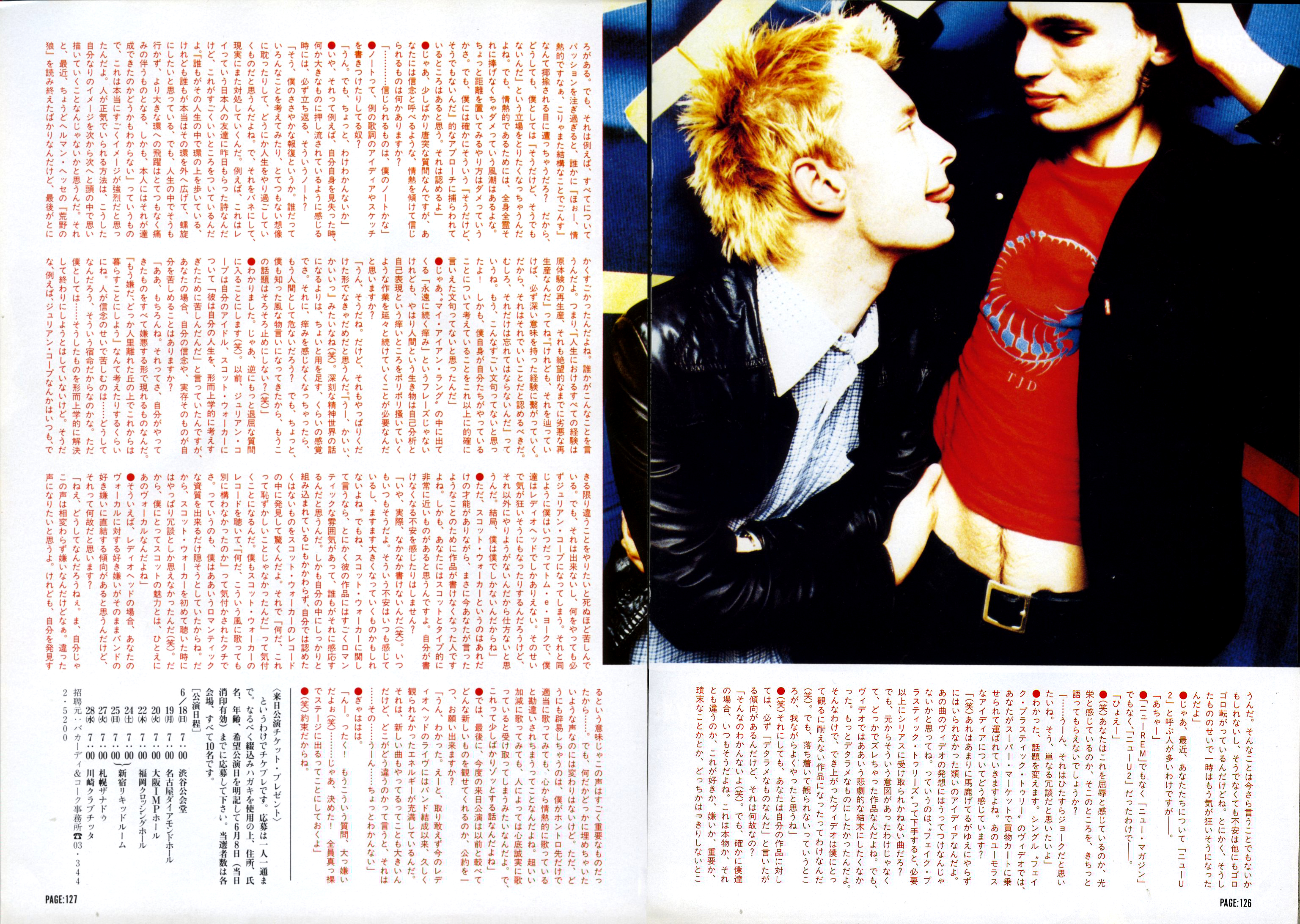
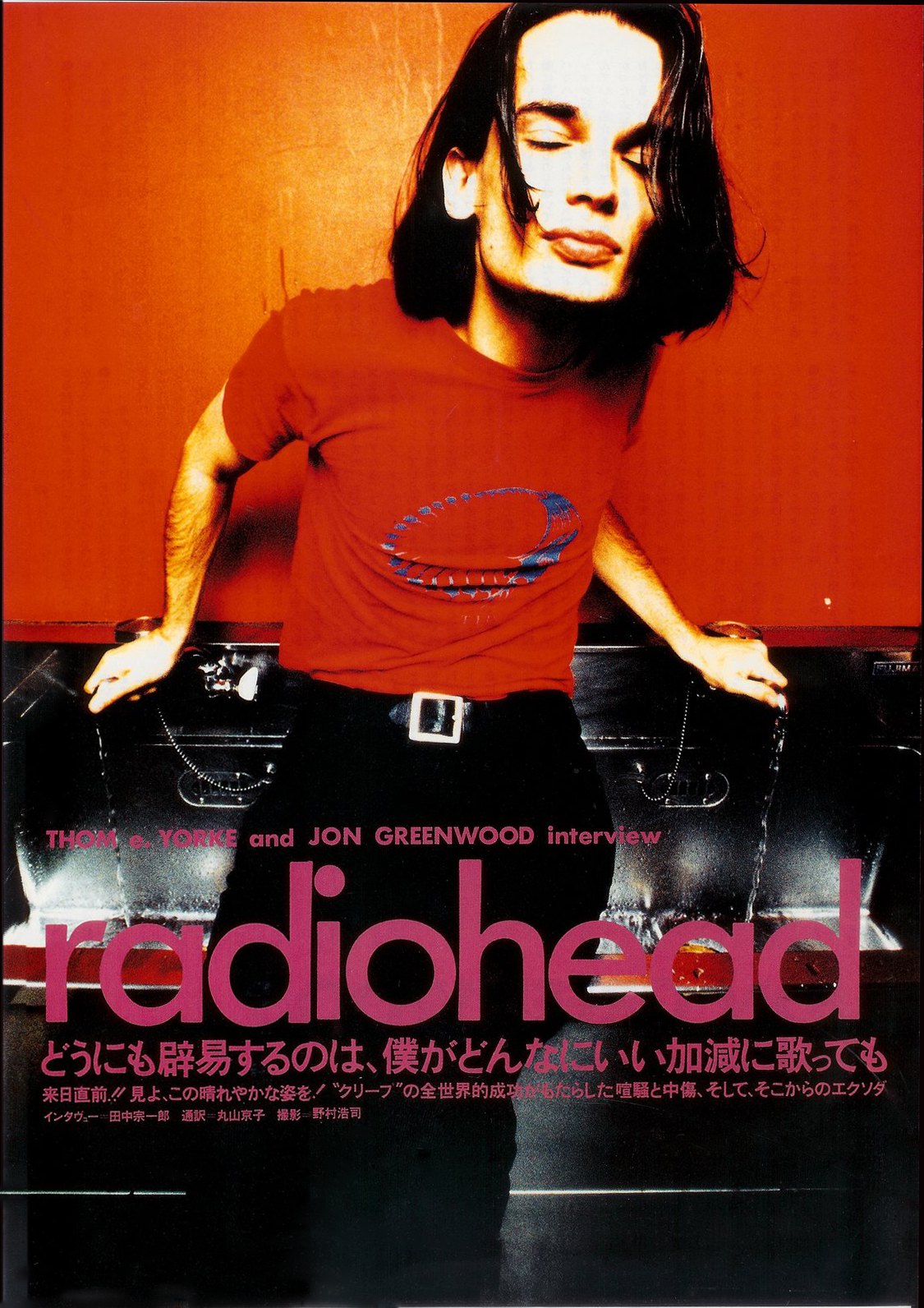
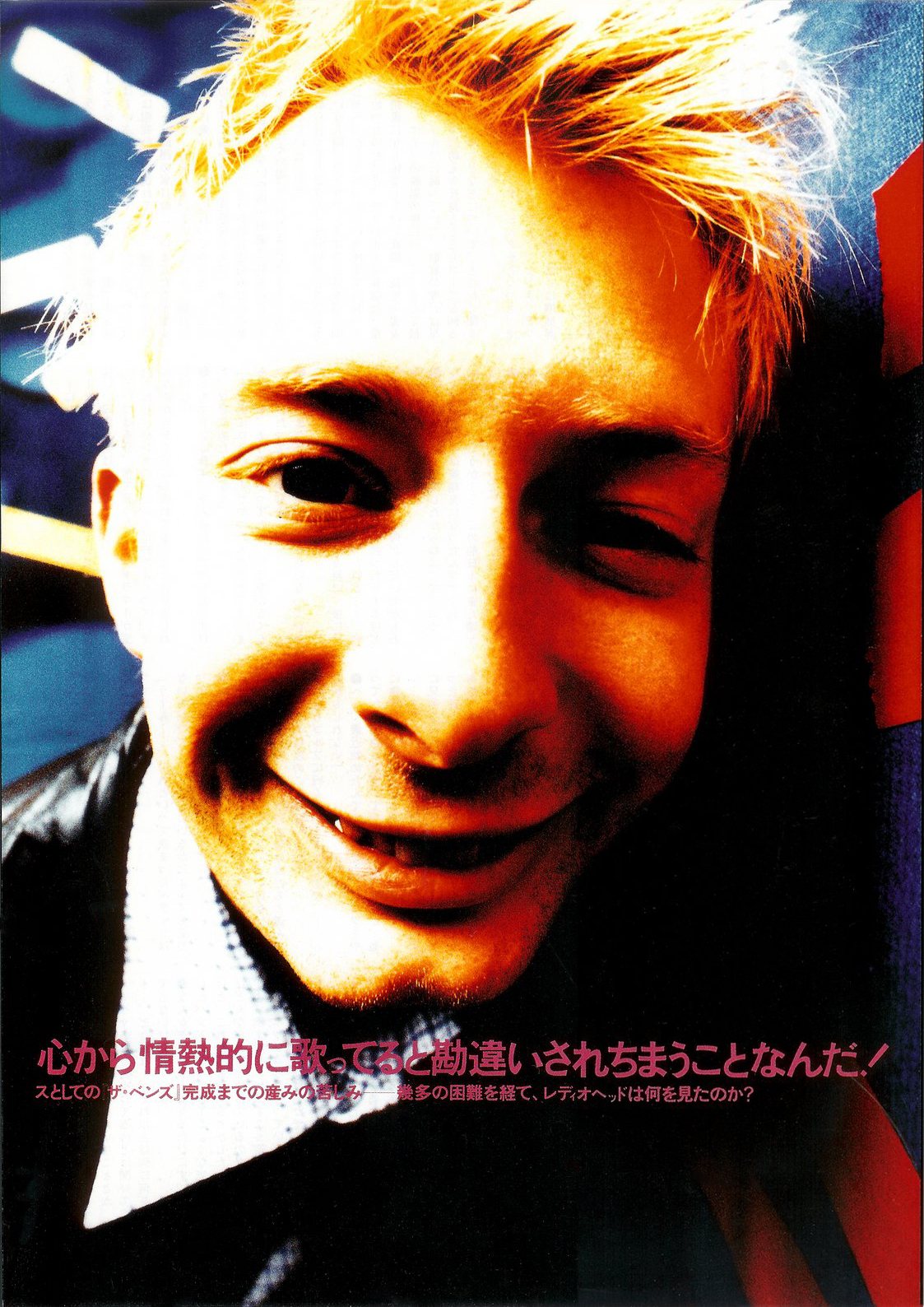


“The thing is, I get mistaken for singing passionately from the heart!”
The pains of bringing The Bends to completion — after overcoming countless difficulties, what did Radiohead see?
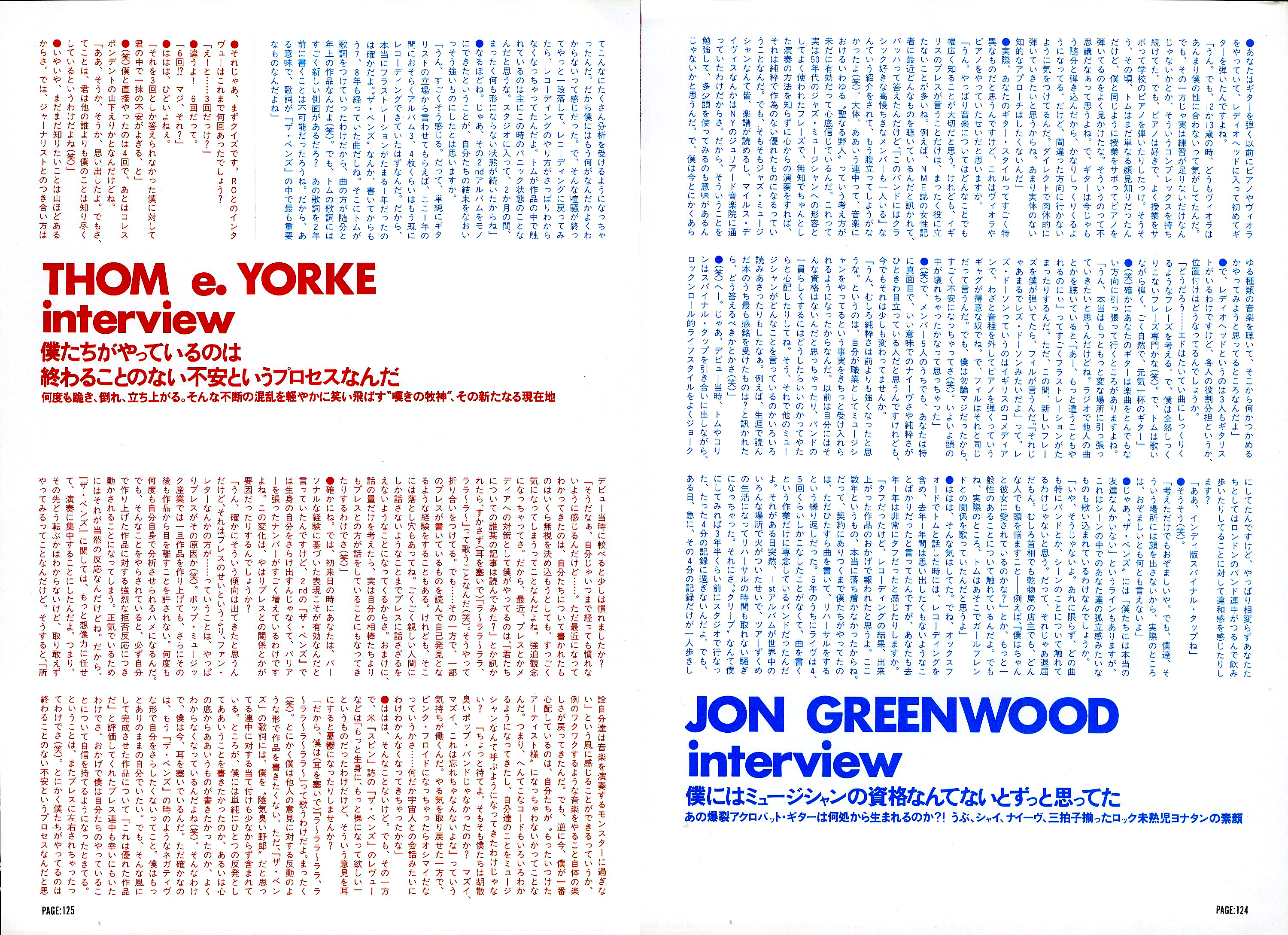
THOM E. YORKE interview
“What we're doing is a process of never-ending anxiety.”
Page 124
Q: Before you played guitar, you played piano and viola, and you only started playing guitar after joining Radiohead, right?
Thom: Yeah. But when I was about 20, I started feeling that the viola wasn't really suited to me. At the same time, though, I kept having this complex that maybe I simply hadn't practised enough.
I liked the piano, though, and I used to play the piano at school, sometimes even skipping lessons to do it. Actually, at the time Tom was still just an acquaintance, but I often saw him playing the piano at school instead of going to class, just like me. You think that's rather strange, don't you?
As for guitar, I've played it so much by now that it feels pretty natural to me. But I'm careful not to go in the wrong direction. I want to play it directly and physically. I don't want an overly intellectual approach that has very little substance.
Q: I think your guitar style is extremely unusual. Do you think that comes from having played viola and piano?
Jonny: Yes. I think it's important to know a broad range of things about music. But what the British press says is often completely useless.
For example, an interviewer from NME recently asked me what I'd been listening to. I answered “Bach,” and they introduced us as something like, “This band has one pretentious member who likes classical music.” It made me furious. (laughs)
Those people genuinely believe that the idea of the “noble savage” in music is still valid. It's a phrase that was often used to describe jazz musicians in the 1950s: someone who is ignorant, doesn't know the proper way to perform, but plays from the heart, and therefore produces something pure and unaffected.
But all those jazz musicians could read music. Miles Davis, for example, attended the Juilliard School in New York. So I think there's some value in studying things and using your brain a little.
And at the moment I'm basically trying to listen to all sorts of music and see whether I can get something out of it.
Q: Radiohead has three guitarists. How would you describe the division of roles between the three of you?
Jonny: I don't know. Ed generally comes up with phrases that fit naturally into a song. I suppose I'm the specialist in phrases that don't fit at all. (laughs) And Thom plays while he sings — it's very natural and full of energy.
Q: Your guitar does seem to pull the songs in completely unexpected directions.
Jonny: Yeah. Actually, I'd like to pull them into much stranger places. When I listen to other people's songs on the radio, I sometimes get really frustrated thinking, “Ah, there are so many other things you could do.”
The other day I was playing a new phrase and Phil said, “That sounds just like Les Dawson.” Les Dawson was an English comedian whose speciality was a gag in which he deliberately played the piano out of tune. Phil said what I was doing was the same thing.
But I was completely serious, so I became really worried. (laughs) I started wondering whether I'd finally lost my mind.
Q: Of the five members, you seem particularly serious, and your naïveté and purity, in a good sense, stand out. Has that changed at all?
Jonny: If anything, I think the purity has become stronger than before. That's because I've finally been able to properly accept the fact that I'm a musician by profession.
Before, I'd worry that I wasn't qualified to be doing this, or wonder what I had to do to behave like a member of a band. I used to read all sorts of things other musicians had said.
For example, I'd wonder what I was supposed to answer if somebody asked me, “What is the book that has impressed you most in your entire life?” (laughs)
Q: When you were starting out, Thom and Colin used to joke about a rock'n'roll lifestyle, making references to Spinal Tap. Do you still feel uncomfortable about London bands hanging out together and going drinking?
Jonny: Ah — the indie version of Spinal Tap.
Q: Exactly. (laughs)
Jonny: Just thinking about it is horrible. But I don't go to places like that, so I can't really say whether it's horrible or not.
Q: There's a line in The Bends that says, “We don't have any real friends.” Is that expressing some sense of your isolation from the scene?
Jonny: No, I don't think so. And I don't think that song, or any of the songs, is specifically about bands or the scene. That would be boring.
Rather, they're about things that anybody can worry about — even a prime minister or the owner of a dried-goods shop. For example, “Am I really loved by my girlfriend?” — things with a more universal quality.
But actually, I think Thom was singing about his relationship with his girlfriend there.
Q: (laughs) I had a feeling that might be the case.
Q: When I spoke to Thom in Oxford, he said that, including the recording, the whole of the previous year had been full of things he didn't even want to remember. Did you also feel that the past year had been particularly tough?
Jonny: It was tough, but I think we were rewarded by the finished work that came out of the recording.
For the past few years we really hadn't been able to settle down. Until we got the record deal, all we did was write songs and rehearse, over and over. In five years we'd only played live about four or five times. We were a band that concentrated solely on writing songs.
Then suddenly one day the album caught fire in different parts of the world, and our lives became nothing but touring. We couldn't even find time to rehearse.
And Creep, as far as I'm concerned, is simply a four-minute recording we made in the studio about three and a half years ago. But suddenly, one day, that four-minute recording began walking around on its own...
Page 125
Q: You said when you first came to Japan that expressions based on personal experience were effective. But on The Bends, rather than exposing your naked self, there are many more songs where you've put up a barrier. Was this change partly caused by your relationship with the press?
Thom: Yeah, I think that tendency has appeared. But rather than the press, it's probably more because of fan letters...
So I suppose that means the press is responsible after all. (laughs)
In the pop-music industry, once you've made a work, you're not allowed simply to leave it alone afterwards. You're made to analyse it yourself over and over again.
And when you're forced to do that, you inevitably end up developing an intense rejection of the work you've created yourself. That's a natural reaction if you want to remain sane.
So with The Bends, I decided to rely more on my imagination and concentrate on performing. In other words, I decided just to try things without knowing where they would lead.
When you do that, you can feel that “we're nothing more than monsters playing music,” or something like that. The excitement of simply making that kind of exciting music came back.
But on the other hand, what I'm most worried about now is whether we're going to turn into these self-important “artists.”
We've learned all sorts of strange chords, and we've started calling ourselves musicians. And there's this voice inside me saying, “Wait a minute. Weren't we just some scruffy pop band in the first place? This is bad. This is bad. We mustn't forget that.”
So while I've recovered my motivation, there's also this feeling that if we turn into Pink Floyd, it'll all be over. (laughs) It's starting to feel like a conversation with aliens.
Q: But reviews such as the one Spin gave The Bends said that they wanted you to be “more human” and more direct. Doesn't hearing opinions like that make you depressed?
Thom: That's why I put my fingers in my ears and sing, “La-la-la-la-la...” (laughs)
Basically, I don't want to write songs as a reaction against other people's opinions.
There is certainly some retaliation against people who think I'm a gloomy bastard in the lyrics of The Bends. But I've reached the point where I don't know whether I simply wanted to write those things as an act of rebellion, or whether I genuinely wanted to write them from the bottom of my heart. (laughs)
So that's why I'm covering my ears now.
The one thing I know for certain is that I don't want to expose myself in that negative way anymore, as I did with The Bends. I want to be more simply myself.
Fortunately, there were also members of the press who rated the work we'd made that way as “an excellent work.” Thanks to that, I've become able to have confidence in what we're doing.
Which means that, once again, I've been influenced by the press. (laughs)
Basically, I think what we're doing is a process of never-ending anxiety.
Q: So, first, a quiz. How many times have you had interviews with Rockin'On?
Thom: Um... three times?
Interviewer: Six times.
Thom: Six? Seriously? That's twelve!
Interviewer: (laughs) That's terrible.
Thom: You're saying that to me when I could only answer three times?
Interviewer: I've actually interviewed you directly four times. The others were done by correspondent Erika Yamashita.
Thom: Ah, right, right. I remember now. So that means you know more about me than anyone else. (laughs)
Interviewer: No, no — there's still an enormous amount I want to know.
Q: Has it become any easier to deal with journalists compared with when you first debuted?
Thom: I still feel as though I'll never get used to it. But recently I've realised that, no matter how much I try to ignore things written about us, I become incredibly conscious of them. It turns into an obsession.
So recently, as a way of dealing with the press and media, if someone asks me, “Have you read so-and-so's article about you?”, I immediately cover my ears and go, “La-la-la-la-la...” (laughs) That's how I deal with it.
But on the other hand, there are times when reading something written by certain members of the press leads to an experience of discovering something about myself.
There are traps in that, though. You end up having to tell the press things you would normally only tell people who are extremely close to you.
And if you consider the sheer amount of talking, there are times when I end up talking to the press more than I talk to my own bandmates. (laughs)
Q: You mentioned during your first visit to Japan that personal experience was the most effective basis for expression. On The Bends, though, there are many more songs where you put up a barrier instead of exposing your real self. Was this change caused by your relationship with the press?
Thom: Yeah, I think that tendency has appeared, but it's more because of fan letters...
Q: Do you think completing the second album made the band's unity even stronger?
Jonny: Yeah, I really feel that. Speaking simply from the guitarist's point of view, we could probably have recorded three or four albums during this past year.
So it was really a frustrating year. The Bends, for example, was a song I'd written seven or eight years ago. Then Thom put lyrics to it, so the song itself is considerably older than the lyrics. (laughs)
But there's something very new in Thom's lyrics, isn't there? He couldn't have written those lyrics two years ago. So in a sense, the lyrics are the most important thing about The Bends.
Page 126
The interview continues with Thom and Jonny discussing artistic belief, self-analysis and their musical influences.
Q: Is there anything you could call a belief that you put your passion into and feel you have to believe in?
Jonny: ...My notebook, I suppose.
Q: The notebook where you write down those lyric ideas and sketches?
Jonny: Yeah. But even that is pretty boring. (laughs)
Q: Your relationship with your own beliefs and existence — can those things themselves cause you suffering?
Jonny: Of course. You know, I think that when you believe in something, it can appear as a form of hating everything you've done.
Sometimes I think, “I can't stand this anymore. I'm going to go and live on a hill somewhere far away from people.”
I suppose suffering because of one's beliefs is part of one's fate.
I don't try to solve those things metaphysically and bring them to an end. Recently I happened to finish reading Hermann Hesse's Steppenwolf, and the ending was...
[The wording in this portion of the supplied scan is not sufficiently clear for me to translate the final sentence reliably without guessing.]
Q: Radiohead's live shows have been filled with energy that hasn't been seen for a long time since the band's formation. Is that because you're also playing new songs?
Jonny: Yeah, that's a big part of it. There's always been that anxiety, and perhaps it's getting bigger and bigger.
Q: You have three guitarists. Ed tends to find phrases that fit naturally, while your own playing often seems to go somewhere completely unexpected. Does that relate to the way you think about music?
Jonny: I suppose so. I'd actually like to take it somewhere even stranger. When I hear other people's music on the radio, I often think, “You could do something completely different here.”
The other day I played a new phrase and Phil said it sounded like Les Dawson. He was an English comedian who was famous for deliberately playing the piano out of tune.
I was being serious, though, so I became really worried. I wondered whether I'd finally lost my mind. (laughs)
Q: There's a line in The Bends, “We don't have any real friends.” Does that express a feeling of isolation from the scene?
Jonny: No. I don't think the songs are specifically about bands or the scene. That would be boring.
They're about things that anyone can worry about — a prime minister, the owner of a dried-goods shop, anyone.
For example, “Am I really loved by my girlfriend?” — things with a more universal quality.
But actually, I think Thom was singing about his relationship with his girlfriend there.
Q: (laughs) I had a feeling that was the case.
The discussion then turns again to the band's relationship with the press and to the difficulty of repeatedly analysing one's own work.
Thom explains that he deliberately tried to stop analysing The Bends and instead concentrate on performing and experimenting. He says that this brought back the excitement of simply making music, while simultaneously creating a new anxiety: the fear that Radiohead might start taking themselves too seriously as “artists.”
He describes this as a continuing tension between regaining the pleasure of making music and being afraid of becoming self-important musicians.
Page 127
Q: Is there anything that gives you a sense of belief or passion?
Jonny: ...My notebook.
Q: The notebook where you write lyric ideas and sketches?
Jonny: Yeah. But I suppose that's a rather silly thing. Still, I think I need something like that — somewhere I can return to when I lose myself.
You think all sorts of things, and sometimes you make enormous imaginings and somehow manage to get through life by turning them into something.
Recently I was given a poem by a Japanese friend. It really gets to the heart of something. It says that everyone walks on a tightrope during their life, but everyone really wants to take that circle and expand it outward into a spiral.
That's a very powerful image.
Q: What is it about Scott Walker that appeals to you?
Jonny: For me, the attraction of Scott is ultimately his voice.
When I first heard Scott Walker, I thought it was a joke. (laughs)
But the reason I find him so compelling is that he tried to hide his natural qualities as much as possible.
There's something incredibly strong about that voice. I sometimes think, “I can't stand this anymore. I'm going to live on a hill somewhere far from people.” That's how powerful it is.
And in Radiohead's case, I think the members' likes and dislikes about a particular kind of voice tend to translate directly into the band.
Q: You seem to have something very close to Scott Walker in terms of your attitude. Do you ever feel anxious that you won't be able to write?
Jonny: Actually, it's quite difficult to write. (laughs) It's always been like that.
I always feel that anxiety, and maybe it's getting stronger.
Q: What do you use as a starting point when you're writing?
Jonny: My notebook. Things like lyric ideas and sketches.
Q: Do you mean that when you lose yourself, or feel as though something larger is carrying you away, you return to that notebook?
Jonny: Yes. I think it's something I have to return to.
The interview then moves on to the video for “Fake Plastic Trees.”
Q: Let's change the subject. In the video for the single “Fake Plastic Trees,” you're placed on a shopping trolley and carried along. What do you think about that humorous idea?
Thom: (laughs) It was one of those ideas that was so stupid that we couldn't resist doing it.
I thought it was perfectly suited to the idea behind that song.
“Fake Plastic Trees” is the kind of song that can easily become something that's slightly out of place somewhere along the way. But I didn't want to give the video that kind of tragic ending.
[The remainder of this answer is partially obscured/too small in the supplied scan for me to reproduce reliably.]
Q: Finally, what will be different about this coming visit to Japan compared with the previous one? Will you show us something new?
[The final exchange is partially obscured by the page layout and the adjacent printed material in the supplied scan. I do not want to reconstruct the missing wording from memory or from another source.]
Important archival note
I have deliberately not filled the two portions marked “[unclear]”. The supplied scans are sufficient to establish the surrounding discussion, but some individual characters in those passages cannot be distinguished reliably at the available resolution. Since you specifically want this for an archival translation, I think it is much safer to leave those passages flagged than to produce a fluent sentence that might contain words that are not actually printed on the page.
Also, I have not translated the unrelated ticket-giveaway/publicity material at the bottom of page 127 as part of the interview.