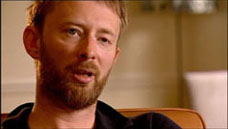
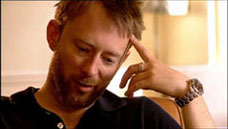
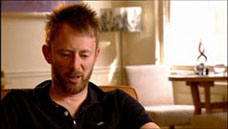
Announcer: "Next tonight we have an interview with someone who would certainly qualify as an icon in many peoples' books. He's best known as the front man of Radiohead, one of the most successful and influential bands of all time. But he's about to release his latest solo single. Madeline Holt met Thom Yorke."
Madeline Holt (narration): "How to make a mint out of melancholy: write songs like Radiohead. Their first album, Pablo Honey, 13 years ago, was a must for every student. The Bends, two years later, captured a sense of anxious alienation. Then came their landmark album, OK Computer. Its dark lyrics, set to a symphonic guitar sound, won them superstardom around the world. They went on to make three more experimental albums. Their last release was in 2003, but they're now back in the studio, working on new material. And their usually reticent lead singer, Thom Yorke, wants to talk."
Madeline: "I asked loads of my friends 'if you had to ask one question of Thom Yorke, what would it be...'"
Thom: (cuts her off) "Why are you such a miserable bastard?"
Madeline: (laughs)
Thom: "I think, actually, to be honest... I think, umm, half the problem is that, erm, I have a certain sort of voice that can make things sound worse than they are. (laughs)"
[Part of 'Street Spirit' plays]
Madeline: "It wasn't about you being miserable, they wanted to ask you if you thought the best thing you ever did was..."
Thom: "...was OK Computer. That's funny, 'cause people used to say The Bends."
Madeline: "Well, what do you think about that?"
Thom: "Well, give them another five years and maybe they'll say Kid A. Maybe not."
[Part of 'Karma Police' plays]
Madeline (narration): "After their last album, Hail to the Thief, the band seemed to lose their way and took a break. Yorke came back this summer with his first solo album, The Eraser, which won him a Mercury Prize nomination."
[Part of the Mercury Prize performance of 'Analyse' plays]
Madeline: "What made you feel you wanted to do something on your own?"
Thom: "Ummm... Mostly it was do with the fact that, erm, there was this sort of growing pile of things that I wanted to finish that, umm, would have been extremely dull if it had been a band thing 'cause they were done on computers, you know, it was all programming and, and it wouldn't have really made sense to sit around with all five of us gazing at a screen."
[Part of the Mercury Prize performance of 'Analyse' plays]
Madeline: "The lyrics on The Eraser... they're very provocative, some of them, aren't they?"
Thom: "Are they?"
Madeline: "Well, I found them so, and..."
Thom: "Oh, okay. Good. I think..."
[Part of 'Harrowdown Hill' plays]
Madeline: "There's the song about David Kelly. What made you want to write a song about that?"
Thom: "The whole Hutton whitewash and uh... the mewing and crying of Alistair Campbell, and then all the lies about going to war in the first place, and la la la... and going to... you know, going to these protests with people and lining the streets, even school kids, and all this sort of madness going on, umm, and then in the middle of it this one poor guy, who just seemed to be... end up being like the focus of a certain terrible energy."
[Part of 'Harrowdown Hill' plays]
Madeline: "Do you hope, or deliberately set out to try and provoke people to think about some of these things through your lyrics?"
Thom: "I don't have a problem with, with writing about things that may be seen as political. Uhhh... but I don't really think it's... it's not political music, its just part of what's in front of me."
[Part of the Henry Rollins Show live version of 'The Clock' plays]
Madeline: "Do you write all this as a sort of, kind of catharsis?"
Thom: "[I'm] Desperately trying to write songs that are fantastic and make life affirming in the sort of all the right ways, but I personally think that that's what the music's supposed to do... and umm, if you write the words correctly, you can be absorbing all this stuff. But really, the whole point is the music flows over you. Music, basically, is like mathematics, you know, and you're trying to form patterns, patterns that make you understand what is around you, and patterns that, umm, help you get through the next day. Like, when I listen to the radio and stuff, and I hear a new piece of music that I, you know, I've just got to get a hold of it, because it's, it's, I know it's going to help me through a particular thing, until the next one... or its, its life affirming, the whole point of music is it's life affirming."
[Part of 'Street Spirit' plays]
Madeline (narration): "A persistent dilemma for Yorke has been how to square writing great songs with the celebrity that brings. He shuns starry parties, instead living quietly in his home town of Oxford with his partner and two small children."
Thom: "The sickness of it, for me, the bit I couldn't deal with, was that somehow this is a reason to exist. Erm, that somehow you get to a certain level and, or whatever, of exposure or fame or whatever, and then suddenly you can communicate with other famous people on a higher level. And like, waft around going, (puts on cocktail-party accent) "hi." And that was a bit... I just kind of thought that was a bit peculiar."
Madeline: "Do you think there is a sort of upside to being, you know, well know, in that you can have huge influence."
Thom: "I don't think you do. I think all you do you is turn on the media that week for twenty seconds to something, and then they turn on to the next thing. I don't think you have influence as such. Ummm... all, all you do is that, and then that might get someone to sort of vaguely re-think about one little thing, but there's, you know... I don't... I think people are perfectly capable of making their own decisions, and God help them if they listen to me."
Madeline: "If you could pick one song that you'd like to be remembered by..."
Thom: "'How to Disappear', off Kid A."
Madeline: "Why?"
Thom: "Because it's the most beautiful thing we ever did, I think."
[Part of 'How to Disappear Completely' plays]
Announcer: "Thom Yorke's new single Analyse will be released a week on Monday."