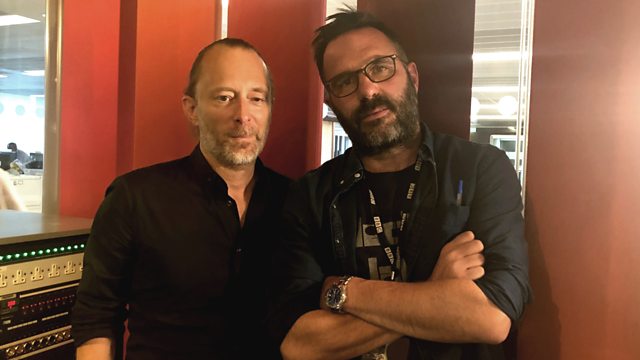
Shaun Keaveny: Hello.
Thom Yorke: Hello.
Shaun Keaveny: Before we really get into this, right... When you get interviewed—and you don't do loads—is part of the reason because people perhaps go in a bit too hard? A bit too cerebral? A bit too... you know, sort of studious about things? They take things extremely seriously. Does that happen a lot in interviews?
Thom Yorke: Yes. Yeah. And also, I think the habit of talking about yourself and your work is a little bit like... you know, you're expected to explain and justify what you do. But if it becomes a thing in itself, it just gets boring.
It's like looking at yourself in the mirror. Some people probably enjoy that. I'm not particularly fond of it myself. So you do it for a bit, and then you have to walk away, because otherwise you get into this sort of mental feedback loop.
Years and years ago, when I did have to do a lot of interviews in order to get people listening, you got into this thing where that sort of analysis about what you're doing feeds into what you're doing. So you find yourself explaining what you're doing while you're doing it, which is not healthy. It's not good for you.
There's a limit to how many times you should explain things, I think.
Shaun Keaveny: I've done it, though! Look at these pages. I mean, look at all this.
Thom Yorke: Well, that's right. At least your analysis is all there.
Shaun Keaveny: To be fair, it's about eight sides. I feel like I've done a thesis on Thom.
Well, what about this then, just to get warmed up. You're in a gun-to-your-head scenario. You have to do either Strictly Come Dancing or I'm a Celebrity... Get Me Out of Here!. Which one would you choose?
Thom Yorke: Strictly, I think.
Shaun Keaveny: Really?
Thom Yorke: They asked me once. It was around the early days of the programme. I was like... "Are you...?" It was just the most peculiar thing. I'm pretty sure I got the call from the office one day.
Shaun Keaveny: Well, that's good to know. So it would be Strictly. Maybe 2020.
Thom Yorke: You never know.
Shaun Keaveny: Maybe we could both do it.
Thom Yorke: (laughs)
Shaun Keaveny: But there's lots to talk about. Among them, Anima and ANIMA, the 15-minute film directed by Paul Thomas Anderson and available on Netflix. It's a thing of great beauty. I would say that because you're in the room—but it really is brilliant.
For people who haven't seen it, tell us a little bit about what's going on. There's a beautiful sense of choreography throughout it. Who first had the germ of the idea for the visuals?
Thom Yorke: When I did the live show, we started collaborating with Tarik Barri, who creates these incredible live computer-rendered visuals. It's not like most visuals where someone just presses "play" and lets them run. Tarik is actually performing them. He's like another musician on stage, so the three of us are collaborating in real time.
Initially, we were just trying to find a way of bringing that approach into a video. Then I had this idea of working with Damien Jalet, who was the choreographer on Suspiria. If anyone's seen that film, they'll know it's pretty extraordinary.
I'd really enjoyed working with Damien and wanted to collaborate with him again. So Paul and I went down to France with Nigel Godrich, and we started talking through ideas. On the train back we were all saying, "Well, of course we can't afford this, so never mind..."
Then Paul made a phone call. He came back and said, "Netflix are going to pay for it."
So suddenly we were actually making it.
Then it became a really bizarre process. We decided to film a lot of it on the Underground, and for weeks we were just bouncing ideas back and forth.
I'd never really collaborated like that before. I'd worked with Paul on Daydreaming, but this was on another level. It became a proper production with a proper crew.
My partner, Dajana, was involved as well, and we were all working together on the choreography. We had five days of rehearsals. It was incredibly involved.
It was difficult, but it was also enormous fun.
Shaun Keaveny: That's relatively new territory for you, though, isn't it? Choreography.
There's that beautiful sequence on the train where people are nodding off, waking up, rubbing their faces—and somehow it all becomes a dance.
Thom Yorke: We had to get it absolutely right. Dajana and I had about three days to learn it before we went out there.
Then the professional dancers arrived.
Watching them walk into a rehearsal, be shown these movements once, and simply absorb everything... I'd never seen anything like it.
Some of them had literally flown in from elsewhere in Europe that same day. Within an hour they were performing the choreography perfectly.
It reminded me of musicians reading music.
Shaun Keaveny: Like an orchestra?
Thom Yorke: Exactly. That's how they work.
Meanwhile I'm standing there in front of Paul saying, "Was that all right? Was it all right?"
He was amazing because he somehow made the whole thing feel completely normal... when it really, really wasn't.
Shaun Keaveny: There's another lovely aspect to the film. You almost become a Buster Keaton character. There's a wonderfully deadpan, slightly hapless quality to it.
Has it made you think about acting? A sitcom, perhaps?
Thom Yorke: (laughs) No.
The problem is that, as soon as I open my mouth...
If I'm silent, I can probably get away with it.
That whole Buster Keaton thing was really Paul's idea. He genuinely believed I could do it.
The humour actually grew out of the choreography. He kept saying he wanted it to be funny.
It was very strange for me because I'm on one side of the camera doing all this stuff, thinking, "I'm not funny."
Then I'd watch it back afterwards and think, "That's actually really funny..."
...but that's me.
It didn't make any sense.
It felt like I was watching somebody else.
Shaun Keaveny: If you haven't seen it yet, do check it out—it's brilliant.
I suppose this is the thing: people seem to connect with the most vulnerable part of you as an artist. If they want invincibility, they might go to Queen or Kiss. They come to your music for something completely different. There's a vulnerability there.
Do you ever wish you were Gene Simmons instead of Thom Yorke?
Thom Yorke: (laughs) Jesus...
No. That wouldn't be my first choice.
Shaun Keaveny: You know what I mean, though. There's a different sort of weight that comes with being someone people expect to express anxiety or introspection, as opposed to just being the fun-time rock star.
Thom Yorke: I don't really feel like I carry that weight.
I think some of what we do is really funny. Some of it's gnarly. Some of it's really angry.
The only time I genuinely feel vulnerable is when I'm writing music.
If you're not willing to make yourself vulnerable while you're writing, you just end up turning yourself into a caricature. You're only copying something that already exists.
Doing the ANIMA film was another kind of vulnerability altogether. Suddenly I was trying to do something I basically didn't know how to do.
I had no idea whether it was going to work.
But that's the whole point.
That's the job.
You have to leave your comfort zone.
Shaun Keaveny: Which brings us neatly back to the music.
You made that your thing years ago. You had those first three extraordinary records that are now part of the classic guitar-rock canon, and then you deliberately stepped away from that.
You decided to leave your comfort zone.
Anima feels like another example of that.
Tell us a little about the album itself. It's a beautiful record. There are Jungian ideas running through it—dreams, the subconscious...
Thom Yorke: I didn't really realise that until the very end.
That only started coming into focus while Stanley Donwood and I were finishing the artwork, around the time the record was being mixed.
We kept talking about dreams... or rather, about the subconscious.
The first time I sat down with Paul Thomas Anderson, he asked me for the Hollywood version—the one-line pitch.
I remember saying something like:
"Anima, to me, is about your subconscious self pulling one way while your conscious mind is trying to pull another."
Your body is telling you one thing, while your rational mind insists on something else.
It's a bit like millions of people going to work every day.
They keep doing it because that's what they do.
But perhaps their bodies are saying, "We don't want to do this anymore. We can't keep doing this."
That conflict happens on a subconscious level.
It comes out in dreams.
If you're dreaming every night that you're somebody else, eventually those dreams begin to seep into your waking life.
That's really where the record came from.
I don't know exactly why.
It just gradually became the central idea.
Shaun Keaveny: So it emerged from the subconscious itself?
Thom Yorke: I think so.
I also think it's a reflection of where we all are at the moment.
We're all going through the motions of everyday life, while at the same time we're watching things around us—Brexit and everything else—apparently coming apart.
Somehow we have to reconcile those two realities.
Sometimes I think our bodies are probably just saying, "Run."
But we can't.
Shaun Keaveny: I was reading something you said a few days ago about anxiety. It's always seemed to be an undercurrent in your work, certainly from OK Computer onwards.
Back then it was often about technology and the sense that the things we depend on aren't necessarily our friends.
But twenty-odd years later, everything has changed in such a colossal way.
Twenty or thirty years ago we still felt we had institutions we could rely on. We trusted governments. We trusted scientists. We expected jobs for life.
Is that part of what you're trying to communicate now—that kind of underlying anxiety?
Thom Yorke: Yes... but not consciously.
I think that's simply where the songs end up.
If I'm really honest, a lot of these songs were born out of performing them live.
I'd be lying if I said I consciously decided, "Right, I'm going to write about this."
It was only afterwards, when I looked back at everything, that I realised these themes kept appearing.
Yes, anxiety is part of it.
But it's more like the feeling you get in a city—London especially—where everyone is living these very isolated lives, even though we're constantly thrown together.
There's this sense that something is happening underneath the surface.
Shaun Keaveny: Almost like we're all living in little cages.
Thom Yorke: Maybe.
More like... none of us really has the time to stop and ask, "Hang on a minute..."
Shaun Keaveny: Do you ever have that dream where you're driving a car—but somehow you're operating the car in front of the one you're actually sitting in?
Thom Yorke: (laughs) No.
I'm always in the back seat.
No one else seems to be driving it.
Shaun Keaveny: Right. So we basically have the same anxiety dream.
We're completely out of control.
Jung would probably have something to say about that.
What's your recurring dream?
Thom Yorke: Mine is waking up inside somebody else's house.
I know I'm not supposed to be there.
It's always dark.
I can't quite see where I am, but I know somebody else is in the house.
I know I have to get out.
But I can't.
Then I wake up.
Shaun Keaveny: That's imposter syndrome.
Thom Yorke: Oh yes.
I've always had that.
Shaun Keaveny: Really? Even now?
Thom Yorke: Not so much anymore.
I think I've finally accepted that this is what I do for a living.
Shaun Keaveny: Well, that's good. We worked through that one!
We're going to play Traffic, the single from Anima.
Before we do, though, there seem to be lyrical references to privilege—mentions of Kensington and Chelsea, foie gras...
Can you tell us a little about that?
Thom Yorke: I honestly wish I could.
That was one of those songs where I was simply improvising words on stage because they sounded right.
Then afterwards I went back and wrote them down.
So I take absolutely no responsibility for them.
Shaun Keaveny: (laughs) I love that.
Thom Yorke: It wasn't me.
Blame my subconscious.
Shaun Keaveny: Let's have a listen.
This is Traffic.
Afterwards, we'll have part two of our conversation with Thom Yorke.
Shaun Keaveny: Welcome back.
We've had a tremendous response to our conversation with Thom Yorke already.
One listener says, "I can hear the reverence in your voice, Shaun. It's great to hear such a thoughtful and creative person on your programme."
Thanks... I think.
We're also hearing from people with their own Thom Yorke stories.
Douglas writes:
"Back in the 1990s I did business with Thom's father. We were meeting at a hotel in West Oxfordshire and he said, 'My son will be dropping by.' Sure enough, this young lad with untidy hair and a guitar on his back turned up, said hello, his dad gave him twenty pounds, and he disappeared again. It was around the time of Pablo Honey, before the royalty cheques started arriving. I had no idea it was Thom Yorke until years later, when I heard him mention that his father worked selling scientific instruments."
Now, let's talk about Dawn Chorus.
It's one of the emotional centres of Anima, but it's also a song that's been around for quite a long time, hasn't it?
Thom Yorke: Yes.
It's had a very long gestation.
It never really made sense until now.
Shaun Keaveny: That's interesting, because as soon as the album came out everyone immediately started trying to explain it.
I came across one interpretation online that said the opening line, "Back at the cul-de-sac", represents a dead end in life, and that the song is about regret, denial, and wishing you could live your life differently.
Thom Yorke: (laughs)
That's an interesting exercise...
Just don't listen to Genius.
They don't really know.
It's psychology by guesswork.
Hackery of the worst order.
Shaun Keaveny: So what do you look for when you're listening to music?
Your own music is often described as serious, thoughtful and challenging, but it's also incredibly rhythmic. There's soul in it. You can dance to it.
When you listen to other people's records, are you always looking to be challenged?
Or do you sometimes just want to put on something uncomplicated?
Thom Yorke: (laughs)
That wouldn't necessarily be my first choice...
Shaun Keaveny: Kiss?
Thom Yorke: That's a difficult question.
I listen to plenty of stupid music.
Shaun Keaveny: Thank you!
Thom Yorke: But I don't always want to be challenged.
I think you wear two different hats.
One part of you listens analytically.
You hear something and think, "How did they do that?" or "How did they arrive there?"
That's important because it's your job, and it's inspiring.
But then there are records that simply give you joy.
I never get tired of hearing Pressure Drop by Toots and the Maytals.
It's simple.
But the spirit behind it is extraordinary.
It's just a thing of deep, deep joy.
Sometimes that's exactly what you want.
Three chords all the way through?
That's absolutely fine with me.
It's music that gets into your body instead of your brain.
Shaun Keaveny: Exactly.
There's always that balance, isn't there?
The yin and the yang.
Shaun Keaveny: You mentioned Billie Eilish a while ago. I think you and your daughter went to see her live?
Thom Yorke: My kids are both big fans.
Shaun Keaveny: Mine too.
I know a comment of yours got picked up recently where people reported that you called Billie Eilish "one of the only interesting new artists around."
Thom Yorke: That was a misquote.
What I actually meant was that I was really pleased Billie and Finneas were being given the freedom to do what they wanted.
No one seemed to be trying to force them into becoming something they weren't.
They're genuinely making music on their own terms.
Because she's being herself, people respond to it.
That's the important thing.
Shaun Keaveny: Without sounding like Statler and Waldorf—two old blokes shouting from the balcony—is there something about technology now, social media, Instagram and the constant pressure to perform that worries you?
Do we all, young and old alike, need to stop for a moment and say, "Enough"? Algorithms, artificial intelligence... it can all feel like it's getting out of hand.
Thom Yorke: There's nothing wrong with an algorithm when it's being used properly.
A good old-fashioned algorithm isn't the problem.
(laughs)
It's like vegetables.
I like vegetables that still look like vegetables.
I don't want every carrot beside the next carrot to look exactly the same.
That would worry me.
Once you've seen five identical carrots, you start thinking something's gone wrong.
Shaun Keaveny: Even my youngest son—who's become a complete dad-rock fanatic and plays guitar—has worked it out.
He'll put on some modern pop records that are heavily processed and say, "They're not really singing, are they?"
Thom Yorke: I'm not anti-Auto-Tune.
I'm only using it as a metaphor.
All I really care about is that artists still have the freedom to go wherever they want creatively.
That they're not being pushed around.
That they're not making decisions because they're worrying about algorithms.
Shaun Keaveny: You're about to head back out on tour.
You're going to America again.
Do audiences there react differently?
Thom Yorke: Not really.
What was lovely about the last American tour was that we were playing reasonably small theatres.
After the shows we'd often come out and spend ages talking to people.
It wasn't chaotic.
It was really enjoyable.
I realised I'd been living inside my own little bubble.
You forget that the music still has such an effect on people.
One of the reasons for touring is simply to look people in the face.
To make that connection.
Shaun Keaveny: Do you ever look back at the early Radiohead records with affection?
Or do you mainly hear the imperfections?
Has your relationship with those albums changed over time?
Thom Yorke: I don't spend much time looking backwards.
Recently I've been doing it a little because of the Kid A anniversary.
Nigel and I have been going through some of the old tapes.
That's been pretty extraordinary.
Mostly because I find myself wondering, "How on earth did we get there?"
I was listening to Like Spinning Plates and thinking exactly that.
Then I started remembering.
I remembered recording something into a little sequencer.
Nigel played it backwards on the tape.
Then we turned the tape over again.
Colin added that strange Rhodes part.
Then I recorded the vocal backwards.
We reversed the tape again, and I had to learn to sing it exactly the same way forwards.
Looking back now, I think, "How did we ever come up with that?"
It's almost like looking at the work of completely different people.
Shaun Keaveny: It's extraordinary, though. Looking back now, it's like watching a caterpillar become a butterfly.
How does that become this in such a short space of time?
That's really what every musician hopes for, isn't it?
You decide to devote your life to music because you're chasing moments like that.
Thom Yorke: Yes.
That's the feeling you're always looking for.
Shaun Keaveny: Well, there's certainly plenty for long-time Thom Yorke fans to enjoy.
If you haven't seen ANIMA, the film directed by Paul Thomas Anderson, it's available on Netflix.
The album Anima has been out since June and it's a beautiful record.
Good luck with the rest of the tour and everything that's coming up.
Hopefully we'll see Radiohead again somewhere down the line.
Thom Yorke: (laughs)
You know...
The juggernaut keeps rolling.
Shaun Keaveny: It certainly does.
Thom, thanks so much for coming in and talking to us today.
It's been a real privilege.
Thom Yorke: Thanks, man.
Thank you.