new musical directions
When classical and contemporary music combine, the outcome is both challenging and defining. Richard Wolfson looks at the exciting results forged by the Ether festival.
Over the last few years Ether has perhaps done more than any other festival to bridge the gap between the established cultural mores of a major arts centre, and the melee of dangerous genre-bending work, which hovers around the perimeter. Ether has particularly focused on the mercurial world of avant-garde rock and experimental electronic music, giving these exciting areas of cultural action a home in one of the nation’s premier venues. Past Ethers have presented the history of this movement, with appearances by electronic legends Kraftwerk, alternative rock pioneers The Residents, and improvisation sessions featuring the likes of Jim O’Rourke, Ikue Mori and Sonic Youth’s Kim Gordon.
Ether has not just been about music as sound, though. It has invested in artists for whom a startling visual presentation has been a major preoccupation. The extraordinary Japanese band Cornelius, whose interactions between video images and live musicians are a virtuoso display of live synchronisations, and live film and music events, such as the spectacular soundtrack to Metropolis by US electronica king Jeff Mills (both part of Ether back in 2002) have really opened up this visual dimension.
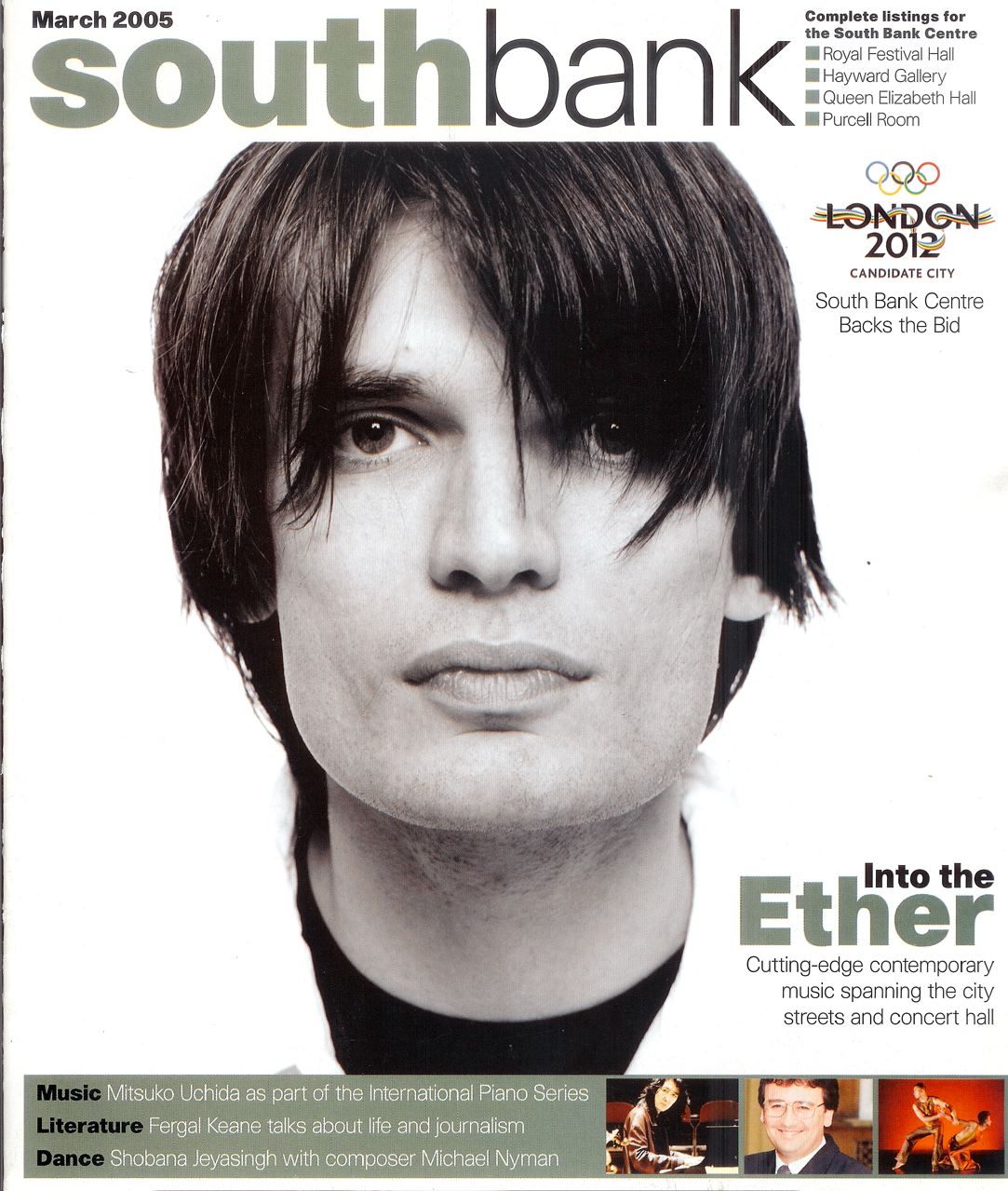
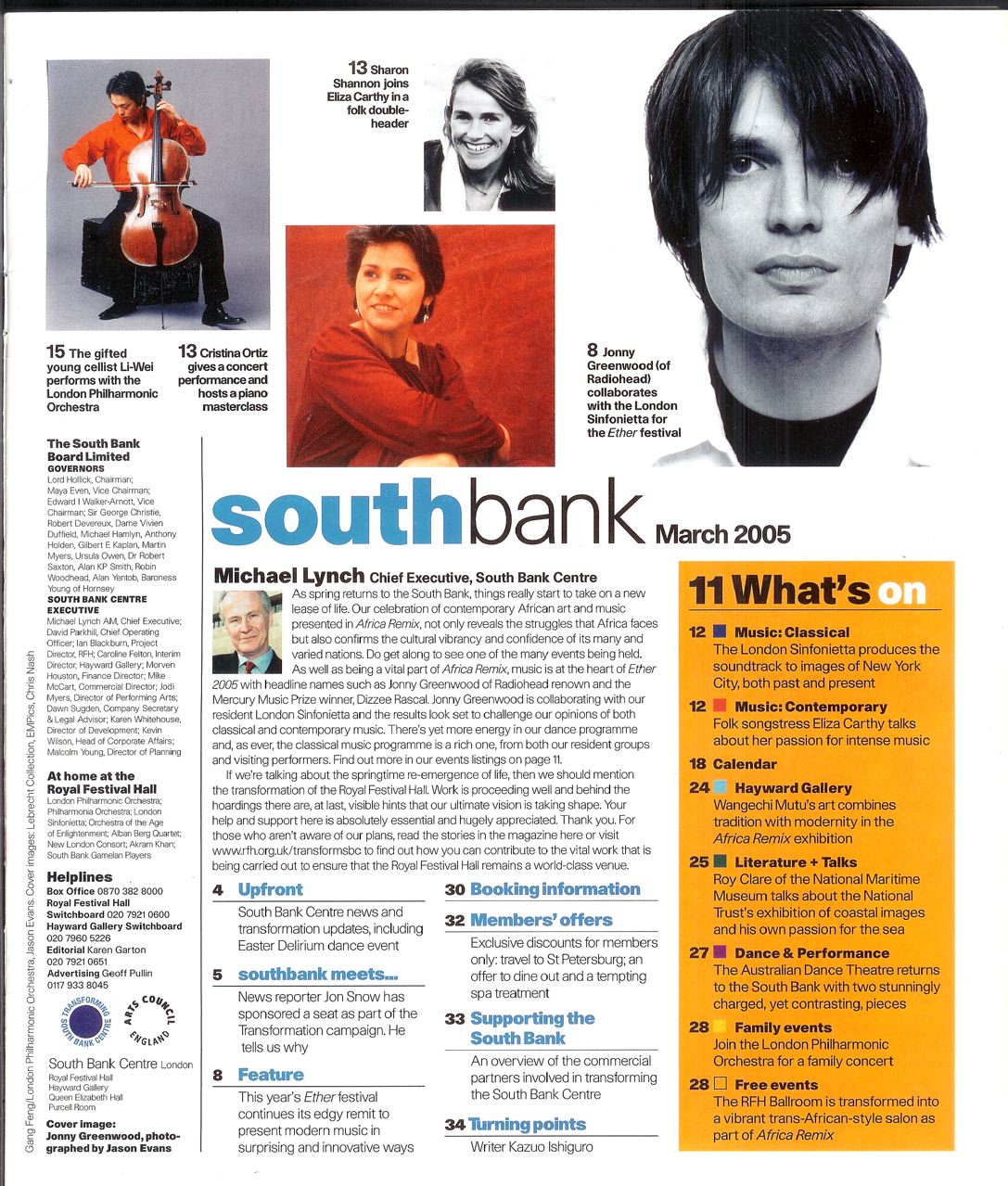
Right at the core of Ether are the collaborations between the London Sinfonietta, the UK’s prime contemporary chamber orchestra, and electronic musicians from the underbelly of pop. Past events have involved artists from the Warp label, including Aphex Twin, Squarepusher and Boards of Canada. This time Radiohead’s Jonny Greenwood is the main collaborator. Jonny has recently demonstrated his compositional chops by penning a soundtrack for the film Bodysong, which steers a path between romantic minimalism, free jazz and electronic soundscapes. Here he will present Smear, a piece originally composed for the Sinfonietta as part of last year’s Fuse festival in Leeds, along with new arrangements of Radiohead songs.
Middle Eastern music has had an enormous impact on Jonny, as is clear from the twisting harmonic structures of Radiohead; intriguingly he has also invited the Nazareth Orchestra, which is formed from Arab and Israeli musicians, to participate in this event. They will perform compositions associated with the singer Oum Kolthoum, who was known as the almost mythical voice of the Arab world of the 1930s and ‘40s.
A key idea behind these collaborations with the Sinfonietta is the insertion into the programme of relevant classics from the 20th century classical repertoire. Past events have included works by Cage, Nancarrow, Stockhausen, Antheil and Ligeti, and the juxtaposition of genres has worked brilliantly, forging new alliances and drawing out the connections between the two worlds. The audience response to these innovations has been ecstatic, and this year’s collaboration has had to anticipate demand by occupying two nights. It will feature works by Messiaen, Ligeti and Penderecki, extending a line of thought right back into the heart of the last century. The Messiaen work will be a performance of a movement from his Quartet for the End Of Time, in an arrangement for six ondes martenots (early electronic keyboard).
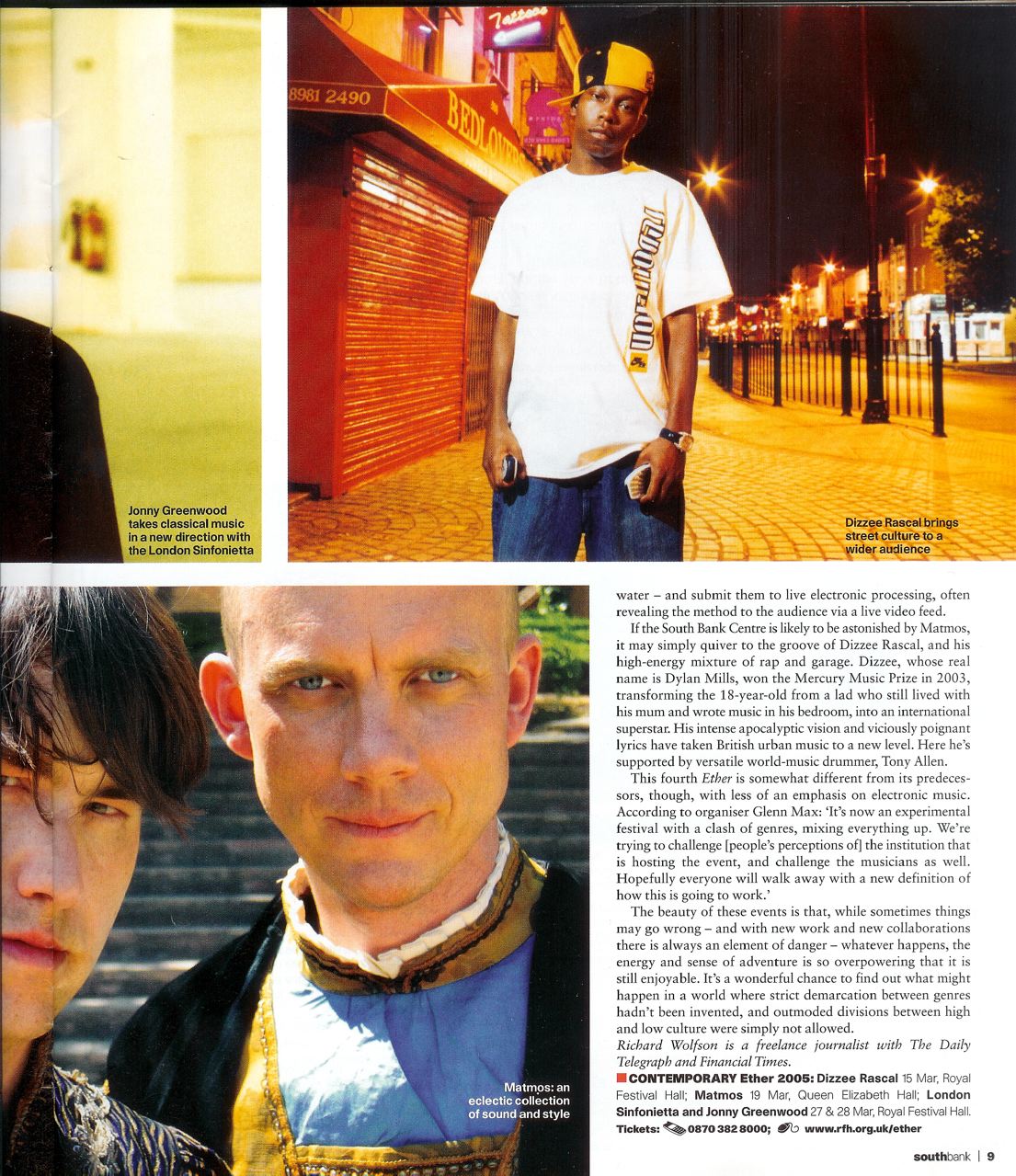
Amongst the other artists appearing at this year’s Ether are Matmos, the San Francisco-based duo of Martin Schmidt and Drew Daniel, who are perhaps most famous for their activities as Björk’s backing band. A recent Matmos album found them sampling the amplified sounds of plastic surgery, and processing the results into sprightly, if rather ghoulish, electronica. They explore less unsightly material with their most recent offering, The Civil War, where they pillage all manner of musics from military chic to medieval crumhorns. Live they like to bring numerous gadgets and weird instruments onto the stage – hurdy-gurdies, buckets of water – and submit them to live electronic processing, often revealing the method to the audience via a live video feed.
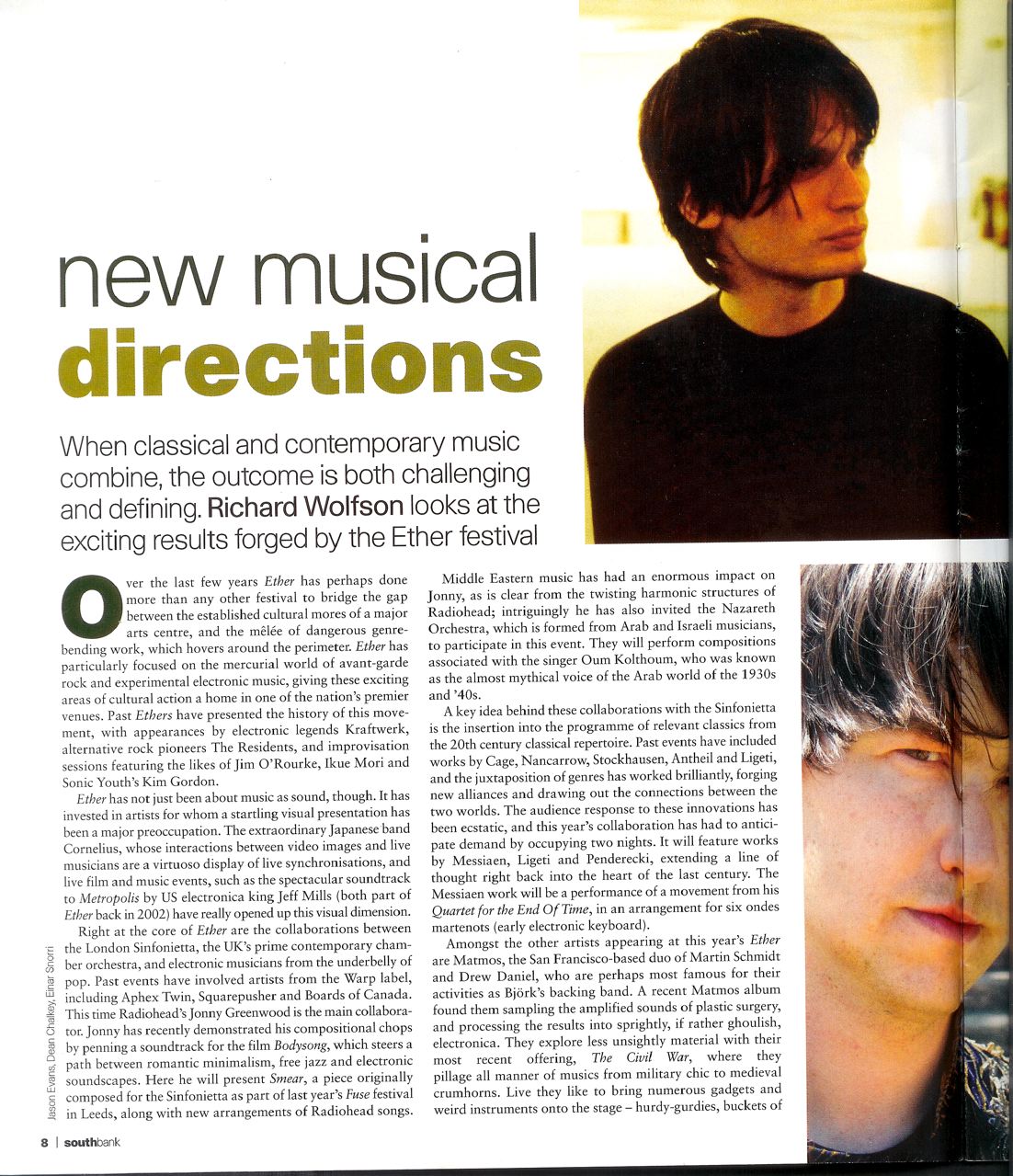
If the South Bank Centre is likely to be astonished by Matmos, it may simply quiver to the groove of Dizzee Rascal, and his high-energy mixture of rap and garage. Dizzee, whose real name is Dylan Mills, won the Mercury Music Prize in 2003, transforming the 15-year-old from a lad who still lived with his mum and wrote music in his bedroom, into an international superstar. His intense apocalyptic vision and viciously poignant lyrics have taken British urban music to a new level. Here he’s supported by versatile world-music drummer, Tony Alien.
This fourth Ether is somewhat different from its predecessors, though, with less of an emphasis on electronic music. According to organiser Glenn Max: ‘It’s now an experimental festival with a clash of genres, mixing everything up. We’re trying to challenge [people’s perceptions of] the institution that is hosting the event, and challenge the musicians as well. Hopefully everyone will walk away with a new definition of how this is going to work.’
The beauty of these events is that, while sometimes things may go wrong – and with new work and new collaborations there is always an element of danger – whatever happens, the energy and sense of adventure is so overpowering that it is still enjoyable. It’s a wonderful chance to find out what might happen in a world where strict demarcation between genres hadn’t been invented, and outmoded divisions between high and low culture were simply not allowed.
Richard Wolfson is a freelance journalist with The Daily Telegraph and Financial Times.