WHAT follows is not an extract, but an out-take. In the context of this site, this feels like an appropriately rock & roll notion. When I started writing I Wouldn't Start From Here, my personal memoir of the 21st century to date, I'd intended to leaven the primary content of the book (ie reportage about angry people in screwed-up places fighting about stuff), with some input from the musical artists I met along the way who were drawing inspiration from such things. The idea was to seamlessly overlap my two primary preoccupations of conflict and music, and perhaps reflect, in passing, upon what effect each was having on the other. I was dissuaded not even slightly by the fact that a previous and not wholly dissimilar effort, 1999's unpopular Rock & Hard Places, had sunk more or less entirely without trace, beyond the baffling (but not ungratifying) minor cult following it enjoys in Eastern Europe. This was possibly as the result of a Whiskey Galore scenario, in which the entire print run was mistakenly loaded aboard a Belgrade-bound barge, which subsequently ran ashore somewhere on the Danube.
In the event, the decision to shift the focus of I Wouldn't Start From Here more towards the swaggering young men with rifles than the swaggering young men with guitars was made for me: I ran out of room. When my infinitely patient publishers finally emerged from the first draft, wearing the haunted expressions of those who've seen too much, fretting about the porters who'd panicked and run away with the luggage somewhere around page 700, they explained that something would have to go, if the final volume was to be readily portable, and so most of the strictly music-and-arts-related content was reluctantly binned.
Out went the account of arguing politics and Arsenal FC with Steve Earle in an Islington hotel, out went the journey to San Francisco to discern how serious Neil Young was about all that 'Let's Impeach The President' rhetoric, out went the discussion with Omar Sharif about whether Lawrence Of Arabia had fatally misinformed western opinion of the Middle East, or whether we'd all just been too thick to pick up the lessons, and out went the following: a trip to Paris on Radiohead's tour bus, around the release of 2003's Hail To The Thief.
Of all the stuff that eventually got chopped, this was the piece over which the axe hovered longest, and least enthusiastically. Mostly because I thought that it did bring something to the book's semi-coherent over-arching narrative, and all that, but partly because it chronicles the beginning of a weekend which reminded me of why I'd wanted to be a rock journalist in the first place. By 2003, I'd pretty much given up spending protracted amounts of time with rock bands, having learnt the hard way that an ability to conjure the odd decent tune is not necessarily accompanied by an agile mind, reflective insight, rudimentary conversational skills, sense of humour, human modesty, common courtesy or interest in reading unillustrated books.
Sometimes, though, you get all that, plus music which reminds you why you choose to spend so much of your time writing about the stuff. But, as a more astute chronicler of the touring life once said: Hey! Enough of my yakking. . .
The road to Paris, France, July 2003
Most of the music I listened to while travelling in the early 21st century was nothing to do with the early 21st century. Most of it wasn’t even recorded in the early 21st century. Like most people – and even, if they’re honest, most rock critics – I arrived in my thirties aware of, and not much bothered about, the truth that my musical tastes were unlikely to expand much further, if at all. I knew what I liked – and, by and large, liked what I knew. It remains, I suppose, theoretically possible that some or other brainstorm will bestir a hitherto utterly dormant affection for techno or reggae, but it also remains theoretically possible, and about as likely, that a long and complex sequence of early deaths and tenuous genealogical links will lead to me being crowned King of Tonga. And if that happens, I hereby promise that my first decree will order the adoption, as the national anthem, of a Derrick May remix of Bob Marley’s 'Jammin’'.
The longer the 21st century went on, the more likely my reply to the question of what kind of music I liked was to be “Both kinds: country and western.” The longer the road rolled in front of me, the more my ears hungered for tears-in-the-beer vocals, crying violins, twanging guitars, lonesome lap steels, duelling banjos and the sort of piano you could imagine being played by some gold-hearted hussy in crinolines and fishnets while Gary Cooper and John Wayne hurled barstools at each other.
But I kept listening to Radiohead, arguably the least country and western white band in the world. The Bends had been one of my favourite albums of the late 20th century, and they seemed one of few bands left who were interested in trying to attempt something as ambitious as a soundtrack for the times – and one of very, very few bands left capable of creating such a thing. Their 2003 album Hail To The Thief was a masterpiece, a superb articulation of the angst felt not just by Radiohead, but by the people rather like Radiohead who constituted much of Radiohead’s audience: that vast global constituency of youngish, fundamentally decent, middle-class liberals born into a fortunate life which held no impediment to their happiness bar the nagging suspicion that their comfort was related to the fact that someone else, somewhere else, was being paid ten cents a week to sew stripes onto their training shoes.
For such a crowd, Radiohead’s singer and principal songwriter, Thom Yorke was the ideal everyman: an aggrieved, affronted figure whose rage was borne of impotence, who was more than willing to rebel against whatever you’d got, but didn’t quite know where to start.
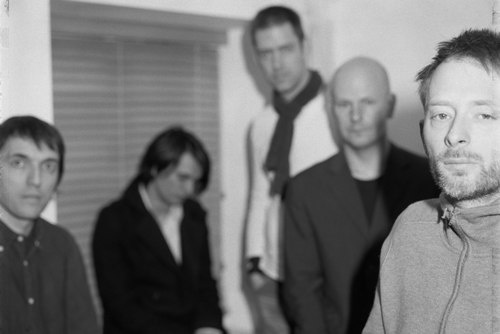
“Welcome aboard,” said Thom Yorke. “Coffee? Instant okay? I think there’s a cafetierre here somewhere, but I’m not sure where. . .” Thom rummaged noisily in a drawer in the kitchen at the back of the bus. Radiohead had just taken delivery of this imposing, midnight-black vehicle, which would be their home for a couple of weeks of European festivals. Today, we were doing London to Paris with a complement of Thom, Radiohead guitarist Ed O’Brien, Radiohead producer Nigel Godrich, Radiohead tour manager Hilda, a crew member whose name I never caught, and myself (I assume there was a driver, as well). We were due to meet the rest of the band in Paris, at the howlingly fashionable Costes Hotel.
“Have you stayed there before?” asked Thom, as he continued his search. I hadn’t, I said. What’s it like? “Unbelievably expensive, full of the most awful wankers, and decorated like a brothel.” He’d stayed there before, then. “We always stay there,” he said. “It’s brilliant.” The downstairs area of the bus contained the kitchen, the toilet, four blue and gold leather seats around a table, a sofa-cum-bed, a vast television hooked up to a PlayStation and DVD player, and a stereo. Upstairs, there was a lounge area, eight bunks, two more vast televisions, at least one more stereo, and, up the back, a separate room with a double bed and a mirrored wall. “Maybe I should take that,” said Ed. “I have trouble fitting into bunks.”
This seemed fair enough. Ed is six and a half feet tall, and tour bus bunks are, generally, less roomy than jockeys’ coffins. “Exactly,” he nodded. “Made for shortarses.” “Hmmm?” said Thom. Thom, even when he stands up after his efforts to locate the cafetierre is, it might charitably be said, bunk-sized. He regarded Ed quizzically, something like a jaguar deciding whether or not to pounce on a faintly annoying rodent.
“I mean,” giggled Ed, “for completely normally proportioned people much like you, Thom. As opposed to grotesque freaks like myself.” Good catch, Ed.
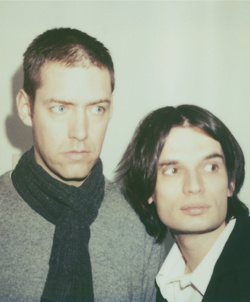
If Thom Yorke the human being was anything like the Thom Yorke of received wisdom, his reaction to Ed’s mild dig might have encompassed any or all of the following: i) Ed’s instant dismissal from Radiohead; ii) the total destruction of every inanimate object on both decks of the bus; iii) Thom’s relocation to a tin shack deep in the woods, there to perch atop a stack of tinned food and argue with the clamorous voices in his head. However, today as in several meetings going back over eight years, Thom Yorke the human being and the Thom Yorke of received wisdom seemed nothing more than a coincidence of names.
Thom was unstoppably talkative, laughed frequently, and was only reluctant to submit to a proper interview because he and Nigel Godrich and I got too absorbed too early in a discussion of the world at large. Thom was vexed about Iraq, especially his own early views on the conflict. “I bought it,” he admitted, glumly. “I thought, okay, if he has these weapons, they should be taken off him. You’d think I’d know better.” A perceptible gloom descended around him; by the time he’d got his head back out of his hands, I had my tape recorder running.
Radiohead’s current album, Hail To The Thief was essentially a distillation of the static that had been buzzing in Thom’s head around the end of 2001. The title was, obviously, a play on the American presidential anthem 'Hail To The Chief' – an old and unsubtle gag, often associated with Richard Nixon, which had been enjoying a resurgence in popularity since George W. Bush’s unorthodox entrance to the White House in 2000.
“It’s not an America-baiting thing,” said Thom, as we watched Kent go by. “That’s not the point at all. And the title keeps coming from different places, anyway. First, it’s about that coup there, but look, there’s another one here, and another one over there. And you could also think of it in terms of access and influence. It sets me off in different directions depending on what day of the week it is.”
Hail To The Thief had an alternative name, The Gloaming. This was more in keeping with the obtuse titles that had graced previous Radiohead albums: 1993’s Pablo Honey (a reference to a sketch by phone pranksters The Jerky Boys), 1995’s The Bends (what Radiohead felt about their sudden rise to prominence in the early 90s), 1997’s OK Computer (an approval of, or submission to, the technology that runs our lives), 2000’s Kid A (possibly borrowed from Carl Steadman’s novel Kid A In Alphabet Land), 2001’s Amnesiac (answers on a postcard).
“I was unhappy,” said Thom, “about the potential consequences of calling it Hail To The Thief. Personal attacks, threats. . . people can get quite upset. So I wasn’t wild about that. But it’s more jubilant, and deranged, and doublespeak, like ‘collateral damage’, or ‘regime change’. The Gloaming was much too. . . aaah AAAAHH ahh.” Thom delivered these last three syllables in a passable impression of a church organ. “And that wasn’t the point either,” he continued. “The record definitely enters a dark place in the middle, but it isn’t the whole thing. When we were doing Kid A and Amnesiac, I had this thing that we were entering a very dark phase. I mean, you know me, I’ve made a career out of saying things like that. But it did strike me that things were going to kick off one way or another, and at the same time there was a rise, politically anyway, in ignorance and stupidity, and all that lovely euphoria after the Berlin Wall came down had disintegrated into this global political and economic anarchy.”
I’d wondered about the alternative titles also given to the songs on Hail To The Thief. They suggested a much gloomier record – the tracks 'Backdrifts', 'Go To Sleep', 'Where I End And You Begin', 'We Suck Young Blood', 'Scatterbrain' and 'A Punchup At A Wedding' had become, respectively, 'Honeymoon Is Over', 'Little Man Being Erased', 'The Sky Is Falling In', 'Your Time Is Up', 'As Dead As Leaves' and 'No No No No No No No'.
“I like that one,” smiled Thom. “That would have been a good name for the record. Here it is, the new album by – guess who – Radiohead, and it’s called No No No No No No No.” Little Man Being Erased would have been a very Radiohead title, as well. “That,” beamed Thom, “is my absolute favourite.”
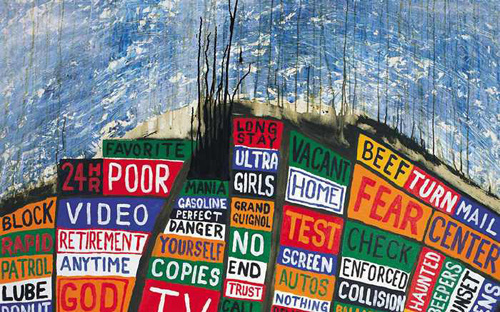
The sleeve artwork of Hail To The Thief, created by Stanley Donwood, was a series of maps of major cities in which the streets have been replaced by coloured blocks, emblazoned with malevolent phrases. London, for example, had districts renamed with the likes of 'Spiked', 'Take You Down', 'Quango', 'Skinned Alive' and 'Shareholders'. It could have been an aerial view of the London of George Orwell’s 1984: the dystopian capital of Airstrip One, with Thom Yorke, his voice a lonely cry of aggrieved, affronted humanity, in the role of Winston Smith. '2+2=5', the title of the opening track on Hail To The Thief, was the formula with which Orwell’s party invigilitator O’Brien demonstrated to Winston his utter powerlessness before the malign forces that ran his life.
I told Thom he could stop me any time he thought I was trying too hard, but. . . “I did re-read 1984 a while before we did this record,” confirmed Thom, “but I’d forgotten where 2+2=5 came from. The other bit in the book I thought about a lot was the fake war – we’re at war with Eurasia, we’ve always been at war with Eurasia.”
I wondered if the utter, and brutally and perpetually reinforced, hopelessness of Winston’s position struck a chord. There was a line in 'Scatterbrain' – “A moving target on a firing range” – that seemed to sum up Thom’s view of most of humanity. “It goes back to the Jubilee 2000 thing for me,” said Thom.
He was, for a while, involved with Jubilee’s lobbying to get first world governments to write off the crippling, unrepayable debts owed them by third world governments. His optimism had evaporated some time before Bono’s. “I realised how out of control the disintegration was. When I started with Jubilee 2000, I thought it was the most exciting thing I’d ever got involved with. Potentially, we could show what’s been going on for what it is. But it never happened, because the G8 were very smart, and they and the IMF and the World Bank kept passing it to each other, and eventually I found myself thinking ‘Now I get it. It’s never going to happen’.”
I wondered if the experience had irrevocably persuaded him that – as the general tenor of Hail To The Thief appeared to argue – there was no point in trying to alter the system from without. “No,” he said. “I’d like to be involved, but it’s difficult to know where to go with it. There were so many disheartening things about it, the fact that so much lip service was given, and you still end up with the reality that the IMF and the World Bank are there to keep everyone under their thumb. They affect millions of people, yet they’re completely unaccountable. I’d like to get involved again, but I find it difficult not to say that we should disband the IMF and the World Bank, to put it politely. Because that’s what I believe. Some people say you have to work within the structures, which is fair enough, because they’re the ones with the money. But if you do that, they’re just going to spin you a line. You get some money, but it’s money to make you go away.”
An experience that was reflected in the songs on Hail To The Thief, presumably. “Oh, completely,” he said. “I guess the whole record was a response to those experiences. Becoming a dad amplified it as well, because you start thinking not only am I powerless, but there’s an extremely dangerous set of things being set up for my son’s future that I can’t sort out for him. That’s quite a simple thing that’s very, very difficult to deal with.” 'Sail To The Moon', a song on Hail To The Thief, contained the line “Maybe you’ll be president / But know right from wrong / Or in the flood you’ll build an ark / And sail us to the moon.” Thom, I knew, had named his son Noah. I’ve always resisted, as far as possible, pestering interview subjects overmuch about their private lives. But since he’d sung about it, and though he was free to tell me it was none of my damn business. . .
“It wasn’t intended,” Thom smiled, “but it ended up being a song for him, yeah.” While we’re up this way, then, I asked, why Noah? “That’s what he looked like,” said Thom. “That’s what you do. Bugger the consequences.” He’d get used to the ark jokes, I supposed. And the “It’s up to you, Noah Yorke” ones. Oh, yeah,” grinned his father, who had lived down worse taunts. “He’ll be fine.”
In Thom’s list of thank-yous on the sleeve of Hail To The Thief, after friends and family, there was a nod to Spike Milligan. Radiohead had dedicated The Bends to the late American comedian Bill Hicks, another funny, outraged iconoclast. Hicks and Radiohead seemed a congruent fit. Both were intelligent, informed, acutely sensitive to hypocrisy – “Bill Hicks,” said Thom, “was able to make things that were incredibly frightening funny, and by doing that make them seem okay.” Milligan, whose best-known work was hyperactively absurd, seemed a less obvious choice of Radiohead hero.
“He did a TV series called Q,” recalled Thom, “which someone bought for me at a car boot sale, and I watched that a few times. There’s this one about a dalek coming home for its tea. ..”
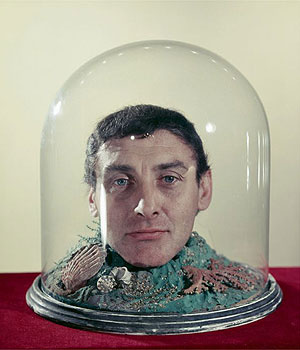
The Pakistani dalek. I remembered that. “Yeah,” said Thom. “The Pakistani dalek family. And every time I watched it, I thought, fucking hell, this is a person on the edge. There was another one where they wheeled in a staircase, and he just walked up and down it wearing costumes. He was so inconsistent, so incredibly spontaneous, and at the same time really fragile. There was also this book, Depression & How To Survive It, which he wrote with Anthony Clare. That had a really big effect on me.”
In what way? “There’s one amazing bit,” continued Thom, “where they’re talking to people about whether there’s a positive side to depression. These aren’t people who are chronic, where it’s really out of control, but a lot of them say yes, there are positive sides. You see things in a way that other people don’t, and you feel things a lot harder than other people, and that’s good, it’s almost okay. It was good to hear people say it like that.”
I wondered whether this had been a constant thing with Thom, or if there had been one particular period when it had been really bad. “On the OK Computer tour,” he said, “we were in a situation where people were trying to persuade us to carry on touring for another six months, we should have said no but we didn’t, and I went bonkers.” When he said bonkers. . . “Oh, bonkers. Not violent, but. . . enormously, uncontrollably depressed, delusional.” In what way? “All sorts. Seeing things.” That’s usually a sign that you should take some time off. . . “No, actually. It was quite interesting. Sort of everywhere. Corner of the eye stuff.” That sounded rather like the idea of the new album’s alternative title, The Gloaming: a twilight netherworld that you can’t quite see, but which you know is out there somewhere. I asked if anyone making the connection would be trying too hard. “No, I guess not,” said Thom. “You know that film Ghost? Terrible film, but there’s this bit where all these shadows come down and take that kid away who gets hit by a car. That’s what it was like. We lost contact with reality, and got to feel like everything that wasn’t related to what we were doing was annoying or irrelevant. We’ll never do that again.”
A couple of months previously, I’d been to see Radiohead play in Edinburgh. Backstage afterwards, I’d noticed a volume of Spike Milligan’s World War II memoirs lying among the effects of Radiohead guitarist Jonny Greenwood. Those books (Hitler: My Part In His Downfall, and several subsequent volumes) were, aside from being very funny, a tremendous expression of the bewilderment of someone being pushed and pulled by forces they cannot control – something they had in common with Hail To The Thief, and its obvious touchstone 1984. Thom, to my surprise, hadn’t read any of them. “I will borrow Jonny’s, though,” he said. “You know, I think the appeal of Milligan is that he didn’t suffer fools, at all. Some people really hated him for that. But why should anyone bother? Life is short, and people are stupid. That’s definitely a depressive thing. You see the holes in things very quickly. Too quickly.”
The Costes hotel in Paris was everything Thom promised. The price of a room would leave some change from the Earth, but not much. The food was great, and all the better for the perverse thrill of paying twenty quid for scrambled eggs. The waitressing staff had apparently been hired by the expedient of placing an advertisement reading “Preposterously beautiful women required to work in absurd restaurant, ability to remember orders or maintain the merest facade of interest in customers unnecessary.”
Those of us who’d arrived by bus parked ourselves in the bar with a bottle of champagne. A woman in a peculiar dress came over to tell Thom how much she liked the new album; Thom accepted the compliment graciously, and told her, correctly, that she looked like Alice in Wonderland, and this went over well. Neil Tennant dropped briefly by the table, and when Colin Greenwood showed up – the only member of Radiohead who dresses at all like a millionaire rock star, or indeed at all like anything other than a dishevelled student – he was disappointed to learn that he missed Yves St Laurent. The Costes was that kind of hotel.
Thom was one of the last to retire. He was an even better talker with a few glasses of fizz inside him, and he was funny, very funny, with his own failings the punchline to most of his anecdotes. Of Radiohead’s legendary appearance at Glastonbury in 1997, he remembered “That show was a disaster. Everything that could have gone wrong did. I thundered off stage, really ready to kill, and my girlfriend grabbed me, made me stop, and said, ‘Listen’. And the crowd were just going wild. It was amazing.”
A few hours earlier on the bus, Thom and Ed had sat down to write the setlists for their festival appearances, and for the performance for French television that Thom and Jonny would be recording in Paris. In between lobbying as forcefully as I dared on behalf of my favourites – I believe I may have saved 'Exit Music' for some lucky festival-goers – I’d asked Thom if his position made it more or less difficult to articulate Radiohead’s hymns to humanity’s impotence. He was a millionaire rock star, after all, and presumably got to run his life more on his own terms than most of us. “It’s easier,” he decided. “It’s easier, because you have more time to think about these things, more time to listen to Radio 4 and worry. But it’s sort of my job. Just like you’ve got your job, mine is to be the Ides of March type person, and some poor fucker has to do it. Somebody has to put the jester’s hat on and make a tit of himself. ‘We’re all fucking doomed.’ It might as well be me.”