Sailing to the Moon
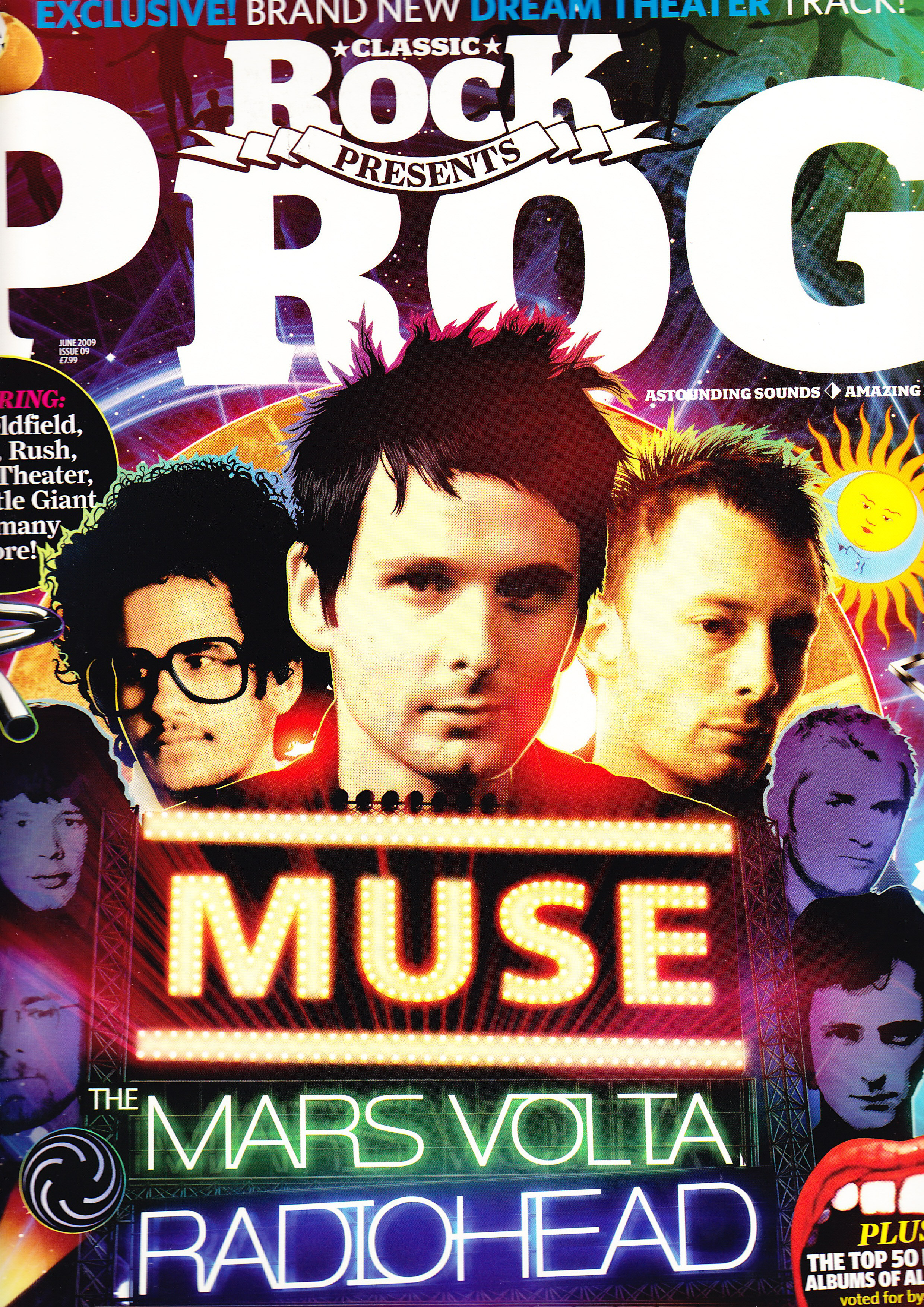
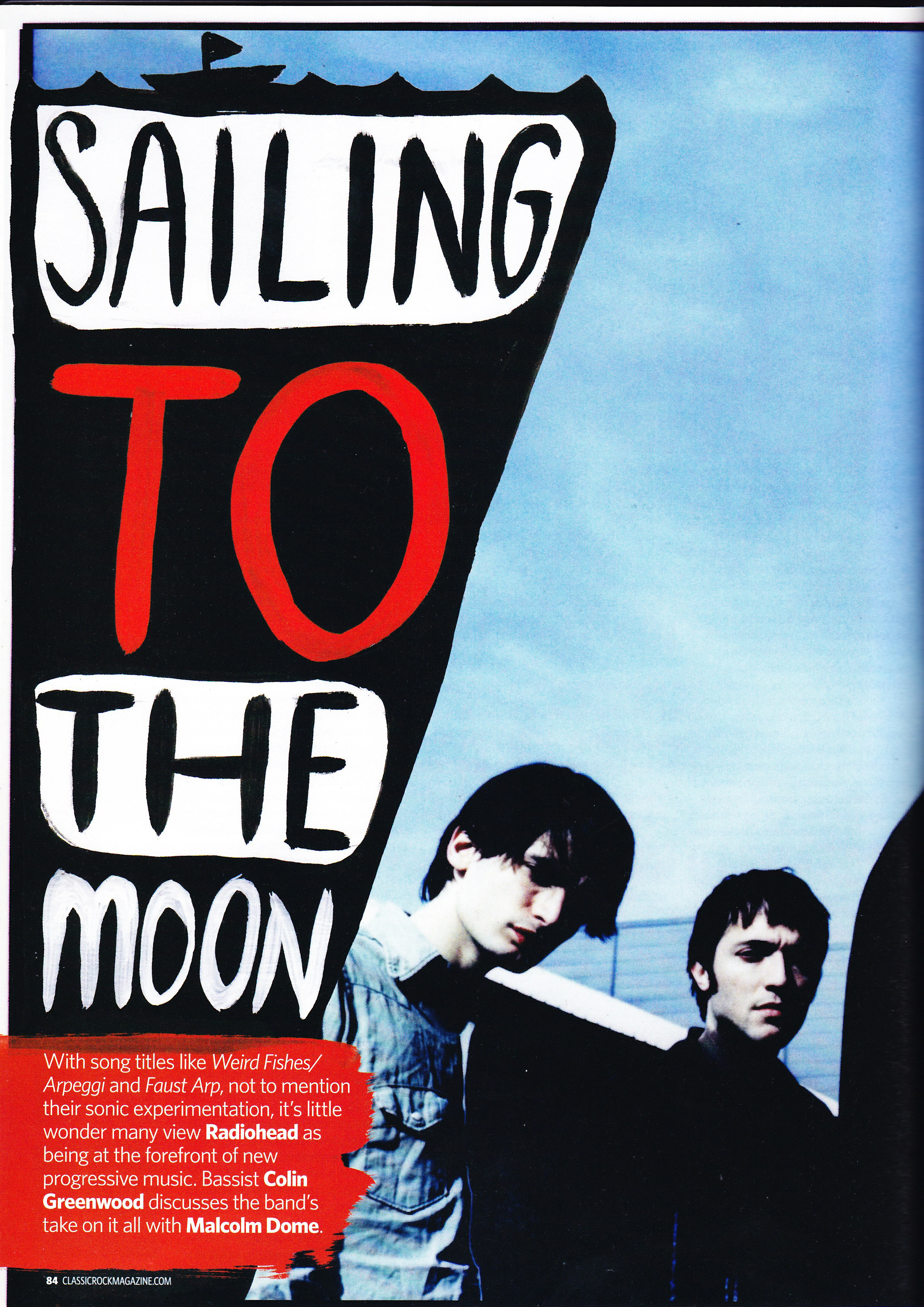
With songs like Weird Fishes/ Arpeggi and Faust Arp, not to mention their sonic experimentation, it's little wonder many view Radiohead as being at the forefront of new progressive music. Bassist Colin Greenwood discusses the band's take on it all with Malcolm Dome.
So, what are Radiohead doing in a progressive music magazine? A band who openly pay allegiance to post-punk artists such as The Smiths and The La's, and are more in tune with alternative heroes like the Pixies and Talking Heads. A band who've steadfastly refused to ally themselves in any way to prog rock. Yet, an aversion to paying lip service to progressive roots and influences in no way undermines the fact that the Oxfordshire quintet are, without question, pushing the mores and parameters of rock music, in the process proving to be at least partial heirs to the legacies of Pink Floyd and King Crimson.
"You'd think by now we'd know what's going to work, and what's still frustrating for us. But it's kind of encouraging that we don't know whether something's going to come across played on a laptop, or whether it has to be done on a piano," says Colin Greenwood. "It's gotten so twisted. But what we've learned is that you can't repeat a method that you've already used on different song, just because it worked back then."
Recognise the philosophy? It really could have been a quote from Roger Waters or Robert Fripp, the doyens of unshakeable unpredictability. Despite - or maybe because of- their enormous global success and profile, Radiohead are still very much a work in progress, constandy keeping themselves on the edge by daring to be different.
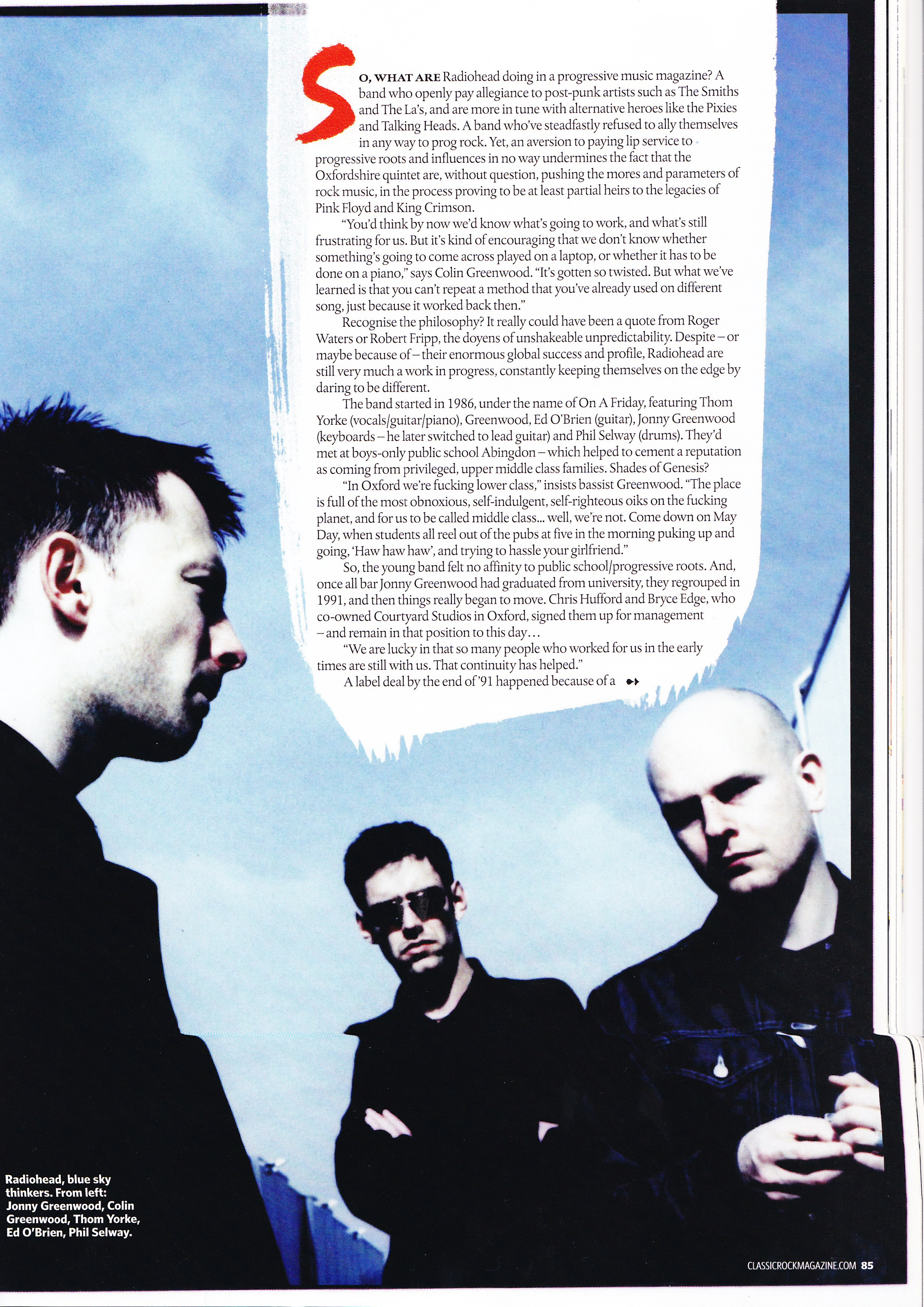
The band started in 1986, under the name of On A Friday, featuring Thom Yorke (vocals/guitar/piano), Greenwood, Ed O'Brien (guitar), Jonny Greenwood (keyboards - he later switched to lead guitar) and Phil Selway (drums). They'd met at boys-only public school Abingdon—which helped to cement a reputation as coming from privileged, upper middle class families. Shades of Genesis?
"In Oxford we're fucking lower class," insists bassist Greenwood. "The place is full of the most obnoxious, self-indulgent, self-righteous oiks on the fucking planet, and for us to be called middle class... well, we're not. Come down on May Day, when students all reel out of the pubs at five in the morning puking up and going, 'Haw haw haw', and trying to hassle your girlfriend."
So, the young band felt no affinity to public school/progressive roots. And, once all bar Jonny Greenwood had graduated from university, they regrouped in 1991, and then things really began to move. Chris Hufford and Bryce Edge, who co-owned Courtyard Studios in Oxford, signed them up for management - and remain in that position to this day...
"We are lucky in that so many people who worked for us in the early times are still with us. That continuity has helped."
A label deal by the end of '91 happened because of a chance meeting between the bassist and EMI representative Keith Wozencroft, at a record store where the former was employed at the time. It seemed fate had fingered the young quintet (now known as Radiohead, named after a Talking Heads song) as future giants.
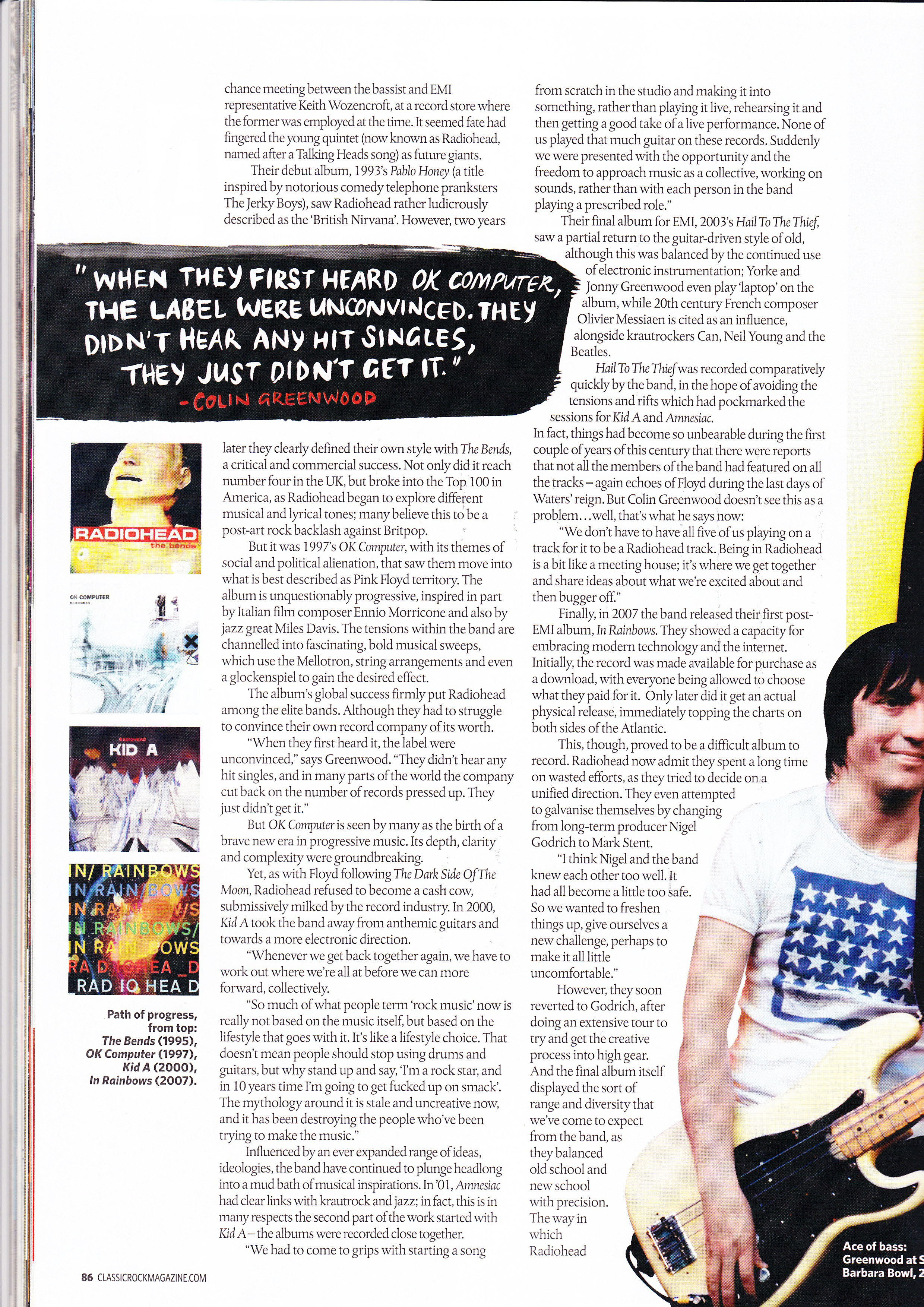
Their debut album, 1993's Pablo Honey (a title inspired by notorious comedy telephone pranksters The Jerky Boys), saw Radiohead rather ludicrously described as the 'British Nirvana'. However, two years later they clearly defined their own style with The Bends, a critical and commercial success. Not only did it reach number four in the UK, but broke into the Top 100 in America, as Radiohead began to explore different musical and lyrical tones; many believe this to be a post-art rock backlash against Britpop.
But it was 1997's OK Computer, with its themes of social and political alienation, that saw them move into what is best described as Pink Hoyd territory. The album is unquestionably progressive, inspired in part by Italian film composer Ennio Morricone and also by jazz great Miles Davis. The tensions within the band are channelled into fascinating, bold musical sweeps, which use the Mellotron, string arrangements and even a glockenspiel to gain the desired effect.
The album's global success firmly put Radiohead among the elite bands. Although they had to struggle to convince their own record company of its worth.
"When they first heard it, the label were unconvinced," says Greenwood. "They didn't hear any hit singles, and in many parts of the world the company cut back on the number of records pressed up. They just didn't get it."
But OK Computer is seen by many as the birth of a brave new era in progressive music. Its depth, clarity and complexity were groundbreaking.
Yet, as with Floyd following The Dark Side Of The Moon, Radiohead refused to become a cash cow, submissively milked by the record industry. In 2000, Kid A took the band away from anthemic guitars and towards a more electronic direction.
"Whenever we get back together again, we have to work out where we're all at before we can more forward, collectively.
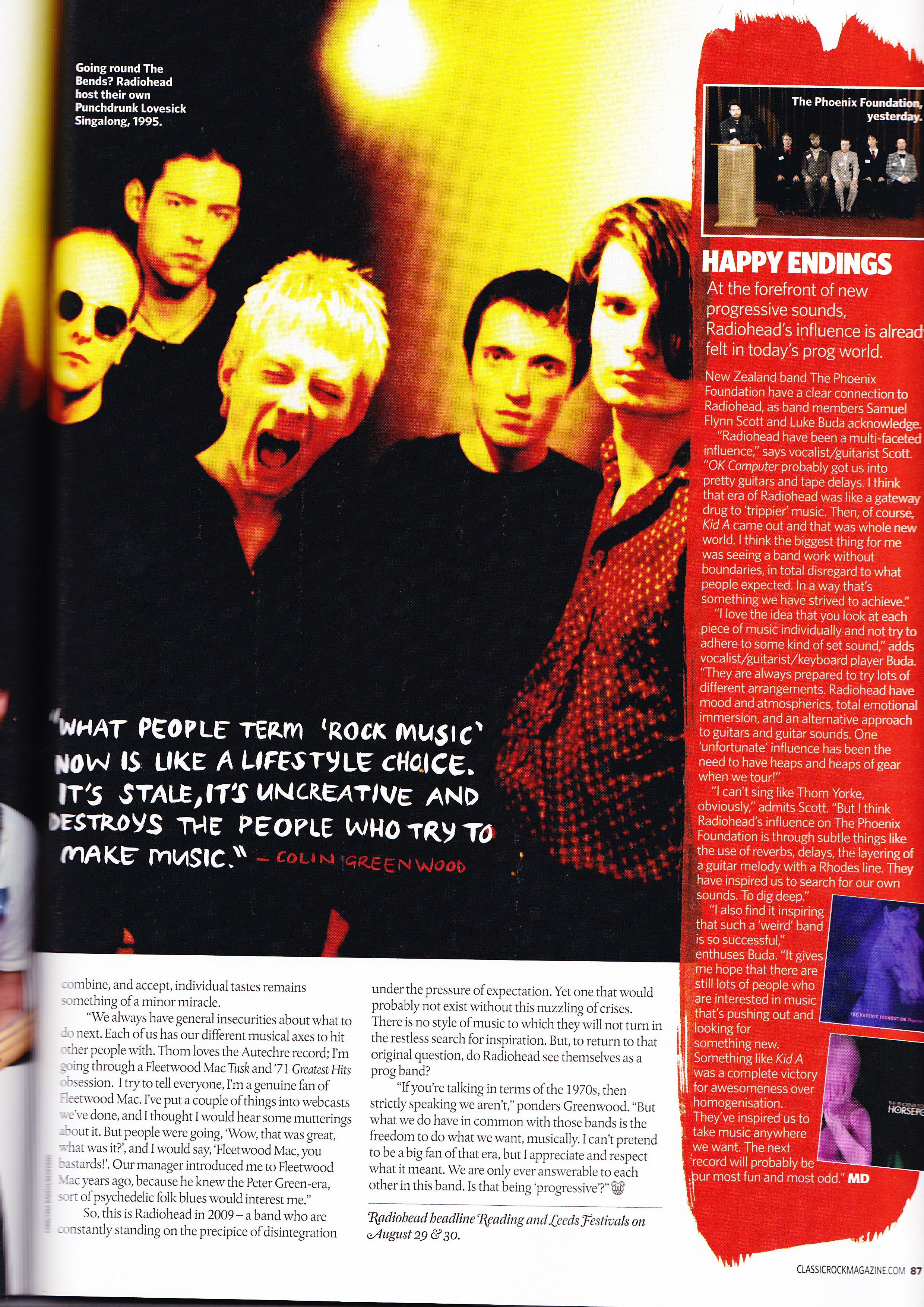
"So much of what people term 'rock music' now is really not based on the music itself, but based on the lifestyle that goes with it. It's like a lifestyle choice. That doesn't mean people should stop using drums and guitars, but why stand up and say, 'I'm a rock star, and in 10 years time I'm going to get fucked up on smack'. The mythology around it is stale and uncreative now, and it has been destroying the people who've been trying to make the music."
Influenced by an ever expanded range of ideas, ideologies, the band have continued to plunge headlong into a mud bath of musical inspirations. In '01, Amnesiac had clear links with krautrock and jazz; in fact, this is in many respects the second part of me work started with Kid A - the albums were recorded close together.
"We had to come to grips with starting a song from scratch in the studio and making it into something, rather than playing it live, rehearsing it and then getting a good take of a live performance. None of us played that much guitar on these records. Suddenly we were presented with the opportunity and the freedom to approach music as a collective, working on sounds, rather than with each person in the band playing a prescribed role."
Their final album for EMI, 2003's Hail To The Thief, saw a partial return to the guitar-driven style of old, although this was balanced by the continued use of electronic instrumentation; Yorke and Jonny Greenwood even play laptop' on the album, while 20th century French composer Olivier Messiaen is cited as an influence, alongside krautrockers Can, Neil Young and the Beatles.
Hail To The Thief was recorded comparatively quickly by the band, in the hope of avoiding the tensions and rifts which had pockmarked me sessions for Kid A and Amnesiac.
In fact, things had become so unbearable during me first couple of years of this century that mere were reports that not all the members of the band had featured on all the tracks - again echoes of Floyd during the last days of Waters' reign. But Colin Greenwood doesn't see this as a problem... well, that's what he says now:
"We don't have to have all five of us playing on a track for it to be a Radiohead track. Being in Radiohead is a bit like a meeting house; it's where we get together and share ideas about what we're excited about and then bugger off."
Finally, in 2007 the band released their" first post-EMI album, In Rainbows. They showed a capacity for embracing modern technology and the internet. Initially, the record was made available for purchase as a download, widi everyone being allowed to choose what they paid for it. Only later did it get an actual physical release, immediately topping the charts on both sides of me Atlantic.
This, though, proved to be a difficult album to record. Radiohead now admit they spent a long time on wasted efforts, as they tried to decide on a unified direction. They even attempted to galvanise themselves by changing from long-term producer Nigel Godrich to Mark Stent.
"I think Nigel and the band knew each other too well. It had all become a little too safe. So we wanted to freshen things up, give ourselves a new challenge, perhaps to make it all little uncomfortable."
However, they soon reverted to Godrich, after doing an extensive tour to try and get the creative process into high gear. And the final album itself displayed the sort of range and diversity mat we've come to expect from the band, as they balanced old school and new school with precision. The way in which Radiohead combine, and accept, individual tastes remains something of a minor miracle.
"We always have general insecurities about what to do next. Each of us has our different musical axes to hit other people with. Thom loves the Autechre record; I'm going through a Fleetwood Mac Tusk and ‘71 Greatest Hits obsession. I try to tell everyone,— I'm a genuine fan of Fleetwood Mac. I've put a couple of things into webcasts we've done, and I thought I would hear some mutterings about it. But people were going, 'Wow, that was great, what was it?', and I would say, 'Fleetwood Mac, you bastards!'. Our manager introduced me to Fleetwood Mac years ago, because he knew the Peter Green-era, sort of psychedelic folk blues would interest me."
So, this is Radiohead in 2009 - a band who are constantly standing on the precipice of disintegration under the pressure of expectation. Yet one that would probably not exist without this nuzzling of crises. There is no style of music to which they will not turn in the restless search for inspiration. But, to return to that original question, do Radiohead see themselves as a prog band?
"If you're talking in terms of the 1970s, then strictly speaking we aren't," ponders Greenwood. "But what we do have in common with those bands is the freedom to do what we want, musically. I can't pretend to be a big fan of that era, but I appreciate and respect what it meant. We are only ever answerable to each other in this band. Is that being 'progressive'?"
Radiohead headline Reading and Leeds festivals on August 29 & 30.