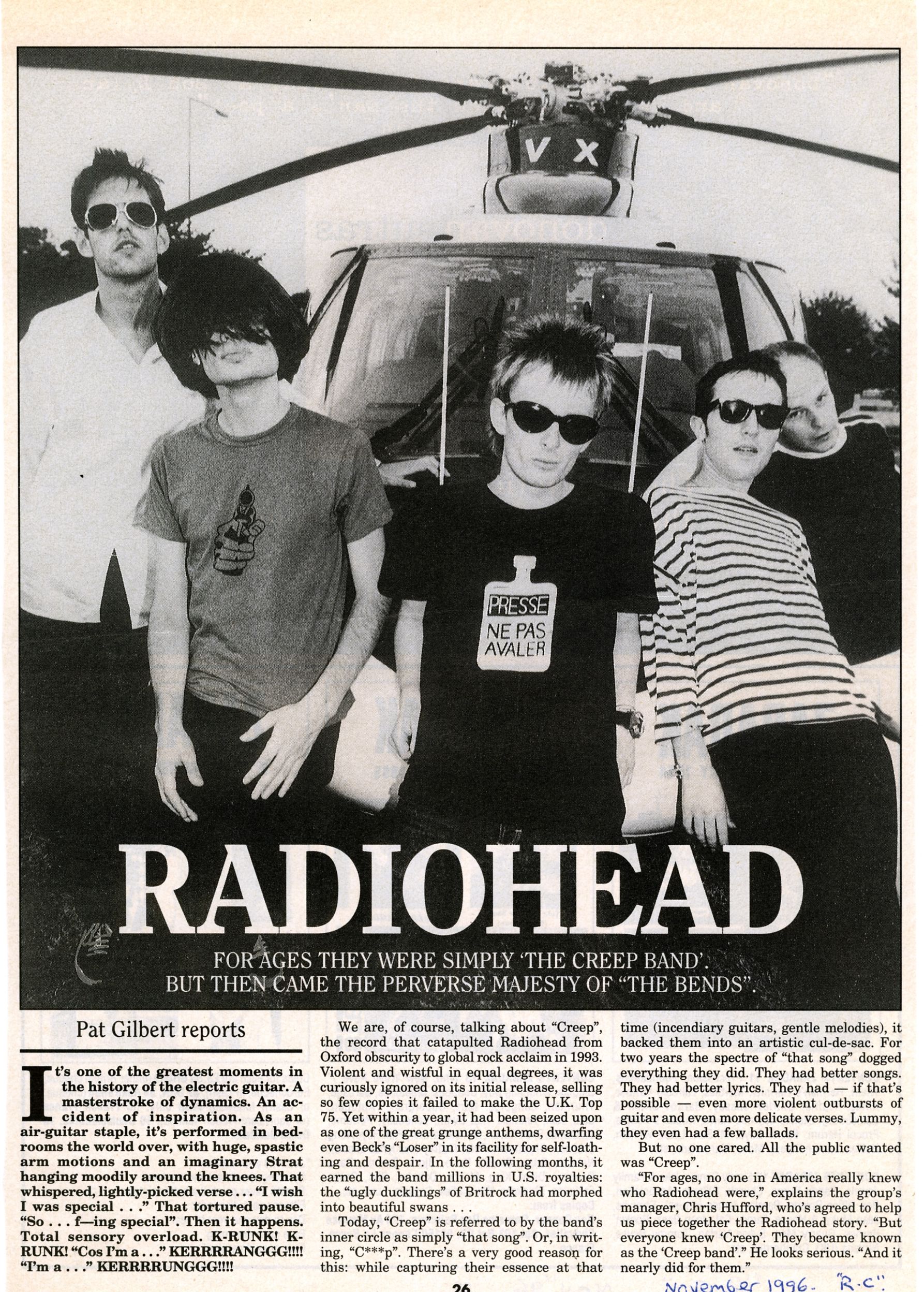

It’s one of the greatest moments in the history of the electric guitar. A masterstroke of dynamics. An accident of inspiration. As an air-guitar staple, it’s performed in bed- rooms the world over, with huge, spastic arm motions and an imaginary Strat hanging moodily around the knees. That whispered, lightly-picked verse . . . “I wish I was special...” That tortured pause. “So... f—ing special”. Then it happens. Total sensory overload. K-RUNK! K- RUNK! “Cos I’m a . . .” KERRRRANGGG!!!! “I’m a...” KERRRRUNGGG!!!!
We are, of course, talking about “Creep”, the record that catapulted Radiohead from Oxford obscurity to global rock acclaim in 1993. Violent and wistful in equal degrees, it was curiously ignored on its initial release, selling so few copies it failed to make the U.K. Top 75. Yet within a year, it had been seized upon as one of the great grunge anthems, dwarfing even Beck’s “Loser” in its facility for self-loathing and despair. In the following months, it earned the band millions in U.S. royalties: the “ugly ducklings” of Britrock had morphed into beautiful swans . . .
Today, “Creep” is referred to by the band’s inner circle as simply “that song”. Or, in writing, “C***p”. There's a very good reason for this: while capturing their essence at that time (incendiary guitars, gentle melodies), it backed them into an artistic cul-de-sac. For two years the spectre of “that song” dogged everything they did. They had better songs. They had better lyrics. They had - if that’s possible - even more violent outbursts of guitar and even more delicate verses. Lummy, they even had a few ballads.
But no one cared.
All the public wanted was “Creep”. “For ages, no one in America really knew who Radiohead were,” explains the group’s manager, Chris Hufford, who’s agreed to help us piece together the Radiohead story. “But everyone knew ‘Creep’. They became known as the ‘Creep band’.” He looks serious. “And it nearly did for them.”
It’s a miserable autumn day, and RC has just arrived at Didcot Parkway, a moderately large railway station eight miles west of Oxford. A short cab ride delivers us to a sleepy country village, where the only signs of life are an elderly couple shuffling among the fallen autumn leaves, looking for conkers. There’s only one shop. It’s shut.
Nearby, in some swish industrial units, Hufford is awaiting our arrival with his business partner Bryce Edge. A warm serenity pervades their office, which is only disturbed when Supergrass (Hufford’s other charges) turn up later in the afternoon to play him a cassette of their latest recordings. The only other drama that afternoon is, astonishingly, an aborted attempt to erect a new shelf from IKEA.
It’s a far cry from the world of Radiohead that you might imagine. Where's the evidence of angst and self-censure? Where’s the awkwardness? That there should be some physical sign of the band’s problems is perhaps wishful thinking on our part. But there’s nothing even remotely awry. As Hufford points out, this might be because, these days, things have calmed down immeasurably for Thom and co. The critical success last year of their second album, “The Bends”, seems to have dramatically exorcised the demons that had once made life almost unbearable for the group.
A steady seller in the States, it has finally put some distance between the band and their “C***p” nemesis. At the moment, Radiohead are currently hidden away in a studio outside Bath, recording a third album. They are not, as you may have guessed, talking to the press as yet. But an abundance of new tracks have already emerged, with titles like “Electioneering”, “Let Down” and “Paranoid Android”. Make no mistake, Radiohead will soon be back...
Although they didn’t formally start life until 1991, the idea for Radiohead germinated almost a decade earlier, at Abingdon, a private boys’ school outside Oxford. There, Thom Yorke (vocs/guitar) and classmate Colin Greenwood (bass) struck up a friendship that centred around a shared affection for Joy Division and Magazine. The recipient of a Spanish guitar for his eighth birthday, Thom had been born with a paralysed left eye, which although partially corrected with several operations, had always singled him out for unwanted attention. His peers had a nickname for him: ‘Salamander’. As with many other sensitive types, his method of escaping the isolation and occasional brutality of school life was to write songs. That, and monopolising the record decks at parties.
Soon, Thom joined a sixth-form punk band, TNT. When he got fed up with their lack of progress and left, Colin replaced him. Meanwhile, it had emerged that one of the older school bullies, Phil Selway, played the drums. With a fellow senior pupil, the lanky Ed O’Brien, providing guitar, the four boys began rehearsing together. They called themselves On A Friday - that was when they practised...
As the time approached for Phil and Ed to go to university, the group’s gatherings were sometimes swelled by Colin’s younger brother, Jonny (the two are affectionately known as the Greenwood Sisters), who played viola in the Thames Valley Youth Orchestra. A gifted musician, his passion was jazz. The only role On A Friday could find for him was harmonica player. At some point around this time, there are also rumours of an additional horn section, including two sax-playing sisters. Evidently, On A Friday had yet to find their niche.
Not that it mattered that much. Between 1987 and 1991, Oxford’s most musically confused departed the city to study for their degrees. Thom went to Exeter, where he took Fine Art & Literature and, monopolising the record decks yet again (old habits die hard and it was easier than talking to girls), moonlighted as a techno DJ. Ed studied Politics in Manchester, while Colin did English at Cambridge and Phil majored in the same subject at Liverpool.
On A Friday was periodically resuscitated when all the members happened to be back in Oxford, but mostly it was an era of forming college-based bands with curious (i.e. crap) names like King Of Thailand, Shindig and Jungle Telegraph. Characteristically, the most notable achievements were Thom’s. In 1990, he teamed up with Flickernoise, “a computer with dreadlocks” techno act, which survived his departure to release two singles in the early 90s. A song Thom wrote with another Exeter Uni oufit, Headless Chicken," later became part of Radiohead’s early set.
In the summer of 1991, the members of On A Friday reconvened in Oxford. This time, they decided they’d make a serious go of the group. The previous April, they’d recorded a demo tape (stand-out track: “Stop Whispering”), which they passed on to anyone who they thought could help them. None of them would consider embarking on a professional career just yet; so Thom worked in an architect’s office, Ed got a job as a waiter in swanky Oxford tearooms, Brown's, Phil cheated a bit and began publishing a medical journal and Colin manned the counter at Our Price. As the baby of the bunch, 19-year-old Jonny had yet to go to college, and was preparing to take a Music degree at Oxford Poly.
Cue the arrival of Chris Hufford, a local studio owner, producer of toe-staring nearly-made-its Slowdive, and former member of failed early 80s New Romantics, Aerial FX. On the strength of the OAF demo, he went along to see the group at Oxford’s famous Jericho Tavern. “Afterwards he was almost shaking,” Colin told local fanzine ‘Curfew’ in the band’s first ever interview. “He said we were the best group he'd seen in three years, and invited us to record with him at the Courtyard [his studio].”
FRENETIC
“I was completely blown away with it,” concurs Chris. “All the elements of Radiohead were there. It was a lot rougher, a lot punkier, quite frenetic and a faster tempo. But they were still very musical, the songs were well put together. Thom’s stage presence was something else.”
The Courtyard recording sessions spawned the “Manic Hedgehog” tape, which was sold through the Oxford record shop of the same name. Around this time, EMI sales rep Keith Wozencroft heard the tape via Colin at Our Price. He was in the process of switching to A&R, and immediately took a keen interest in the group. He came down to their next Jericho Tavern gig at the end of October. The support band that night was Money For Jam. Bassist Hannah Griffiths remembers: “They had to use our drumkit, because theirs was in such a state. It was strange to see so many people turn up to see them. You could sense something was happening. Thom was like a little kid, having tantrums all over the stage. We shared the door money - we got about £30 each.”
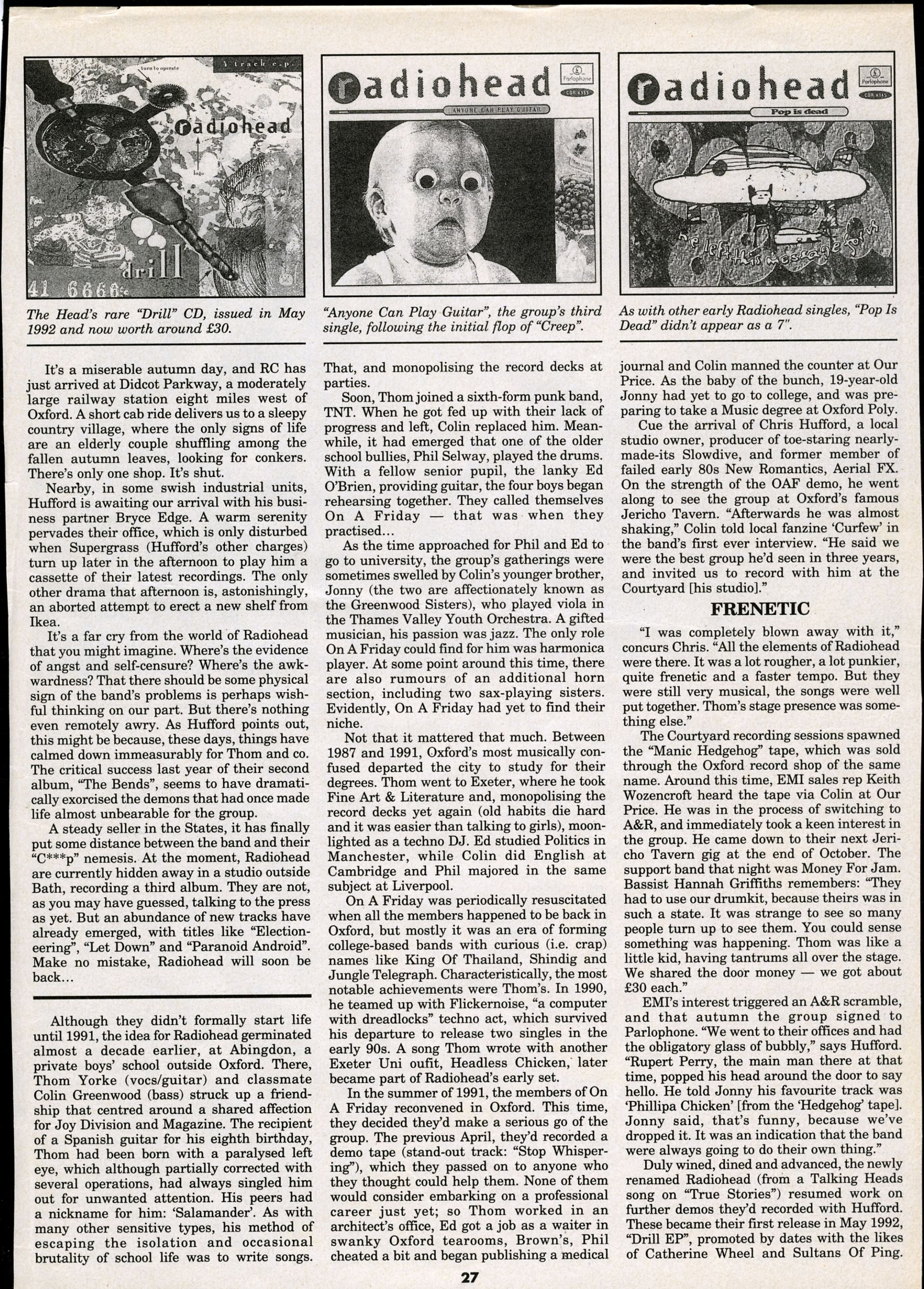
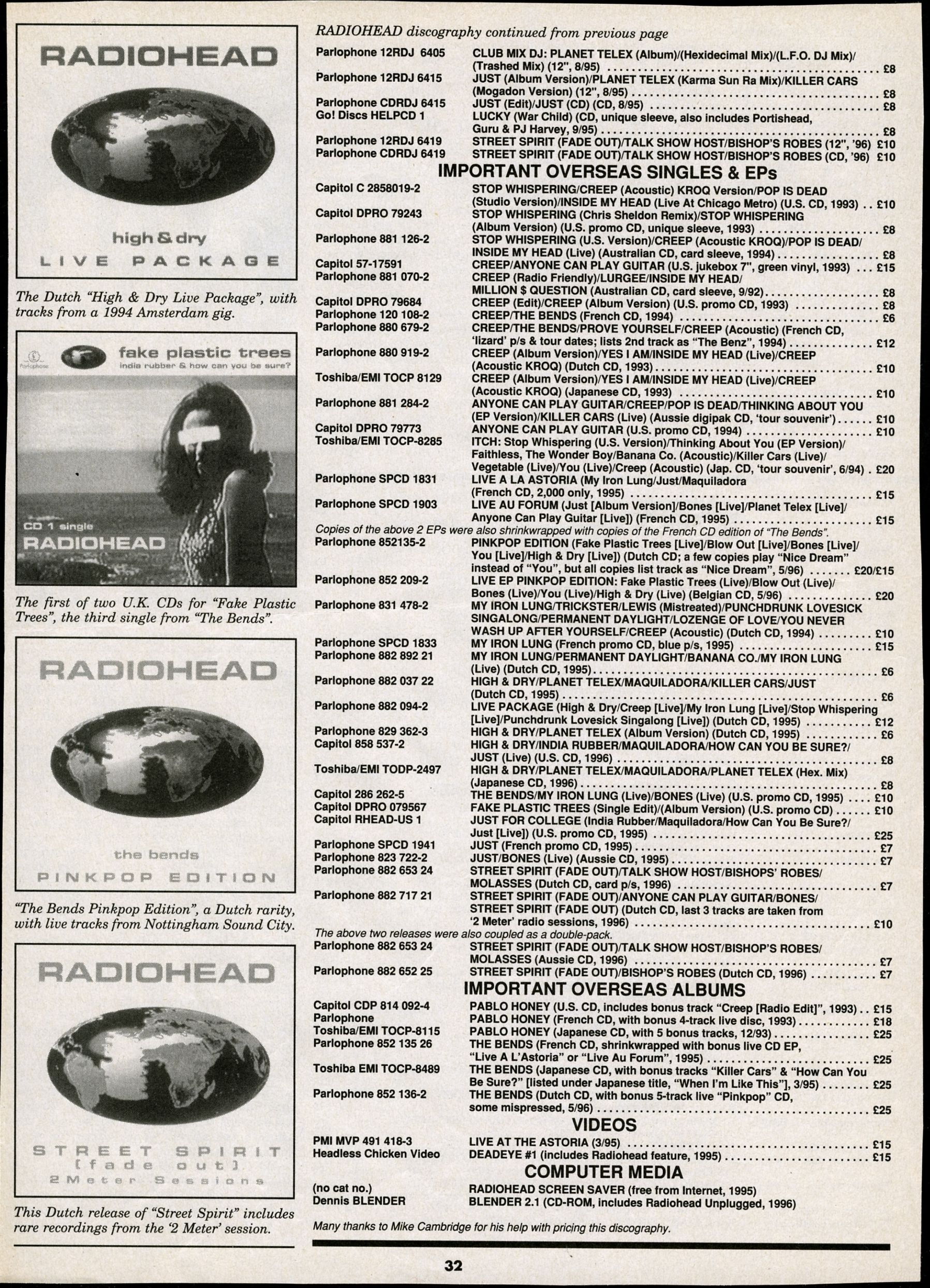
EMI’s interest triggered an A&R scramble, and that autumn the group signed to Parlophone. “We went to their offices and had the obligatory glass of bubbly,” says Hufford. “Rupert Perry, the main man there at that time, popped his head around the door to say hello. He told Jonny his favourite track was ‘Phillipa Chicken’ [from the ‘Hedgehog’ tape]. Jonny said, that’s funny, because we’ve dropped it. It was an indication that the band were always going to do their own thing.” Duly wined, dined and advanced, the newly renamed Radiohead (from a Talking Heads song on “True Stories”) resumed work on further demos they’d recorded with Hufford. These became their first release in May 1992, “Drill EP”, promoted by dates with the likes of Catherine Wheel and Sultans Of Ping.
Abrasive and melancholic by turns, “Drill” kicked off with the punky and splenetic “Prove Yourself”, home to the first in a long history of nihilistic one-liners that suggested Thom’s worldview was one of genuine self-loathing rather than bathetic self-pity. “I wanna breathe, I wanna grow/I’d say I want it but I don’t know/I’m better off dead”. As with similarly sensitive soul, there was little doubt it was 4 Real.
Around the time “Drill” came out, it was agreed that Radiohead should record a couple of numbers with Boston producers Sean Slade and Paul Q. Kolderie. These were the spacey, U2-esque “Inside My Head” and “Million $ Question”. They decided to warm up with a new Thom composition, “Creep”, a whimsical ballad of amazing fragility. Thinking it a little too twee, Jonny decided to sabotage the chorus with crunching metal guitar whiteout, signposted with that now-infamous, muted, two-stroke K-RUNK!! Unbeknown to him, the tape was rolling. He had just ensured Radiohead’s immortality.
Only it didn’t quite happen like that. “The sales were really disappointing. It got to, what? No. 78?” says Hufford. “We thought we’d be on ‘Top Of The Pops’ but it wasn’t to be.” As they propped up the Frank & Walters on a tour of the nation's toilets, life for Radiohead must have seemed ridiculously cruel. Yet there were signs that their genius was being appreciated. In Israel, “Creep” became a massive hit. “We thought, blimey, maybe we’d been right after all,” says Chris. Certainly, it began to seem that way. Despite its poor showing in the charts, “Creep” was voted one of ‘NME’s Top 10 singles of the year, while ‘Melody Maker’ tipped the band for global domination in 1993. “Creep” was slowly beginning to snowball.
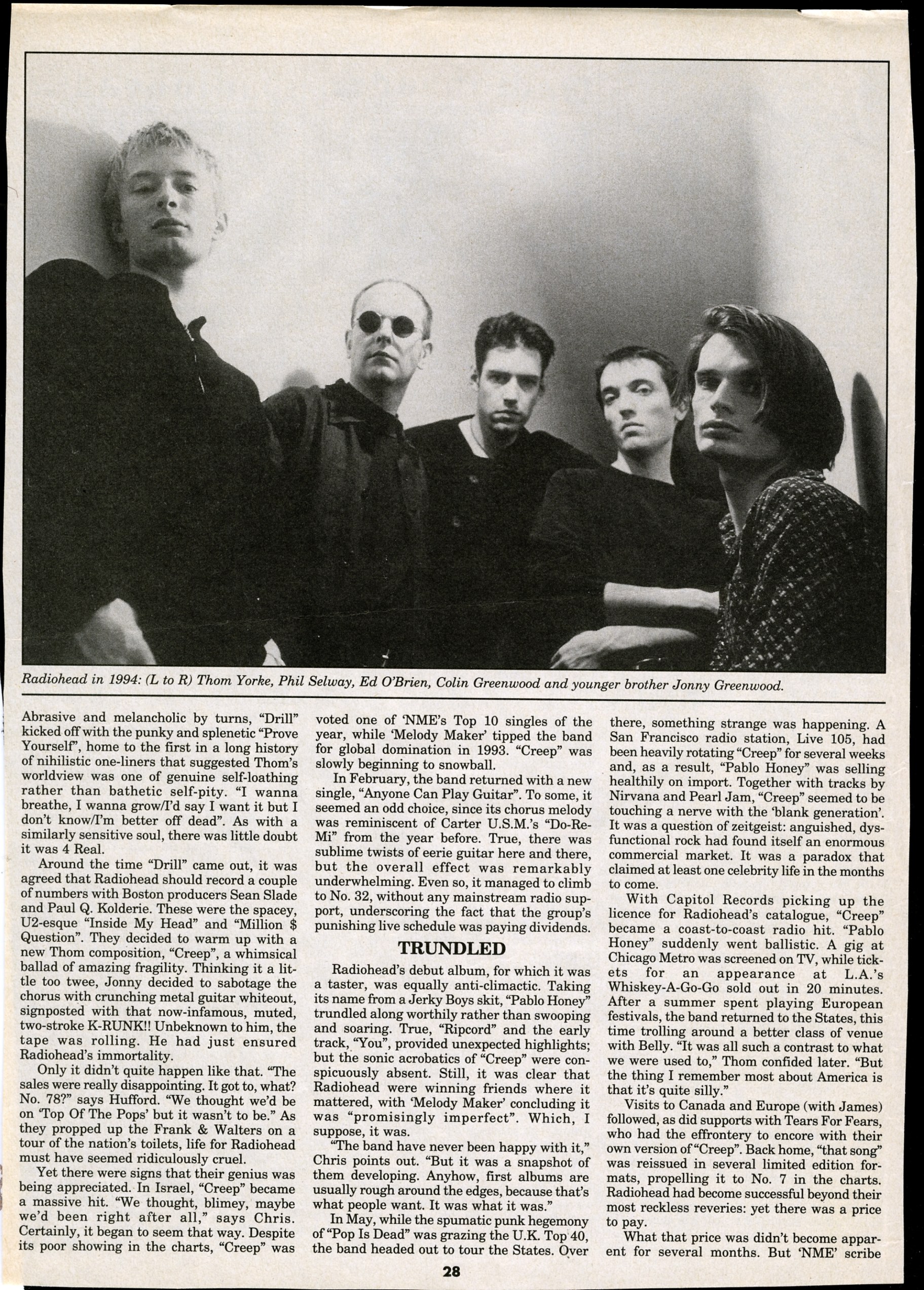
In February, the band returned with a new single, “Anyone Can Play Guitar”. To some, it seemed an odd choice, since its chorus melody was reminiscent of Carter U.S.M.’s “Do-Re- Mi” from the year before. True, there was sublime twists of eerie guitar here and there, but the overall effect was remarkably underwhelming. Even so, it managed to climb to No. 32, without any mainstream radio support, underscoring the fact that the group’s punishing live schedule was paying dividends.
TRUNDLED
Radiohead’s debut album, for which it was a taster, was equally anti-climactic. Taking its name from a Jerky Boys skit, “Pablo Honey” trundled along worthily rather than swooping and soaring. True, “Ripcord” and the early track ,“You”, provided unexpected highlights; but the sonic acrobatics of “Creep” were conspicuously absent. Still, it was clear that Radiohead were winning friends where it mattered, with ‘Melody Maker’ concluding it was “promisingly imperfect”. Which, I suppose, it was.
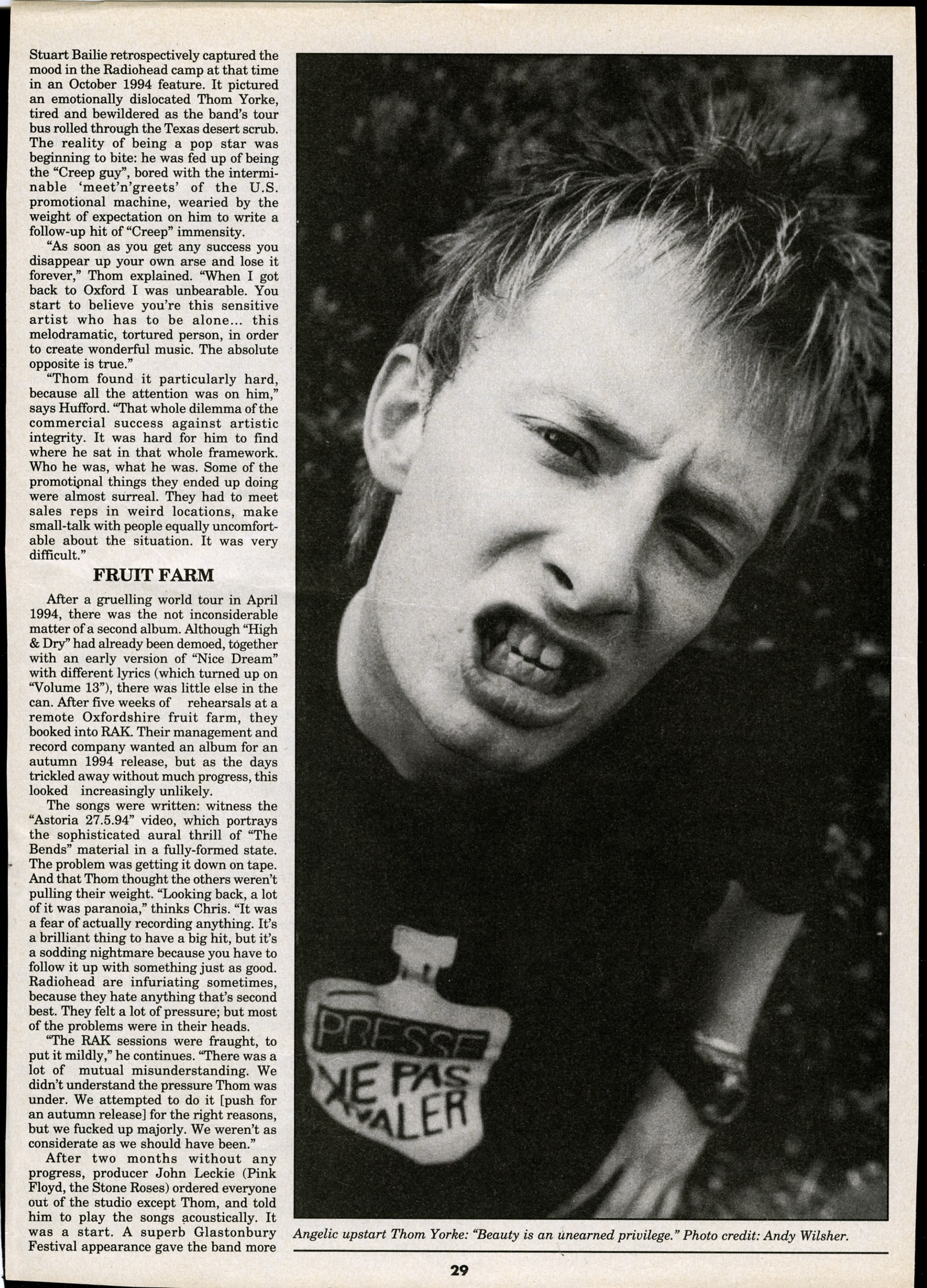
“The band have never been happy with it,” Chris points out. “But it was a snapshot of them developing. Anyhow, first albums are usually rough around the edges, because that’s what people want. It was what it was.” In May, while the spumatic punk hegemony of “Pop Is Dead” was grazing the U.K. Top 40, the band headed out to tour the States.
Over there, something strange was happening. A San Francisco radio station, Live 105, had been heavily rotating “Creep” for several weeks and, as a result, “Pablo Honey” was selling healthily on import. Together with tracks by Nirvana and Pearl Jam, “Creep” seemed to be touching a nerve with the ‘blank generation’. It was a question of zeitgeist: anguished, dysfunctional rock had found itself an enormous commercial market. It was a paradox that claimed at least one celebrity life in the months to come.
With Capitol Records picking up the licence for Radiohead’s catalogue, “Creep” became a coast-to-coast radio hit. “Pablo Honey” suddenly went ballistic. A gig at Chicago Metro was screened on TV, while tickets for an appearance at L.A.’s Whiskey-A-Go-Go sold out in 20 minutes. After a summer spent playing European festivals, the band returned to the States, this time trolling around a better class of venue with Belly. “It was all such a contrast to what we were used to,” Thom confided later. “But the thing I remember most about America is that it's quite silly.”
Visits to Canada and Europe (with James) followed, as did supports with Tears For Fears, who had the effrontery to encore with their own version of “Creep”. Back home, “that song” was reissued in several limited edition formats, propelling it to No. 7 in the charts. Radiohead had become successful beyond their most reckless reveries: yet there was a price to pay.
What that price was didn’t become apparent for several months. But ‘NME’ scribe Stuart Bailie retrospectively captured the mood in the Radiohead camp at that time in an October 1994 feature. It pictured an emotionally dislocated Thom Yorke, tired and bewildered as the band’s tour bus rolled through the Texas desert scrub. The reality of being a pop star was beginning to bite: he was fed up of being the “Creep guy”, bored with the interminable ‘meet’n’greets’ of the U.S. promotional machine, wearied by the weight of expectation on him to write a follow-up hit of “Creep” immensity.
“As soon as you get any success you disappear up your own arse and lose it forever,” Thom explained. “When I got back to Oxford I was unbearable. You start to believe you’re this sensitive artist who has to be alone... this melodramatic, tortured person, in order to create wonderful music. The absolute opposite is true.”
“Thom found it particularly hard, because all the attention was on him,” says Hufford. “That whole dilemma of the commercial success against artistic integrity. It was hard for him to find where he sat in that whole framework. Who he was, what he was. Some of the promotional things they ended up doing were almost surreal. They had to meet sales reps in weird locations, make small-talk with people equally uncomfortable about the situation. It was very difficult.”
FRUIT FARM
After a gruelling world tour in April 1994, there was the not inconsiderable matter of a second album. Although “High & Dry” had already been demoed, together with an early version of “Nice Dream” with different lyrics (which turned up on “Volume 13”), there was little else in the can. After five weeks of rehearsals at a remote Oxfordshire fruit farm, they booked into RAK. Their management and record company wanted an album for an autumn 1994 release, but as the days trickled away without much progress, this looked increasingly unlikely.
The songs were written: witness the “Astoria 27.5.94” video, which portrays the sophisticated aural thrill of “The Bends” material in a fully-formed state. The problem was getting it down on tape. And that Thom thought the others weren’t pulling their weight. “Looking back, a lot of it was paranoia,” thinks Chris. “It was a fear of actually recording anything. It’s a brilliant thing to have a big hit, but it’s a sodding nightmare because you have to follow it up with something just as good. Radiohead are infuriating sometimes, because they hate anything that’s second best. They felt a lot of pressure; but most of the problems were in their heads.
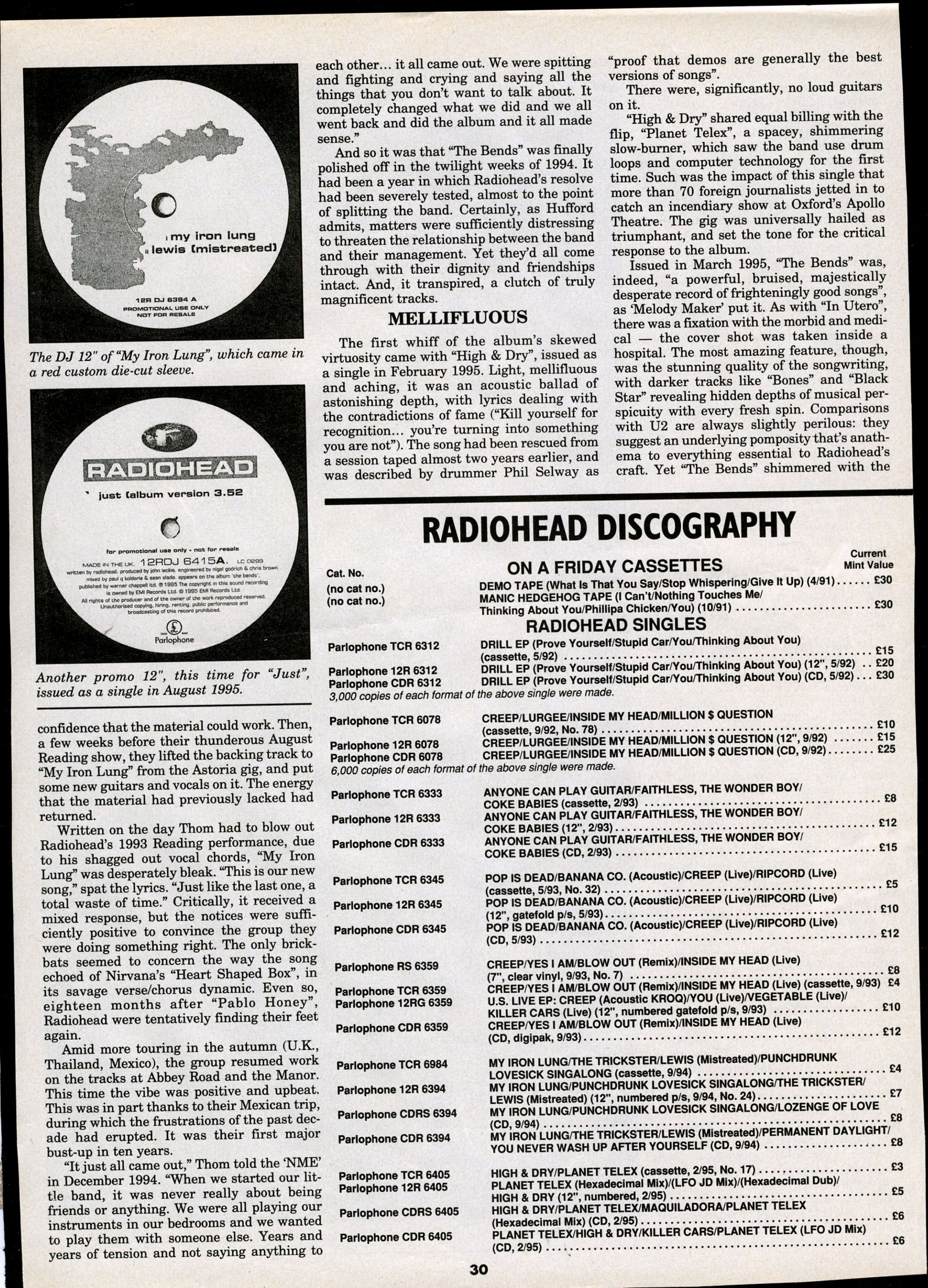
“The RAK sessions were fraught, to put it mildly,” he continues. “There was a lot of mutual misunderstanding. We didn’t understand the pressure Thom was under. We attempted to do it [push for an autumn release] for the right reasons, but we fucked up majorly. We weren’t as considerate as we should have been.” After two months without any progress, producer John Leckie (Pink Floyd, the Stone Roses) ordered everyone out of the studio except Thom, and told him to play the songs acoustically. It was a start. A superb Glastonbury Festival appearance gave the band more confidence that the material could work. Then, a few weeks before their thunderous August Reading show, they lifted the backing track to “My Iron Lung” from the Astoria gig, and put some new guitars and vocals on it. The energy that the material had previously lacked had returned.
Written on the day Thom had to blow out Radiohead’s 1993 Reading performance, due to his shagged out vocal chords, “My Iron Lung” was desperately bleak. “This is our new song,” spat the lyrics. “Just like the last one, a total waste of time.” Critically, it received a mixed response, but the notices were sufficiently positive to convince the group they were doing something right. The only brick- bats seemed to concern the way the song echoed of Nirvana’s “Heart Shaped Box”, in its savage verse/chorus dynamic. Even so, eighteen months after “Pablo Honey”, Radiohead were tentatively finding their feet again.
Amid more touring in the autumn (U.K., Thailand, Mexico), the group resumed work on the tracks at Abbey Road and the Manor. This time the vibe was positive and upbeat. This was in part thanks to their Mexican trip, during which the frustrations of the past decade had erupted. It was their first major bust-up in ten years.
“It just all came out,” Thom told the ‘NME’ in December 1994. “When we started our little band, it was never really about being friends or anything. We were all playing our instruments in our bedrooms and we wanted to play them with someone else. Years and years of tension and not saying anything to each other... it all came out. We were spitting and fighting and crying and saying all the things that you don’t want to talk about. It completely changed what we did and we all went back and did the album and it all made sense.”
And so it was that “The Bends” was finally polished off in the twilight weeks of 1994. It had been a year in which Radiohead’s resolve had been severely tested, almost to the point of splitting the band. Certainly, as Hufford admits, matters were sufficiently distressing to threaten the relationship between the band and their management. Yet they’d all come through with their dignity and friendships intact. And, it transpired, a clutch of truly magnificent tracks.
MELLIFLUOUS
The first whiff of the album’s skewed virtuosity came with “High & Dry”, issued as a single in February 1995. Light, mellifluous and aching, it was an acoustic ballad of astonishing depth, with lyrics dealing with the contradictions of fame (“Kill yourself for recognition... you’re turning into something you are not”). The song had been rescued from a session taped almost two years earlier, and was described by drummer Phil Selway as “proof that demos are generally the best versions of songs”.
There were, significantly, no loud guitars on it.
“High & Dry” shared equal billing with the flip, “Planet Telex”, a spacey, shimmering slow-burner, which saw the band use drum loops and computer technology for the first time. Such was the impact of this single that more than 70 foreign journalists jetted in to catch an incendiary show at Oxford's Apollo Theatre. The gig was universally hailed as triumphant, and set the tone for the critical response to the album.
Issued in March 1995, “The Bends” was, indeed, “a powerful, bruised, majestically desperate record of frighteningly good songs”, as ‘Melody Maker’ put it. As with “In Utero”, there was a fixation with the morbid and medical - the cover shot was taken inside a hospital. The most amazing feature, though, was the stunning quality of the songwriting, with darker tracks like “Bones” and “Black Star” revealing hidden depths of musical perspicuity with every fresh spin. Comparisons with U2 are always slightly perilous: they suggest an underlying pomposity ‘that’s anathema to everything essential to Radiohead’s craft. Yet “The Bends” shimmered with the same mix of technological adventurousness and classic songsmithery that defined Bono and co.’s “Zooropa” - only with far more twisted, anguished and enigmatic guitar work.
In America, though, the public weren’t immediately convinced. “The reaction over there was, ‘It’s rubbish! There’s no ‘Creep”,” chuckles Hufford. “So Capitol went for ‘Fake Plastic Trees’ as a single, to distance the band even further from what they’d done before, and make America realise there was more to them than ‘Creep’. And it worked, though it took a long time. They are no longer the ‘Creep band’. Now it’s, You had a hit with ‘Creep’ ages ago and ‘The Bends’ is brilliant.”
Back in the U.K., Radiohead headlined the Bristol Sound City industry bash (a source of many imported live tracks), and supported R.E.M. at Milton Keynes Bowl. Through August to October, they shadowed Stipe and co. on their “Monster” world tour, ending up in Tel Aviv for a show at which R.E.M.’s singer admitted that he was “frightened by how good they are”. Thom confided to the ‘NME’:
“Everything that we’ve come to expect was completely turned on its head [with that tour]. Like the idea that you get to a certain level and you lose it. Everything was amicable and there was no bitchiness or pettiness about it.” The schedule was so civilised that Radiohead even found time to support Neil Young in Denmark and lay down some new material. They also contributed a newly-taped studio version of “Banana Co.” to the “Axe The Act” compilation.
CONFLICT
In September, the band recorded “Lucky” for the “Help!” album, a fund-raiser for victims of the conflict in former Yugoslavia, before getting their gear nicked on the first date of a tour with Soul Asylum. Then it was off to Europe for more live dates, to promote the “Fake Plastic Trees” and “Just” (fantastic video!) singles, followed by some warmly received U.K. shows and a Christmas visit to the States. By this time, Yorke was beginning to acknowledge that it was inevitable that he couldn’t live the songs every night. “The secret that I’m slowly discovering is that if you don’t feel anything inside for what you’re doing,” he rued, “it doesn’t necessarily mean it’s not working. It’s just that you can’t mean it all the time.”
Even so, anyone who’s ever seen Radiohead live will know they play their songs with a savage abandon that can be as inspirational as it is awe-inspiring. The faint suggestion of dysfunctionality that surrounds the band - Thom looks so weird he’s almost beautiful; Jonny’s so beautiful he looks weird; Ed towers over them both awkwardly - informs their music with an authenticity you could never truly fake. With Jonny scrubbing ferociously at his guitar, and the rhythm section fitting from gentle near-silences to cacophonous outbursts with consummate ease, the lasting impression is of a band capable of fusing traditional rock and explosive avant-garde with wonderfully wonky genius.
In January 1996, Radiohead released the last single from “The Bends”, “Street Spirit (Fade Out)”. Maudlin and gentle, it was as far a cry from “Creep” as you could possibly imagine. It was also a strange choice for a single. “Possibly,” says Hufford. “But it closed the album, so it seemed a fitting closer for the whole ‘Bends’ era.”
After more touring abroad, the band took a holiday and retreated to work on their third album. The rumours are that they’ll be more keyboards and computers, with Thom possibly drawing on his early techno influences. And, according to Chris, some of the other members have even had a stab at songwriting themselves. A barnstorming display at Glasgow’s T In The Park festival in July confirmed that Radiohead can still cut it live, leaving the question, when will the band be back? “An album’s tentatively pencilled in for next spring,” says Hufford.
We can’t wait to hear it.