




Renaissance Men
They returned with the album of the year, played a heart-stopping show at Glastonbury and became unstoppably huge. As Radiohead reach Italy, equipped with new songs, Marmite and crosswords, Thom Yorke reflects on a particularly insane year...
"Shut that fucking door," spits Thom Yorke, staring intently at a rectangle that has briefly allowed him a glimpse of the oustide world. The target of his request - a 16-stone Italian security operative - cannot speak English; so nothing happems at all.
"Let's try this one again," he goes on, pausing as if reloading a verbal pistol. "Shut that fucking door."
The voice is uncomfortably redolent of Mick Jagger in about 1969: slightly nasal, a little bit impudent, seemingly shot through with the superiority complex of the travelling Englishman. That said, Thom can hardly be blamed for his ire. Outside this sanitised, functional venue - a combination of red-brick industrial unit and youth center - the temperature is hovering somewhere around zero.
We are half an hour outside Bologna, in the suburbs of Modena: funky cold Modena, as today's joke would have it. A gaggle of early arrivals are hovering by the entrance of the Vox club (capacity 1200), and thanks to the abundance of loopholes in Italian copyright law, a temporary retail intstallation has been established over the road. In Italy, bootleg merchandise is not hawked by anxious fly-by-nights who scamper around once the show has finished and disappear as soon as il rozzery appear. It is sold on dinky little stalls by council-approved vendors.
Modena, it has to be said, is the ideal place for the aspirant small buisnessman. It's the birthplace of two mega-earning pillars of Italian culture and commerce - Luciano Pavarotti and the Ferrari corporation - and a positive cradle of the deep-pile prosperity that has long seperated the north of Italy from the threadbare south. Downtown, there is a wealth of gleaming renaissance architecture, a lovely branch of Emporio Armani, and unending evidence of why the city is said to have a similar cost of living to the island of Manhattan.
Radiohead, unfortunately, know nothing of this. At the moment, they are permanently resident in a hermetically-sealed home-on-wheels with seats in the front, bunks in the middle and a studio - a studio - at the back. A set of orange power cables emerges from its underside: part of the on-tour deal, it seems, is that Radiohead's rider includes a not inconsiderable supply of the local electricity.
All the voltage that the province of Emilia-Romagna could muster, however, would not mollify today's Arctic conditions. "OK," says Thom, as another bracing draft is allowed to enter the building. "That door is really getting on my tits, so can we fucking shut it?"
A man with a truly enviable collection of laminates sprints to the door, so as to inform Security Man that if he persists in opening and closing it something rather untoward is likely to happen. It works - whereupon Thom is handed his black acoustic guitar, and he begins to play a quite exquisite song that lies somewhere between 'Exit Music' and 'Climbing Up The Walls'. "Once again", he sings, "I'm in trouble with my only friend/She's been smashing up my house again... living in a glass house."
His two trademark elements are in place: dreamlike fragility, along with the ability to evoke all kinds of images while using alarmingly straightforward vocabulary. And then his normal voice cuts through the music again, still Jagger-esque, but conveying an altogether more positive sentiment than before. "Fuck me!" says Thom Yorke. "That's nice. Can we tape that?"
Phil Selway - the drummer who unerringly adopts the clenched posture of a man operating highly complex machinery - has started playing behind him, dispensing a clattering, pared-down rhythm apparently pulled from the sky. As requested, it gets recorded - to be listened to, looped, and played back in the bus-based studio.
Then enacting what turns out to be a daily ritual, each of the members of Radiohead cagily add their signatures to the song. Colin Greenwood goes first. Then comes Ed O'Brien, picking his way away Thom's guitar in the manner of someone else's flower beds. Jonny Greenwood joins in last, playing in equally hesitant fashion. The song stops, starts and eddies along for the best part of ten minutes.
"It's sort of called 'Life In A Glass House', I think," Thom says the following day. "Bits of it have been kicking around for a while. It's not really done at all. But we won't finish it on the road. You can't. When you're at a soundcheck, you've got people watching you, and you can't really do what you want. It doesn't work."
The 'studio', it transpires, is actually an extremely expensive stack of hardware, connected to a pair of headphones, that the group use to store work in progress and tutor themselves in the art of programming. It will not be used to record the follow-up to 'OK Computer', for reasons that are entirely understandable.
Incidentally, MC Hammer wrote and recorded the sucessor to 'Please Hammer Don't Hurt 'Em' in his tourbus. It stiffed.
The following say in Florence, 12.30am (ish). Thom eats his post-gig supper at the back of the bus, mere inches from the aforementioned 'studio' setup.
Do you find that, when you're out on the road, the lack of a creative outlet cab get quite frustrating?
No. I find it more frustrating at home, cos I thrive on the movement on tour. The travelling around is a big part of it for me. [Enthustiastically] There's lots going on every day, and if you go home, you tend to obsess more. I do anyway.
When you come off the road, do you suffer from decompression syndrome?
[Agreeing] Mmmmm. Mmmmmm. We all do. Ed's outbreak was the funniest, the last time. Did he tell you about that? It was excellent. He tried to adjust to coming off the road by getting blind drunk every night. After four days, the guy who lived in his house said, 'I've had enough. I'm off.' (Laughs) So he lost his flatmate.
How does it manifest itself with you?
Oh, the same. Drunken, miserable git. A lot of it's down to the fact that towards the end of a tour it's just drink yourslf stupid all the time, and then you go home and carry on. 'Wa-hey! The end of the tour's coming up. Wa-hey! The tour's finished!'. It just carries on, and you don't really know what to do afterwards.
Is it philosophically stange having to synchronise your creativity with record company product schedules - the way that you create an album, the promote it for two years and thereby deny yourself the chance to be creative?
[Emphatically] Yes. Yes. What I think is fucking ridiculous is the way that you get to a certain point and people get extremely upset if you don't go and play in thier country. I mean, extremely. And it's like blackmail, you know? So every time you do a record, you're blackmailed into going on tour for two years, which is bollocks. It's all part of the [smirks] promotional marketing campaign, you see.
Is it within your power to resist the pressure to do that?
I guess so, yeah. But i don't see that there's much point, because it's probably a good thing for us. We have a lot of time to work on stuff. But I still don't really think we're in control. I don't think you can be. Everyone has to do it - you have to go and promote. And there actually aren't that many bands from Britain who tour like we do. Around the world touring. Having said that, I don't think there's anything worthy in going on tour for two years. You just turn yourself into a fucking maniac. And then you have to turn yourself back.
When do you foresee the frustration with having to tour setting in this time?
Oh, it's permanent. Permanent.
Are there ways and means of remedying it?
Well, there are ways of working without standing in front of a tape recorder. And it helps to be aware that you go through the phases of hyperactivity and a lot of it will be bollocks. There's an initial period when you've finished a record and it's over, so you get this surge, like 'New stuff! Yes! Fucking hell! New stuff.' And it's never that great, usually. You get frustrated with all the things you think you've forgotten to say on the record you've just done, the things you wanted to put across. But actually you realise that you have said them.
The thing is, there's a lot of strength in just omitting a lot of things. Any artist wants to include everything. And then they discover that their best pieces of work are the ones where they haven't said any of the things they thought they were going to say. 'Lucky' was like that - you've gone through all the pre-meditation, you forget about all that, or think you've forgotten about it, and go and do something completely different, and then you realise that you've achieved what you wanted. 'Lucky' was pages and pages and pages of notes, none of which fitted in at all. It was all bollocks. It was trying to be really political. And in the end it wasn't. It was much better to say, "The head of state has called for me by name/But I don't have time for him." And that was it.
Jonny and Ed were saying that Radiohead tend to think too hard. Something gets recorded, and then you want to try it again and again and again, only to return to the first version.
You learn. With this album, because we produced it ourselves, we drove oursleves a bit nuts, really. I guess we were coming from the angle of trying to make it completely spontaneous... and the being panic-stricken about that. Running away from it.
So how do you call time on the whole thing? That must be the most difficult thing in the world.
Well that's exactly what we had to do. In the end we just called time. It could have gone one for another year. Jonny came in, in January, into the studio one morning and said, 'Right, that's it. We have to stop now. We have to finish what we've done and stop.' So we wrote down what we'd done, and went, 'Yeah. OK.'
Does that mean there are glitches on there?
Oh yeah. Fuck, yeah. I'm actually amazed it got the reaction it did. None of us fucking knew any more, wether it was good or bad. What really blew my head off was the fact that people got all the things, all the textures and the sounds and the atmospheres we were trying to create. I figured that it wouldn't happen like that.
I was really amazed about the way the people described how it sounded as well. That was I really thought was great. I suppose that was the bit that was really exciting - doing something you've spent so long on and really agonized about, really having this sound in our heads, like the sound of Ed's guitar on the beginning of 'No Surprises' or the way 'Airbag' starts. One sounds like a car accident, the other sounds like a child's toy. And for people to pick up on those things was a real fucking kick. Really cool.
Was that the first time you've felt completely artistically understood?
[Uproarious laughter]. Next!
IT'S EITHER THE INTERNATIONAL LANGUAGE OF ROCK or a particularly striking example of Italy's complicity in late 20th Century cultural imperialism. Whatever, the youth of Modena react to Radiohead's music exactly as people in Manchester, Glasgow and London have tended to. Just as at home, the entirety of 'Karma Police' is bellowed along to, and the singing reaches a gleeful crescendo with "This is what you'll get" segment. Similar adolescent bondling occurs during the "Rain down" bit of 'Paranoid Android'. They seem to like 'Creep' as well.
Not that tonight is without its regional peculiarities. Owing to a commom Italian retail practice, the problem of overcrowding is hardly eased by the fact that to buy a drink, you must first queue for the appropriate ticket, then jostle once again for the actual liquid. The locals also have a strange pre-encore habit - as well as clapping, stamping and the like, they sing one note and then slowly raise its volume - along with their hands, until their breath runs out and they start again.
The ferocity with which this ritual is performed underscores the fact that tonight's audience are a good crowd - good enough, in fact, to prompt Thom Yorke to join in while saying, "Thank you, people of Modena and surrounding areas" in a manner that exudes a touching kind of gratitude. Prior to a rare reading of 'Electioneering', Ed O'Brien is humbled into an abortive attempt at speaking Italian. "Grazie," he says, only to think better of it, "Er... we don't speak foreign languages. We're sad fucks."
Two hours later, Radiohead begin their drive to Florence (aka Firenze, in non-imperialist parlance). They wake within the parameters of the Palasport, an arena-cumleisure-centre on the city's outskirts. It's here, in the venue's warren-like-basements, that one begins to understand the pillars of Radiohead's road-based-existence.
In one of their two dressing rooms - tiled, toilet-esque spaces into which temporary three-piece suites have been pushed - Jonny Greenwood completes sheafs of crosswords that he has had faxed over from the UK. Down the corridor, at one of the trestle tables that form the eating area, Thom Yorke has a breakfast of grapefruit and cereal, while Luscious Jackson's 'Fever In, Fever Out' album plays in the kitchen, and the band's caterers work on the kind of earthy buffet lunch that cannot help but provide a comforting kind of solace (an impression only furthered by the permanent presence of a jar of Marmite).
As we discover when escorting the group into the centre of Florence for an all-too-brief picture session in Piazza Duomo, the weather here represents no great improvement on Modena. The cold has slightly lessened, but in its place there are biting winds and limp drizzle. Worse still, Radiohead's fame now means that they are instantly recognisable to the drifting global community marked out by backpacks, T-shirts, Oakley sunglasses and the like.
Thus, a group of Japanese students stop by the steps of the cathedral, awestruck: "Radiohead!" they shout. No sooner have they disappeared than a burly American sidles up behind the photographer and begins yelling the 'R' word.
To top it all, Radiohead are all in various stages of illness. Ed O'Brien is complaining of a cold and losing his voice at 25 minutes intervals. Thom Yorke is worried that he may soon go the same way. It is, quite frankly, a blessed relief that tonight's gig has been moved from The Teatro Tendo, a venue on the other side of town.
The name means 'Tent Theatre', which is precisely what it is. One starts to wonder exactly how they would assuage the temper of a touring English celebrity with a twin aversion to cold weather and open doors.
The bus, once again. Supper is almost finished. The engine starts up, so as to recharge the battery. Thom assures Select that we are not going anywhere.
How many times have you been interviewed this year?
Well, when it came out, when it was launched in Barcelona, I was doing about five interviews a day. For six days. Which was cool. And then I started to get really nervous, because the reviews started to get over the top. A few people write in specific magazines that are really influential, and everyone just reiterates it again and again and again. And whatever sentiment was in the original review turns into this garbled echo. Which really winds me up.
And the received opinions started jarring, because I guess they started feeding into the interviews I was doing, so I stopped. Expectations got really high. I had a real crisis point - we all did, the crew and everybody - when we came back from America and did that first tour in Britain. Every minute of that tour was really fucking hard work. It was a nightmare.
That was the tour when you played Brixton Academy...
I hated Brixton. It was bollocks. It really was. It just felt wrong. Meeting people's expectations was not what we were into doing. Especially cos we'd just done five weeks, and we were all mentally and physically fucked. And there we were playing these gigs that we'd really looked forward to, and we weren't able to enjoy it. There was a big wall between us and the audience. Apparently, from their side, it was a one-way mirror - it was fine. But it felt like that to us. For me. I was shocked that I was experiencing it. And there's no way to deal with it, apart from shutting up. No more interviews.
Can you put the finger on what was causing it?
[Pause] I think it was exhaustion as much as anything else. It was a tiredness that was quite hard to express to explain.
Do you feel more positive coming to play these big shows?
I think so. [Pause] I think so. [Pause] I hope so. [Pause] Yeah.
Aside from all the reviews, it was very striking the way Radio 1 took 'Paranoid Android' to their hearts. That it was being played 12 times a day while people worked in typing pools...
I think it was a dare [laughs]. The amount of typing mistakes that must have been going on... I never imagined it.
And as a result of that, the kind of people who probably bought 'Brothers In Arms' now buy Radiohead records.
But I think that's really cool. A lot of people said, 'This is a really difficult record,' yet it was there. It went in at Number One. I thought that was fucking brilliant, cos to us it wasn't that difficult a record. It was just coming from a different place. It's just not [American accent] rack 'n' roll.
Do you now feel empowered to push the boat yet further, musically speaking?
It's one thing to feel empowered, and another to make an issue out of it. You could pathologically push the boat out [laughs], so that everything you do is like, 'How can we shock people with this song?' But that's bollocks. I think we'd had enough of that buy the time we heard 'Paranoid Android' on Radio 1. I think we addressed that issue with the one song.
Do you have any inward idea about the next record? People have said that 'OK Computer' was initially meant to be a straightforward pop record...
That's the thing. That's exactly what I'd say now. I'd say, ' I want to do a straightforward, optimistic record.' There was a running joke while we were doing the album - me and Jonny used to sit there saying, 'Hold on, didn't we want to make a record like '77?' [Talking Heads' stripped down debut album].
Is it fascinating to be in the middle of that kind of process? Seeing a record stray into places you had no idea it was going to go?
Fascinating wouldn't be the right word. It was more that feeling of being the bloke down the bottom of the shed building a spacecraft. You're too involved to be fascinated. It was very random - we were just working and ambling around and wasting time, fucking about. And it was only when a halt was called that it became really difficult. We had to make sense of it; put it into a linear order. Make it into a product.
So sequencing the album tracks was difficult?
That would be an understatement. I got one of those MiniDiscs where you can change the sequence, which was fatal. I was going to sleep at two and getting up at five, because I'd have a sequence in my head. I'd programme it into my MiniDisc and make tapes for everybody, and send them out, and they'd go, 'Thanks very much, Thom.' And then another one - 'Thanks very much, Thom' And they didn't listen to any of them, cos they knew I'd fucking lost it.
So what were some of the alternative sequences?
There was one time we were going to start with 'Exit Music'. Another time we were going to start with 'Fitter happier' which i quite liked. It made certain kind of sense, but there was an idea that it might put people off. 'Paranoid Android' was going to be the first track...
When was the first time you played those songs live, once the album came out? Glastonbury?
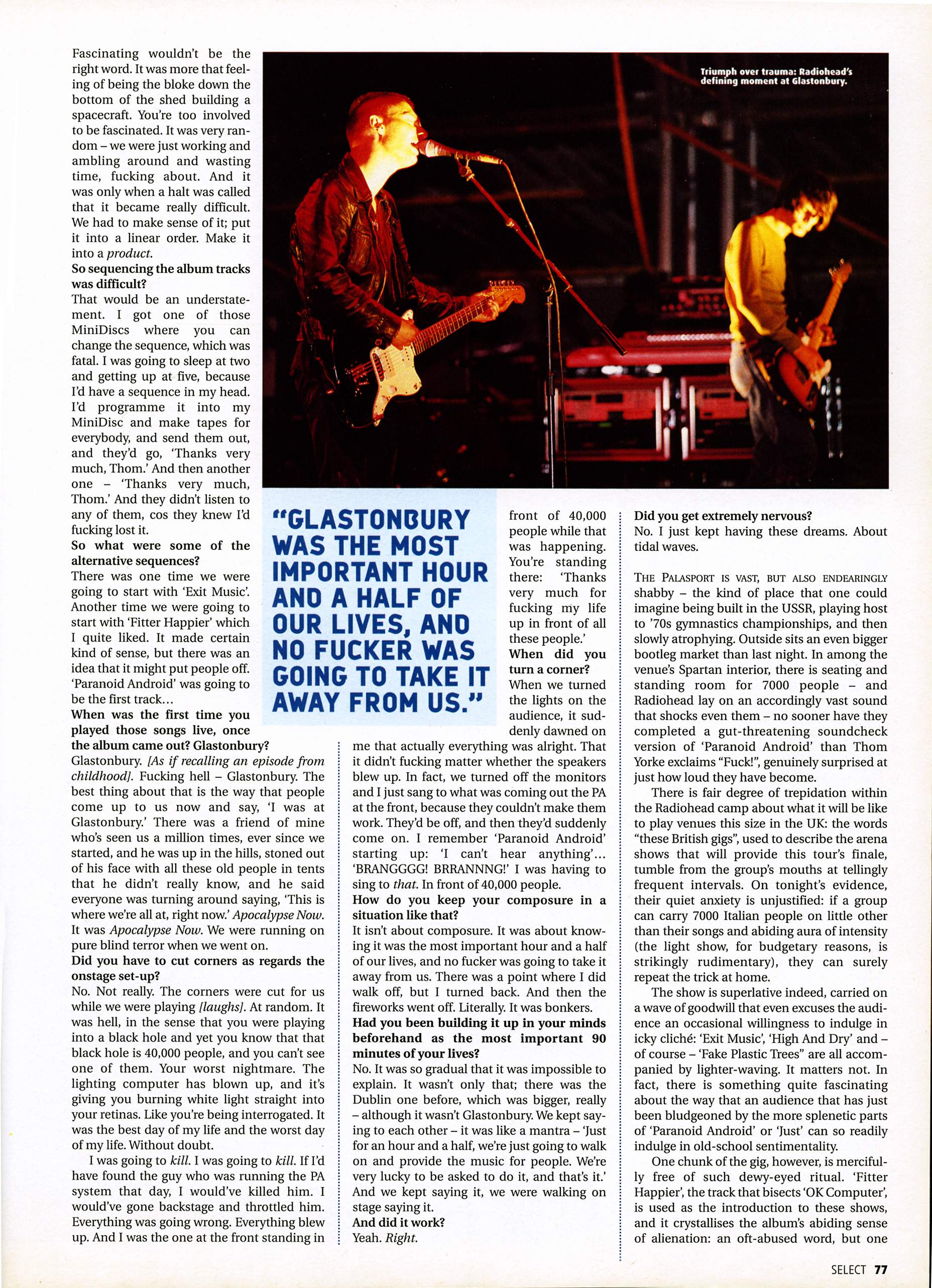
Glastonbury. [As if recalling an episode from childhood]. Fucking hell - Glastonbury. The best thing about that is the way that people come up to us now and say, 'I was at Glastonbury'. There was a friend of mine who's seen is a million times, ever since we started. And he was up in the hills, stoned out of his face with all these old people in tents that he didn't really know, and he said everyone was turning around saying, 'This is where we're all at, right now.' Apocalypse Now. It was Apocalypse Now. We were running on pure blind terror when we went on.
Did you have to cut corners as regards the onstage set-up?
No. Not really. The corners were cut for us while we were playing [laughs]. At random. It was hell, in the sense that you were playing into a black hole and yet you know that that black hole is 40,000 people, and you can't see one of them. Your worst nightmare. The lighting computer has blown up, and it's giving you burning white light strain into your retinas. Like you're being interrogated. It was the best day of my life and the worst day of my life. Without doubt.
I was going to kill. I was going to kill. If I'd found the guy who was running the PA system that day, I would've gone backstage and throttled him. Everything was going wrong. Everything blew up. And I was the one at the front standing in front of 40,000 people while that was happening. You're standing there: 'Thanks very much for fucking my life up in front of all these people.'
When did you turn a corner?
When we turned the lights on the audience, it was suddenly dawned on me that actually everything was alright. That it didn't fucking matter whether the speakers blew up. In fact, we turned off the monitors and I just sang to what was coming out of the PA at the front, because they couldn't make them work. They'd be off, and they'd suddenly come on. I remember 'Paranoid Android' starting up: 'I can't hear anything'... 'BRANGGGG! BRRANNNG!' I have having to sing to that. In front of 40,000 people.
How do you keep your composure in a situation like that?
It isn't about composure. It was about knowing it was the most important hour and a half of our lives, and no fucker was going to take it away from us. There was a point where I did walk off, but I turned back. And then the fireworks went off. Literally. It was bonkers.
Had you been building it up in your minds beforehand as the most important 90 minutes of your lives?
No. It was so gradual that it was impossible to explain. It wasn't only that; there was the Dublin one before, which was bigger, really - although it wasn't Glastonbury. We kept saying to each other - it was like a mantra - 'Just for an hour an a half, we're just going to walk on and provide the music for people. We're very lucky to be asked to do it, and that's it.' And we kept saying it, we were walking on stage saying it.
And did it work?
Yeah. Right.
Did you get extremely nervous?
No. I just kept having these dreams. About tidal waves.
THE PALASPORT IS VAST, BUT ALSO ENDEARINGLY shabby - the kind of place that one could imagine being built in the USSR, playing host to '70s gymnastics championships, and then slowly atrophying. Outisde sits and even bigger bootleg market than last night. In among the venue's Spartan interior, there is seating and standing room for 7000 people - and Radiohead lay on an accordingly vast sound that shocks even them - no sooner have they completed a gut-threatening soundcheck version of 'Paranoid Android' than Thom Yorke exclaims "Fuck!", genuinely surprised at just how loud they have become.
There is fair degree of trepedition within the Radiohead camp about what it will be like to play venues this size in the UK: the words "these British gigs", used to describe the arena shows that will provide this tour's finale, tumble from the group's mouths at tellingly frequent intervals. On tonight's evidence, their quiet anxiety is unjustified: if a group can carry 7000 Italian people on little other than their songs and abiding aura of intensity (the light show, for budgetary reasons, is strikingly rudimentary), they can surely repeat the trick at home.
The show is superlative indeed, carried on a wave of goodwill that even excuses the audience an occasional willingness to indulge in icky cliché: 'Exit Music', 'High And Dry' and - of course - 'Fake Plastic Trees' are all accompanied by lighter-waving. It matters not. In fact, there is something quite fascinating about the way that an audience that has just been bludgeoned by the more splenetic parts of 'Paranoid Android' or 'Just' can so readily indulge in old-school sentimentality.
One chunk of the gig, however, is mercifully free of such dewy-eyed ritual. 'Fitter Happier', the track that bisects 'OK Computer', is used as the introduction to these shows, and it crystallises the album's abiding sense of alienation: an oft-abused word, but one that tends to characterise Thom Yorke's words to perfection.
One dictionary definition of the latter word is 'a sense of estrangement from organised society' - surely the feeling you get listening to that computer-generated voice outline the components of the ideal pre-millennial existance. "Comfortable...Not drinking too much...Regular excercise at the gym, three days a week...Getting on better with your associate employee contemporaries...At ease...Eating well...."
The bus. Two hours after Radiohead have left the stage. The interview's final 20 minutes.
When you were explaining some of the things you were singing about on 'OK Computer', you talked about surveying the headlines and feeling wildly impotent, and a deep frustration with the political system. Since when we've had a mild cultural evolution...
Do you mean the Labour Party? [loud mocking laughter] For three hours when the Labour Party got in, people were nice to each other. That was it. It's been bullshit ever since. I didn't watch it happening. It was so obvious they were going to win. I won't be going to 10 Downing Street, put it that way.
What was far more important was the Princess Di thing. That was when the people got to see the people. People got to see themselves grieving. This woman had died in a car accident, and she was quite famous, but that's not really what was going on, I don't think.
It didn't really affect me at all - people die in car accidents every day. She just happens to be famous and unfortunate. But what was shocking was seeing all those people lined up along the motorway, and people in the Hyde Park crying their eyes out.
A lot of people couldn't figure out what all those crowds were really doing there...
Neither could they. That's what i mean. I don't think all those people turned up for her - I don't think there's enough royalists left. It was actually an anti-royal event, let's fucking face it. Anti-royal and anti-media. That was far more of a revolution than fucking Labour getting in.
But could you survey all those people and say they were making a coherent statement?
Well, that was the sad thing. It can't be a coherent statement because it was mediated through the media. It was coherent for a brief moment when everybody got to see themselves on telly and freaked out, and started crying over this tragic death. And yes, it was a tragic death, but there was loads more going on than that. It was us realising that the royals had had us by the balls for the last hundred years, as had the media and the state. That's what i think.
But the upshot of it all...
Fuck all. Naturally. We're british.
The artwork on the LP and some of the T-shirts on sale - they seem, to have quite a coherent set of concerns, ones that stem from 'Fitter Happier'. Was that an accident?
We actively chose to pursue the 'Fitter Happier' thing. The one that says 'Meeting People Is Easy', I like a lot. In that picture [the only bit of artwork reproduced on the CD itself], one guy's got a briefcase, one guy hasn't. Someone's being sold something they don't really want, and someone's being friendly because they're trying to sell something. That's what it means to me. It's quite sad, and quite funny as well. There's also the thing of Radiohead saying 'Meeting People Is Easy' when we're not known for our social skills [laughs].
It often seems that you're puzzling over a society in which people need outside advice about very primal things - how to remain healthy, how to interact with each other...
All the artwork and so on...we chose to pursue it after we did the track. More relevant is the reason I wrote the words in the first place. [pause] these were things I was being told to do. I showed it to the others and they liked it, and then Stanley - who does the artwork - was playing around on the computer and made it say it.
After that, it went from being a list of things that had a lot of emotional meaning for me and that was it, to coming to life. In fact, it was all the things that I hadn't said in the songs. Stanley was really just pushing into it, and I was as well in the end. It was like, 'I'm not going to hide this thing that I wrote, cos i'm really proud of it.'
It really seems to resonate with people. Especially people in their mid 20s...
It does. I read an interview with Damon when he was talking about a late-20s crisis. I'm like, 'Yeah, fucking right man - fuck this mid-life crisis, I'm having one now.'
In the margin of Douglas Coupland's Generation X there's a defenition of a mid-20s breakdown: 'A period of mental collapse that occurs in one's 20s. Often results from an inability to function outside organised environments, ie school. Marks induction into the ritual of pharmaceutical usage.'
[Big laugh] That kind of language was stuff that me and Stanley were playing around a lot with. But we couldn't make it fit anywhere. The track is the culmination of a lot of work, in a really random way.
The drawings on the sleeves of 'OK Computer' and 'The Bends' and some of the artwork you've done elsewhere (eg Thom's War Christmas Card) are very childlike...
It's because I can't draw [laughs]. They told me I couldn't draw at art college - at least I'm honest about it. My whole argument at art college was, 'What's the fucking point in painting or drawing this thing in this way when I can go and buy a camera for two quid and do it like that? Why should I bother drawing it?' I could never quite work out how I blagged my way into art college anyway.
[Regaining thread] But with the sleeve for 'OK Computer', we were both obsessed by the idea of noise, as we were when we were doing the music. But not just noise - background noise. Everything is background noise. Our whole lives, the way our minds work. And the whole album is about that - levels of mental chatter.
Hence the reference in 'Paranoid Android' to "All the unborn chiken voices in my head"?
Yeah. And the reason 'Fitter Happier' exists is cos of mental background noise. Some days you're in a disturbed state and it moves to the front.
And it's about what the mental chatter is, or suggested remedies for it...
All those things at once. It's not all suggestions, a lot of its observations. 'A pig in a cage on antibiotics' was just a really shocking passage I found in a book. It's by Jonathan Coe and it's called 'What A Carve Up' [published by Penguin]. It's a really funny book, but a lot of it's based on the way... farming has changed [laughs]. The way that insensitive farming happened. One of the characters in the book is this screaming, right-winged farmer with a brother who's an MP lobbying for the relaxation of restrictions on farming.
Anyway, the artwork is bound up with the idea of noise... every page of the artwork is stuff being painted out. Layers and layers of books and whatever we had hanging around, pasted on and on, and then rubbed away. But in rubbing it away you don't quite get rid of it.
...WHICH MAY, OF COURSE, PROVIDE THE KEY TO WHY Thom Yorke's muse is unlikely to desert him, and crowds in Florence, Modena, Manchester, London, Bogota and Reykjavik are likely to honour him with their patronage until he finally decides to call time on his career.
With white noise, unborn chikens, and the lingering traces of 'Life In A Glass House' still floating around the mental etherm Select gets off the bus, stepping back out into the brisk Florentine air.
And yes, we close the door. Very firmly.