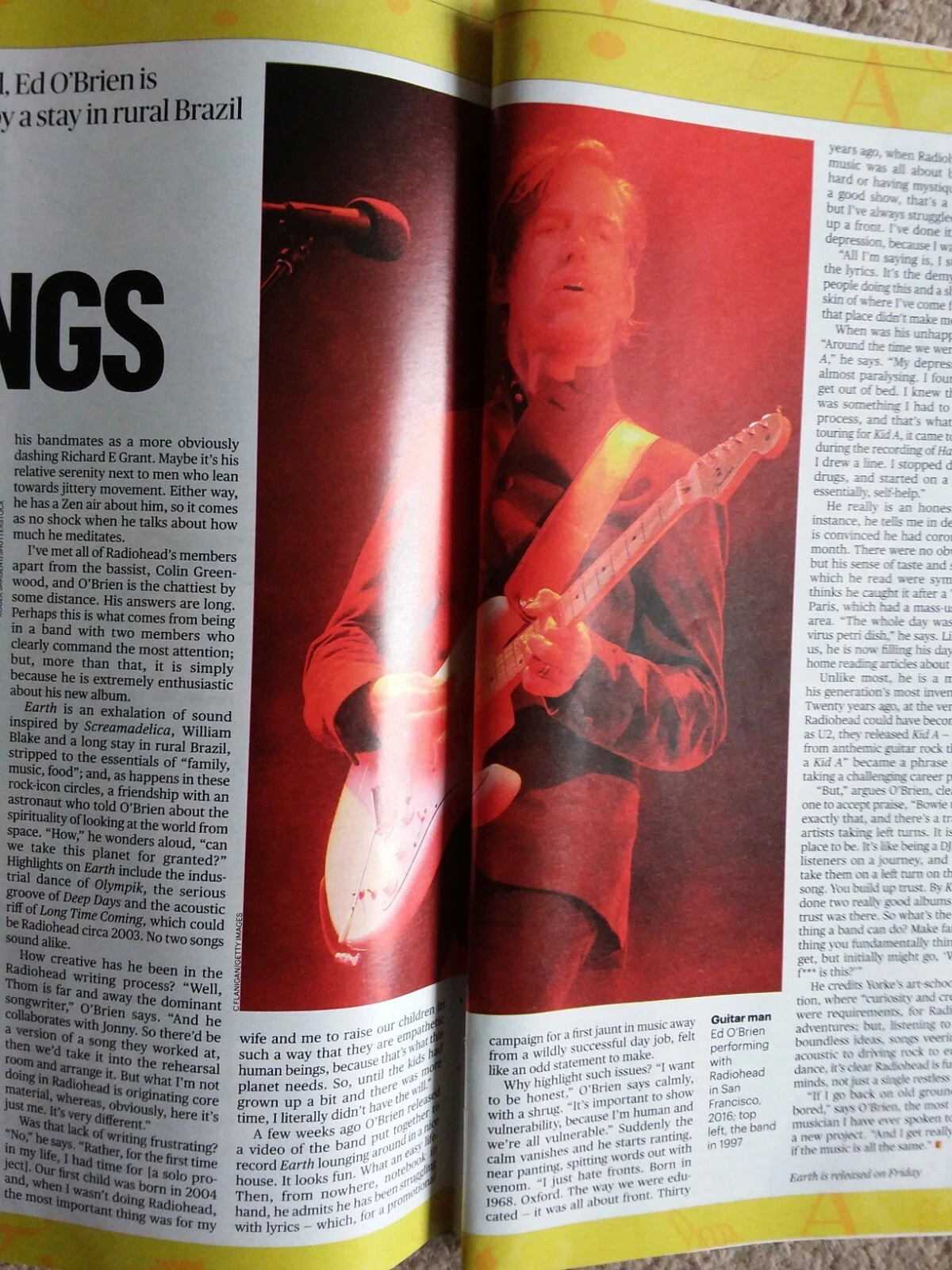
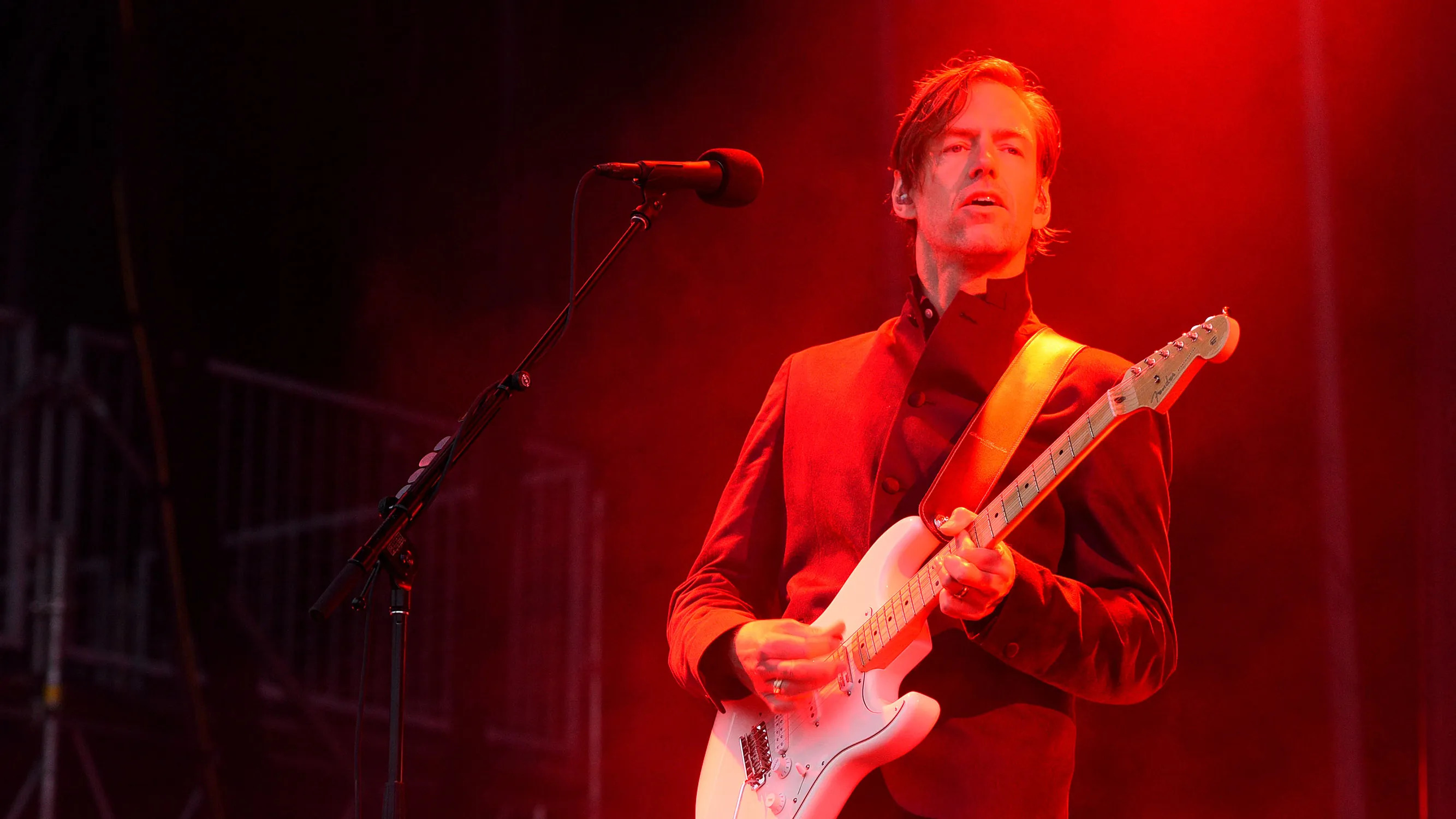
For much of his professional life, Ed O’Brien has stood to the right of Thom Yorke, on stage with Radiohead. Whether in the early days, when O’Brien played guitar, or the experimental era, when it was guitar and various buttons, there he stood, with singer Yorke and multi-instrumentalist Jonny Greenwood, in order at the front, rhythm section behind — a tight unit of five schoolfriends who, 35 years ago, formed what would become the most interesting band in the world.
This month O’Brien is releasing his first solo album, Earth, under the acronym/alias EOB. In Toronto, just before gigs became a bad idea, he played his first live show as a frontman. He is a football fan, so I ask: did it feel like being a defender used to a flat back four who is moved into a back three and suddenly feels positionally disorientated?
“No,” he says, grinning over Skype from his remote home in Wales, where he spends time when not in London, and where he is isolating with his wife and two teenage children. “The analogy is, I have been playing in a Premier League team for 30 years, so now it’s time to be a player- manager and go down two leagues. I’m trying to build up.”
Was he nervous at the Toronto show? “I had a lot of self-doubt,” he says, leaning back on a sofa in front of the stacked bookshelf you’d expect from a member of a cerebral rock group. “But even in Radiohead, the first shows of a tour are always weird. In 1992 we did 120-odd gigs, but it took until the end of 1993 for everything to click. It’s like a muscle. You get better at it. So there is always initial discomfort, but this was exponential, because I was singing.”
“Over the years,” he continues, “standards in Radiohead got higher, so what I expect to be able to do is more. There’s a threshold to reach and so, for me, the uncomfortable bit was, yes, the vocals and frontman thing. But I want to experience this fully, even if I’m scared out of my head. And I was nervous as hell.”
O’Brien’s role in Radiohead seemed, to outsiders, like the anchor. Maybe it’s his height — at 6ft 4in, he towers above his bandmates as a more obviously dashing Richard E Grant. Maybe it’s his relative serenity next to men who lean towards jittery movement. Either way, he has a Zen air about him, so it comes as no shock when he talks about how much he meditates.
I’ve met all of Radiohead’s members apart from the bassist, Colin Greenwood, and O’Brien is the chattiest by some distance. His answers are long. Perhaps this is what comes from being in a band with two members who clearly command the most attention; but, more than that, it is simply because he is extremely enthusiastic about his new album.
Earth is an exhalation of sound inspired by Screamadelica, William Blake and a long stay in rural Brazil, stripped to the essentials of “family, music, food”; and, as happens in these rock-icon circles, a friendship with an astronaut who told O’Brien about the spirituality of looking at the world from space. “How,” he wonders aloud, “can we take this planet for granted?” Highlights on Earth include the industrial dance of Olympik, the serious groove of Deep Days and the acoustic riff of Long Time Coming, which could be Radiohead circa 2003. No two songs sound alike.
How creative has he been in the Radiohead writing process? “Well, Thom is far and away the dominant songwriter,” O’Brien says. “And he collaborates with Jonny. So there’d be a version of a song they worked at, then we’d take it into the rehearsal room and arrange it. But what I’m not doing in Radiohead is originating core material, whereas, obviously, here it’s just me. It’s very different.”
Was that lack of writing frustrating? “No,” he says. “Rather, for the first time in my life, I had time for [a solo project]. Our first child was born in 2004 and, when I wasn’t doing Radiohead, the most important thing was for my wife and me to raise our children in such a way that they are empathetic human beings, because that’s what this planet needs. So, until the kids had grown up a bit and there was more time, I literally didn’t have the will.”
A few weeks ago O’Brien released a video of the band put together to record Earth lounging around in a nice house. It looks fun. What an easy life. Then, from nowhere, notebook in hand, he admits he has been struggling with lyrics — which, for a promotional campaign for a first jaunt in music away from a wildly successful day job, felt like an odd statement to make.
Why highlight such issues? “I want to be honest,” O’Brien says calmly, with a shrug. “It’s important to show vulnerability, because I’m human and we’re all vulnerable.” Suddenly the calm vanishes and he starts ranting, near panting, spitting words out with venom. “I just hate fronts. Born in 1968. Oxford. The way we were educated — it was all about front. Thirty years ago, when Radiohead emerged, music was all about bands looking hard or having mystique. Putting on a good show, that’s a British thing, but I’ve always struggled with putting up a front. I’ve done it, but it led to depression, because I wasn’t myself.
“All I’m saying is, I struggled with the lyrics. It’s the demystification of people doing this and a shedding of the skin of where I’ve come from. Because that place didn’t make me happy.”
When was his unhappiness worst? “Around the time we were making Kid A,” he says. “My depression became almost paralysing. I found it hard to get out of bed. I knew that darkness was something I had to go into and process, and that’s what I did. After touring for Kid A, it came to a head, and during the recording of Hail to the Thief I drew a line. I stopped drinking and drugs, and started on a journey of, essentially, self-help.”
He really is an honest man. For instance, he tells me in detail why he is convinced he had coronavirus last month. There were no obvious signs, but his sense of taste and smell went, which he read were symptoms. He thinks he caught it after a TV show in Paris, which had a mass-use catering area. “The whole day was a corona-virus petri dish,” he says. Like many of us, he is now filling his days sitting at home reading articles about virologists.
Unlike most, he is a member of his generation’s most inventive band. Twenty years ago, at the very moment Radiohead could have become as huge as U2, they released Kid A — such a jolt from anthemic guitar rock that “doing a Kid A” became a phrase for bands taking a challenging career path.
“But,” argues O’Brien, clearly never one to accept praise, “Bowie used to do exactly that, and there’s a tradition of artists taking left turns. It is the best place to be. It’s like being a DJ. You take listeners on a journey, and wouldn’t take them on a left turn on the second song. You build up trust. By Kid A we’d done two really good albums, and the trust was there. So what’s the ultimate thing a band can do? Make fans something you fundamentally think they’ll get, but initially might go, ‘What the f*** is this?’”
He credits Yorke’s art-school education, where “curiosity and creativity” were requirements, for Radiohead’s adventures; but, listening to Earth’s boundless ideas, songs veering from acoustic to driving rock to euphoric dance, it’s clear Radiohead is full of like minds, not just a single restless one.
“If I go back on old ground, I get bored,” says O’Brien, the most excited musician I have ever spoken to about a new project. “And I get really bored if the music is all the same.”
Earth is released on Friday