


21st Century Fix
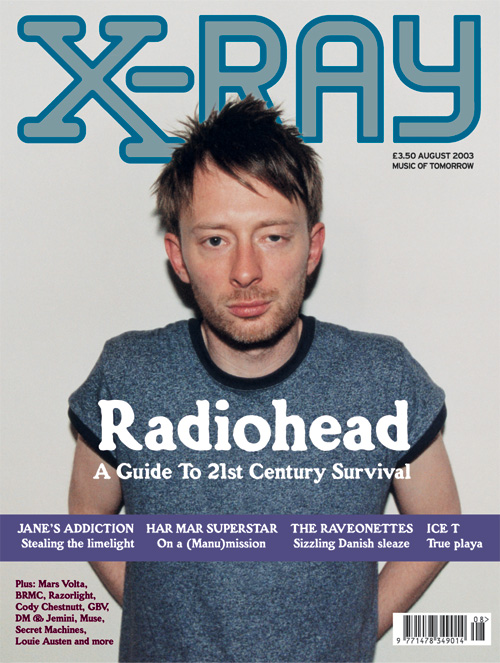
Radiohead appear to have lightened up. Yet, although happier in themselves, they're still very aware of global threats. We investigate their world view and get some tips for survival.
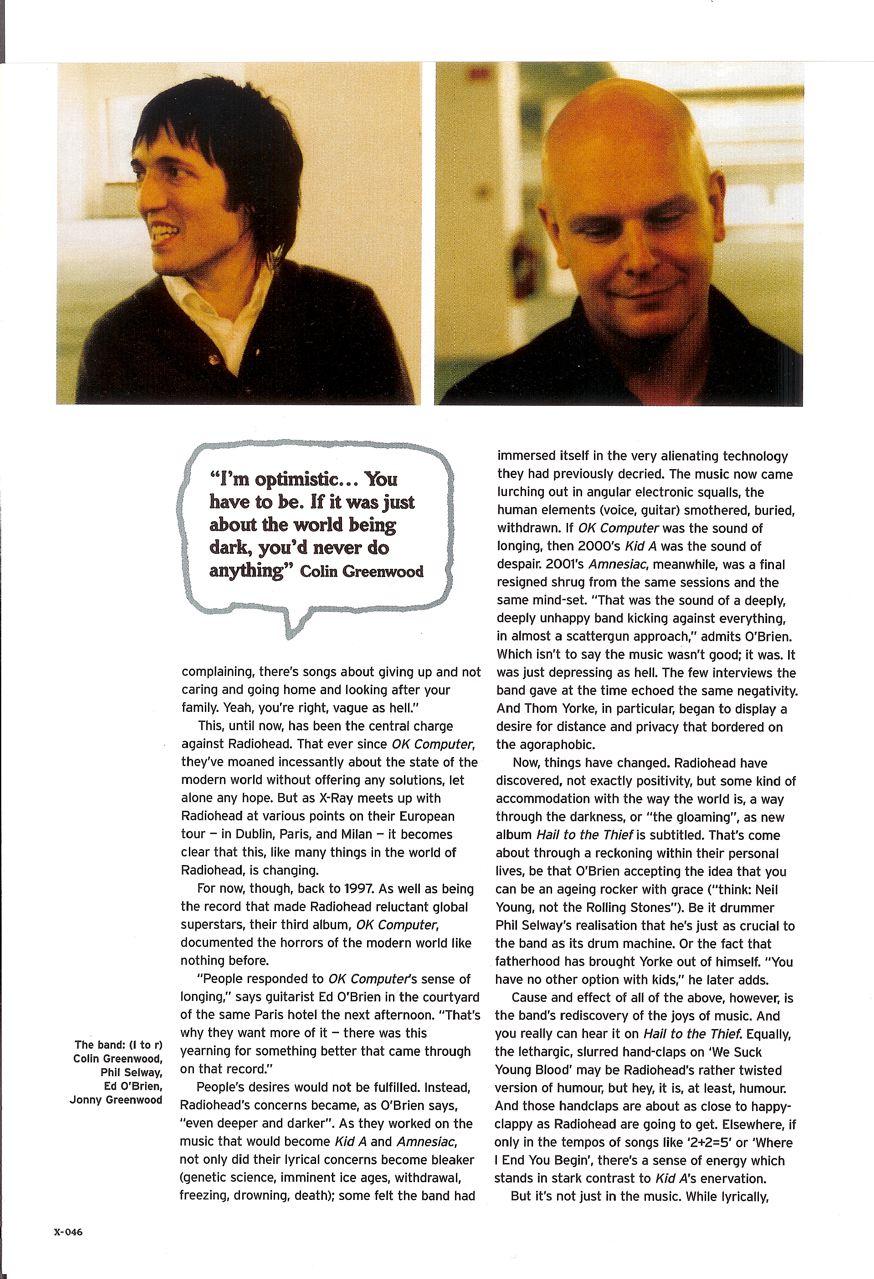
"OUR REACTION to the modern world has been vague," admits Jonny Greenwood, guitarist for these chroniclers of the ills of the modern world. "The sense that something's wrong, that there's a threat. Our reaction is as confused and contradictory as anyone else's. But it'd be awful if a record was 15 minutes of extremely well-researched, dogmatic ranting about the state we're in and what to do about it." It's midnight in the courtyard of a plush Paris hotel, and flickering candles illuminate the city's chic, beautiful and affluent around us. Grabbing a late supper, Greenwood stops to think, fork poised, never one to rush his thoughts. "And for every song complaining, there's songs about giving up and not caring and going home and looking after your family. Yeah, you're right, vague as hell."
This, until now, has been the central charge against Radiohead. That ever since OK Computer, they've moaned incessantly about the state of the modern world without offering any solutions, let alone any hope. But as X-Ray meets up with Radiohead at various points on their European tour – in Dublin, Paris, and Milan – it becomes clear that this, like many things in the world of Radiohead, is changing.
For now, though, back to 1997. As well as being the record that made Radiohead reluctant global superstars, their third album, OK Computer, documented the horrors of the modern world like nothing before.
"People responded to OK Computer's sense of longing," says guitarist Ed O'Brien in the courtyard of the same Paris hotel the next afternoon. "That's why they want more of it – there was this yearning for something better that came through on that record."
People's desires would not be fulfilled. Instead, Radiohead's concerns became, as O'Brien says, "even deeper and darker". As they worked on the music that would become Kid A and Amnesiac, not only did their lyrical concerns become bleaker (genetic science, imminent ice ages, withdrawal, freezing, drowning, death); some felt the band had immersed itself in the very alienating technology they had previously decried. The music now came lurching out in angular electronic squalls, the human elements (voice, guitar) smothered, buried, withdrawn. If OK Computer was the sound of longing, then 2000's Kid A was the sound of despair. 2001's Amnesiac, meanwhile, was a final resigned shrug from the same sessions and the same mind-set. "That was the sound of a deeply, deeply unhappy band kicking against everything, in almost a scattergun approach," admits O'Brien. Which isn't to say the music wasn't good; it was. It was just depressing as hell. The few interviews the band gave at the time echoed the same negativity. And Thom Yorke, in particular, began to display a desire for distance and privacy that bordered on the agoraphobic.
Now, things have changed. Radiohead have discovered, not exactly positivity, but some kind of accommodation with the way the world is, a way through the darkness, or "the gloaming", as new album Hail to the Thief is subtitled. That's come about through a reckoning within their personal lives, be that O'Brien accepting the idea that you can be an ageing rocker with grace ("think: Neil Young, not the Rolling Stones"). Be it drummer Phil Selway's realisation that he's just as crucial to the band as its drum machine. Or the fact that fatherhood has brought Yorke out of himself. "You have no other option with kids," he later adds.
Cause and effect of all of the above, however, is the band's rediscovery of the joys of music. And you really can hear it on Hail to the Thief. Equally, the lethargic, slurred hand-claps on ‘We Suck Young Blood' may be Radiohead's rather twisted version of humour, but hey, it is, at least, humour. And those handclaps are about as close to happy-clappy as Radiohead are going to get. Elsewhere, if only in the tempos of songs like ‘2+2=5' or ‘Where I End and You Begin', there's a sense of energy which stands in stark contrast to Kid A's enervation.
But it's not just in the music. While lyrically, …Thief may still be far from a walk in the park with its gloaming and its wolves at the door, there is now less distance from, and more engagement with, the world. Songs like ‘I Will' and ‘A Wolf at the Door' express anger, yes, but it's a desire to act, not to turn in and away.
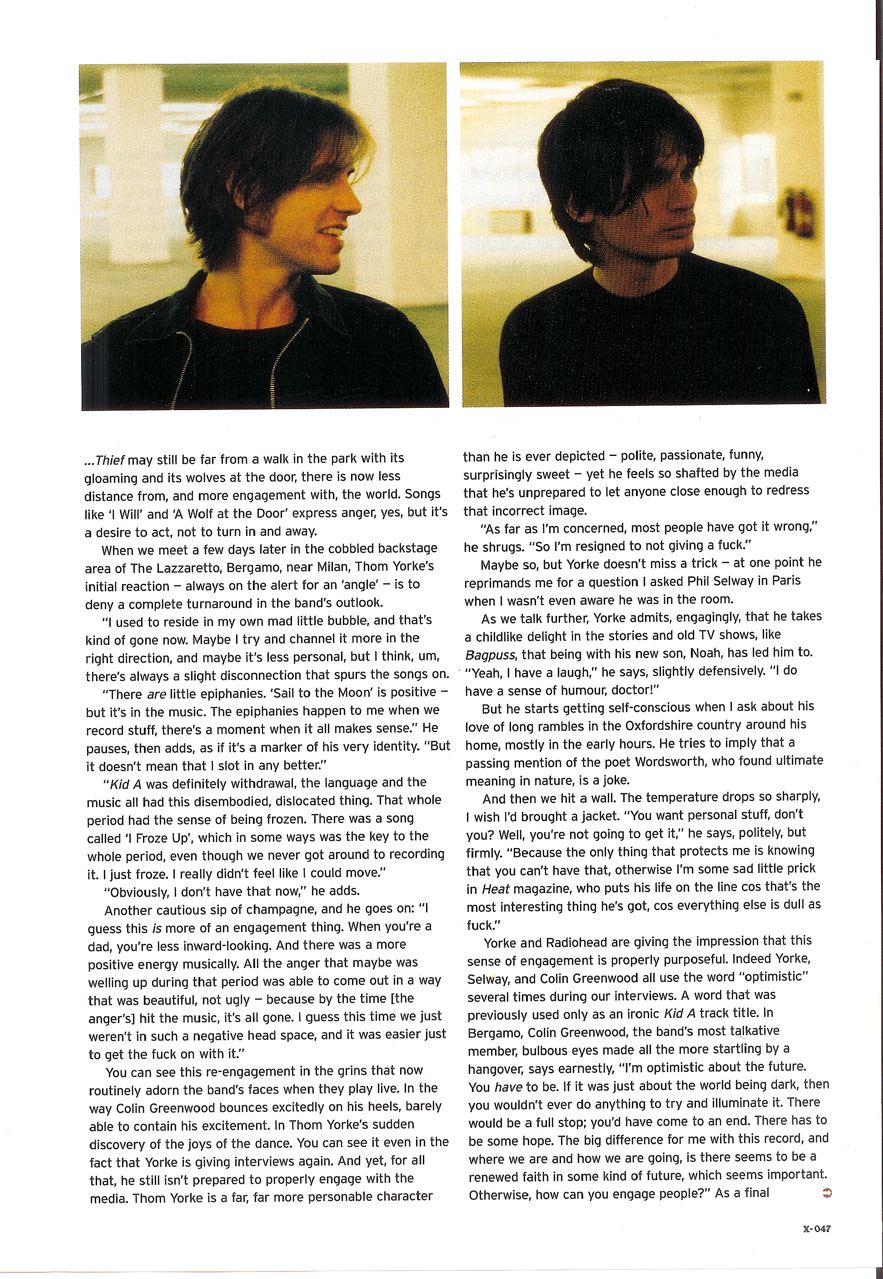
When we meet a few days later in the cobbled backstage area of The Lazzaretto, Bergamo, near Milan, Thom Yorke's initial reaction – always on the alert for an ‘angle' – is to deny a complete turnaround in the band's outlook.
"I used to reside in my own mad little bubble, and that's kind of gone now. Maybe I try and channel it more in the right direction, and maybe it's less personal, but I think, um, there's always a slight disconnection that spurs the songs on.
"There are little epiphanies. ‘Sail to the Moon' is positive – but it's in the music. The epiphanies happen to me when we record stuff, there's a moment when it all makes sense." He pauses, then adds, as if it's a marker of his very identity. "But it doesn't mean that I slot in any better."
"Kid A was definitely withdrawal, the language and the music all had this disembodied, dislocated thing. That whole period had a sense of being frozen. There was a song called ‘I Froze Up', which in some ways was the key to the whole period, even though we never got around to recording it. I just froze. I really didn't feel like I could move."
"Obviously, I don't have that now," he adds.
Another cautious sip of champagne, and he goes on: "I guess this is more of an engagement thing. When you're a dad, you're less inward-looking. And there was a more positive energy musically. All the anger that maybe was welling up during that period was able to come out in a way that was beautiful, not ugly – because by the time [the anger's] hit the music, it's all gone. I guess this time we just weren't in such a negative head space, and it was easier just to get the fuck on with it."
You see this re-engagement in the grins that now routinely adorn the band's faces when they play live. In the way Colin Greenwood bounces excitedly on his heels, barely able to contain his excitement. In Thom Yorke's sudden discovery of the joys of the dance. You can see it even in the fact that Yorke is giving interviews again. And yet, for all that, he still isn't prepared to properly engage with the media. Thom Yorke is a far, far more personable character than he is ever depicted – polite, passionate, funny, surprisingly sweet – yet he feels so shafted by the media that he's unprepared to let anyone close enough to redress that incorrect image.
"As far as I'm concerned, most people have got it wrong," he shrugs. "So I'm resigned to not giving a fuck."
Maybe so, but Yorke doesn't miss a trick – at one point he reprimands me for a question I asked Phil Selway in Paris when I wasn't even aware he was in the room.
As we talk further, Yorke admits, engagingly, that he takes childlike delight in the stories and old TV shows, like Bagpuss, that being with his new son, Noah, has led him to. "Yeah, I have a laugh," he says, slightly defensively. "I do have a sense of humour, doctor!"
But he starts getting self-conscious when I ask about his love of long rambles in the Oxfordshire country around his home, mostly in the early hours. He tries to imply that a passing mention of the poet Wordsworth, who found ultimate meaning in nature, is a joke. And then we hit a wall. The temperature drops so sharply, I wish I'd brought a jacket. "You want personal stuff, don't you? Well, you're not going to get it," he says, politely, but firmly. "Because the only thing that protects me is knowing that you can't have that, otherwise I'm some sad little prick in Heat magazine, who puts his life on the line cos that's the most interesting thing he's got, cos everything else is dull as fuck."
Yorke and Radiohead are giving the impression that this sense of engagement is properly purposeful. Indeed Yorke, Selway, and Colin Greenwood all use the word "optimistic" several times during our interviews. A word that was previously used only as an ironic Kid A track title. In Bergamo, Colin Greenwood, the band's most talkative member, bulbous eyes made all the more startling by a hangover, says earnestly, "I'm optimistic about the future. You have to be. If it was just about the world being dark, then you wouldn't ever do anything to try and illuminate it. There would be a full stop; you'd have to come to an end. There has to be some hope. The big difference for me with this record, and where we are and how we are going, is there seems to be a renewed faith in some kind of future, which seems important. Otherwise, how can you engage people?" As a final reminder that there are five thinkers in Radiohead, he comes up with this image: "As you get older, you have to let go – it's like falling backwards and thinking you'll be caught."
So, contrary to what Greenwood's brother Jonny says in Paris, Radiohead are getting much less vague about what to do about the modern world. They are, musically, politically, even personally, one of the few rock bands who seem to be actually thinking about the future, moving beyond the immediate here and now, uninterested in revisitation or retro. And so, compiled and deduced from our time with them, here is Radiohead's guide to surviving the 21st century.
THE WORLD WILL CHANGE FOR THE BETTER
Or in Radiohead language, "are you such a dreamer, to put the world to rights?" Answer: a definite "yes." Says Yorke: "I'm really optimistic at the moment. People are like ‘fuck this' – we aren't benefiting from this. The Iraq war was the first example of proper public resistance. Not like waving red flags around in the 80s, it was just like, ‘we don't want this to happen'. Then you've got the rise of Union resistance to Labour. And in countries like Argentina, people are taking to the streets. It's a very dangerous time for those in authority, because the basis for western democracy was the trickle down theory, and the game's kind of up.
"I'm not anti-capitalist. It's not like, fucking smash the whole system, that's just the media's way of dismissing these movements as left wing loonies and as naïve. It's about accountability within the existing system. And I think we can do a number of things. I think we can get the IMF disbanded, and the World Bank too. We can get the World Trade Organisation to make trade fairer. All these are achievable."
FORM COALITIONS
Radiohead are big on coalitions right now. The band, since the role-reassessments of Kid A, being an obvious example – even people not playing on a track contribute to it, and feel they have emerged the stronger for it. Colin Greenwood: "Back in the 70s and 80s, all there was were unifying theories, like communism, that were just inhuman and didn't work. You never used to hear the word ‘coalition'. The left could never work together on anything. Rather than having a huge vision of how things ought to be, now we're reacting to how things are and trying to change them." Showing quite how far Radiohead have moved since the withdrawal of the Kid A period, Jonny Greenwood adds: "The Greek word of the word ‘politics' is the art of living with other people. In ancient Greek civil society, you were only defined as a human being by the relationship you had with the other people around you, and if you lived in isolation, you were considered not human. "
MAKE THE MACHINES WORK FOR YOU
"You need to take computers back from the software programmers," says Jonny Greenwood, excitably. "I've gone back to making my own programmes, and I feel free again. It's like computers have been given back to me. Since the 80s, there's been this barrier in the way, and we're not talking to computers any more. For me, that's the future, using computers in a much more raw way, not using anybody else's idea of how something should work or sound. All these things, like Cubase and Logic and Photoshop –- things that supposedly free you up – you feel like you're on tramlines, and being guided to do certain things. So it all comes out the same. We didn't use any software on the new album. We wrote it all. That means you can come up with ideas on what sound is and what sound does. Traditionally, bands get to our stage and lose focus, becoming more interested in their collection of sports cars. We're still interested in making new sounds. "
TREAT THE MEDIA WITH CAUTION
Thom Yorke: "It's really tough, but you've got to resist the mainstream media, and the level and the complicity of most of the media. I was watching CNN, and it's spectacular, you may as well just have the voice of the White House. The way, when Alastair Campbell was accused of doctoring the 45 minute thing, he stopped Radio 4 having access to Tony Blair for a week just to rattle ‘em. And during the Iraq war, they made a deal with Murdock, with Sky and The Times and The Sun, they had first access to Blair if they were nice about the war. It was revolting. The whole media goes along with it, cos they're constantly threatened that they won't get access. And if you were opposed to the war, suddenly you were being accused of demoralising our troops. Everything seems to be based on fear and mind control. It requires a lot of effort to keep your brain ticking over, to see it as bullshit."
SHOP FROM YOUR CHAIR
"The internet is gradually coming into step with the needs in your life," says Phil Selway. "For a long time it was all potential and little practicality – like the whole mobile networks thing now. Now it's actually becoming much more part of the scenery. I buy pretty much everything on the internet."
YOU CAN'T EVER GO BACK
Get used to it: Radiohead's methodology is not going to return to that of OK Computer. As Colin Greenwood says, "on Kid A and Amnesiac we were reading the manual – now we've worked out how to do what we wanted to do with the machines. We're comfortable with the tools we use, whether it's a sequencer of a guitar. What Thom wants to hear from us as a group, and himself, is sounds that he's never heard before. And that's exciting. It's like [early 20th Century American author] Thomas Wolfe said: ‘You Can't Go Home Again'."
Jonny Greenwood adds: "People ask me all the time why I don't play more guitar. You get the impression they haven't bought a record since 1993. It's not enough for me to keep making the same record, it's like everyone wanting Steven Coogan to make another Alan Partridge series, and when he does, everyone goes, ‘oh, it isn't very good'! We're still interested in making new sounds. You can always do more."
ESCAPISM ISN'T RESIGNATION
"Tonight we escape; we escape," Yorke once sang on ‘Exit Music (For A Film)'. But ask Yorke about escapism from this miserable, fucked-up world and he laughs with genuine pleasure. "There's definitely a role for something that completely takes you out of yourself," he says. Examples, please? "The best book I've read this year is The Wind-Up Bird Chronicles by Haruki Murakami. It had ‘The Gloaming' in it! [He laughs again] When we were finishing the record, it made me confident about all the darkness and paranoia that's in it. It's about this guy who goes and sits at the bottom of a well and drags the top over, so he's in complete darkness, and after several hours he ceases to be a self, he just becomes numb. It's like people that go to the top of a mountain, and starve themselves, and start seeing things."
And Yorke's favourite film of recent years? Darren Aronofsky's Pi, which he has only recently caught up with. "It had all these mathematics things that had been going round my head all the way through the Kid A thing, and suddenly it was in this film. The idea that there's this code and there's this number and you've just got to find it."
All of this is never truer, of course, than with music. And so the final entry in the Radiohead manual of surviving the 21st Century simply has to be:
BELIEVE IN THE POWER OF MUSIC
This is one area where Radiohead have definitely found the code. As Jonny Greenwood says in Paris, "the twin poles of confrontation and escapism are surely the foundation of most art, of most kinds of expression in the culture, whether it's Wordsworth of the Sex Pistols." Nowadays, Radiohead manage both with ease and grace.
Colin Greenwood goes on: "We have music that people choose to have as part of their emotional lives. A kid going snowboarding in America listening to ‘Bones' really loudly from The Bends. Somebody splitting up with their girlfriend when Amnesiac came out. Like in that George Lucas film American Graffiti, the music is interwoven into the culture." Yorke will say too: "All this ranting I've been doing – I've found that when I'm playing music I can channel all this frustration into it, because that's the best place for it. It's escapism, because everything that's wonky and isn't right, is right when we're playing."
If you need any proof of this, it's provided by the show in the Lazzaretto, in Bergamo. Its eighth century arches and cloisters surround a huge classical courtyard, where the sick used to be healed during that century's pestilences. Tonight's crowd may be a tanned and healthy 4000 strong group of young Italians in front of a modern metal stage, but there's still a sense of communal healing at work tonight.
The Alps sit majestically behind the stage, the sky is purple and the moon orange – as if nature is on Radiohead's side. Wordsworth would have loved it. And the band are on absolutely blinding form. There's Thom's increasingly irresistible geeky dancing; there's the energy in the new songs, and the now patented grins.
But most strikingly of all, there's a wave of almost overwhelming emotion. People brush tears away during ‘Fake Plastic Trees' (the only time the lighters come out). They greet ‘Exit Music (For a Film)' with breathless silence. They sing the "rain down" coda of ‘Paranoid Android' with the faith and dedication of Gregorian monks, and, unlike English audiences, even manage to sing in tune. It's a genuinely moving, communal experience.
This crowd understand that Radiohead are a band who are looking forward instead of backwards. Who have no interest in going back to what they or anybody else once was. Who are utterly committed to the scary and uncertain, but ultimately, unavoidable future.
Hail to the Thief is out on Parlophone
Interviews, competitions, videos and more at xfm.co.uk/radiohead