How To Reinvent Completely
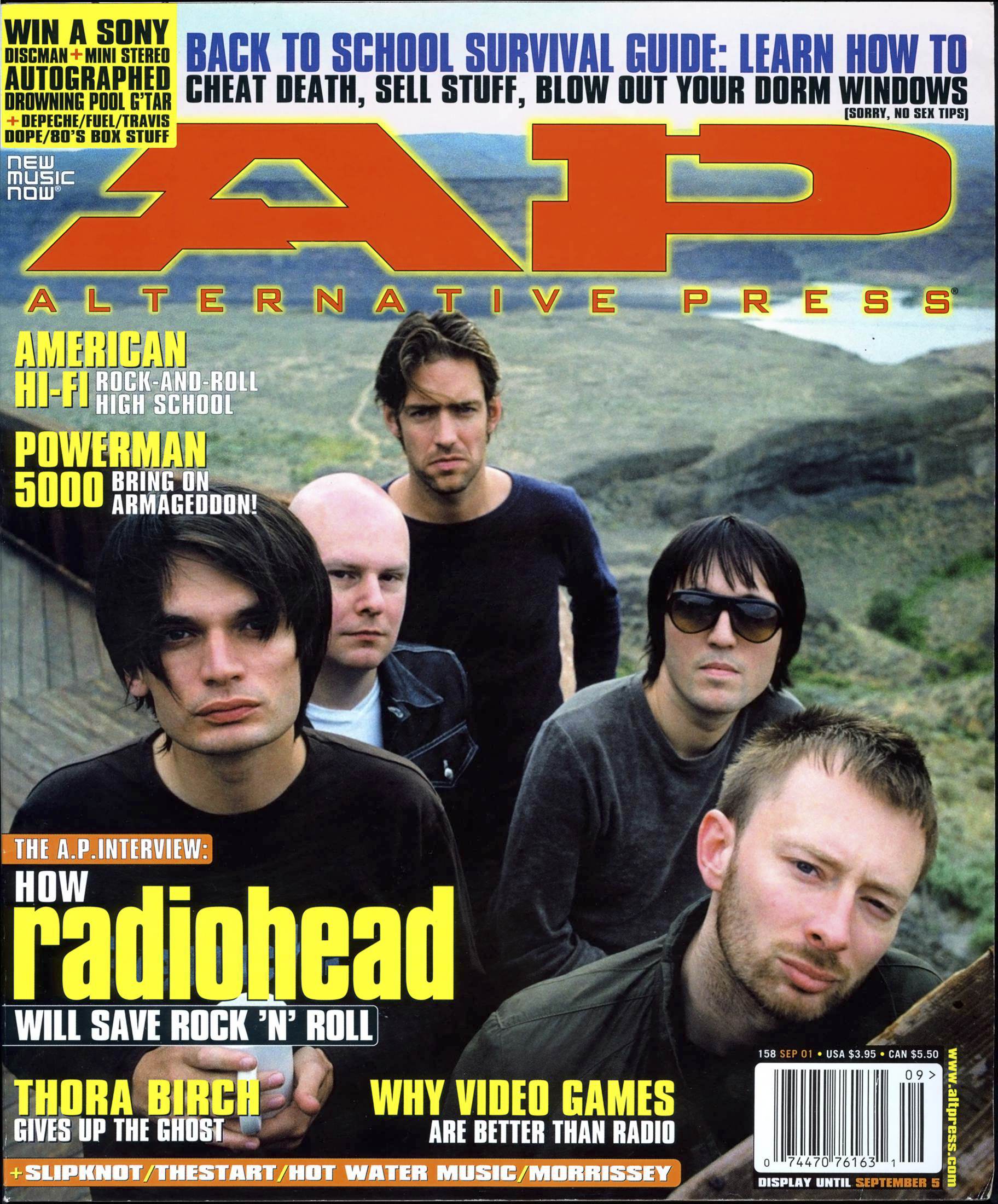
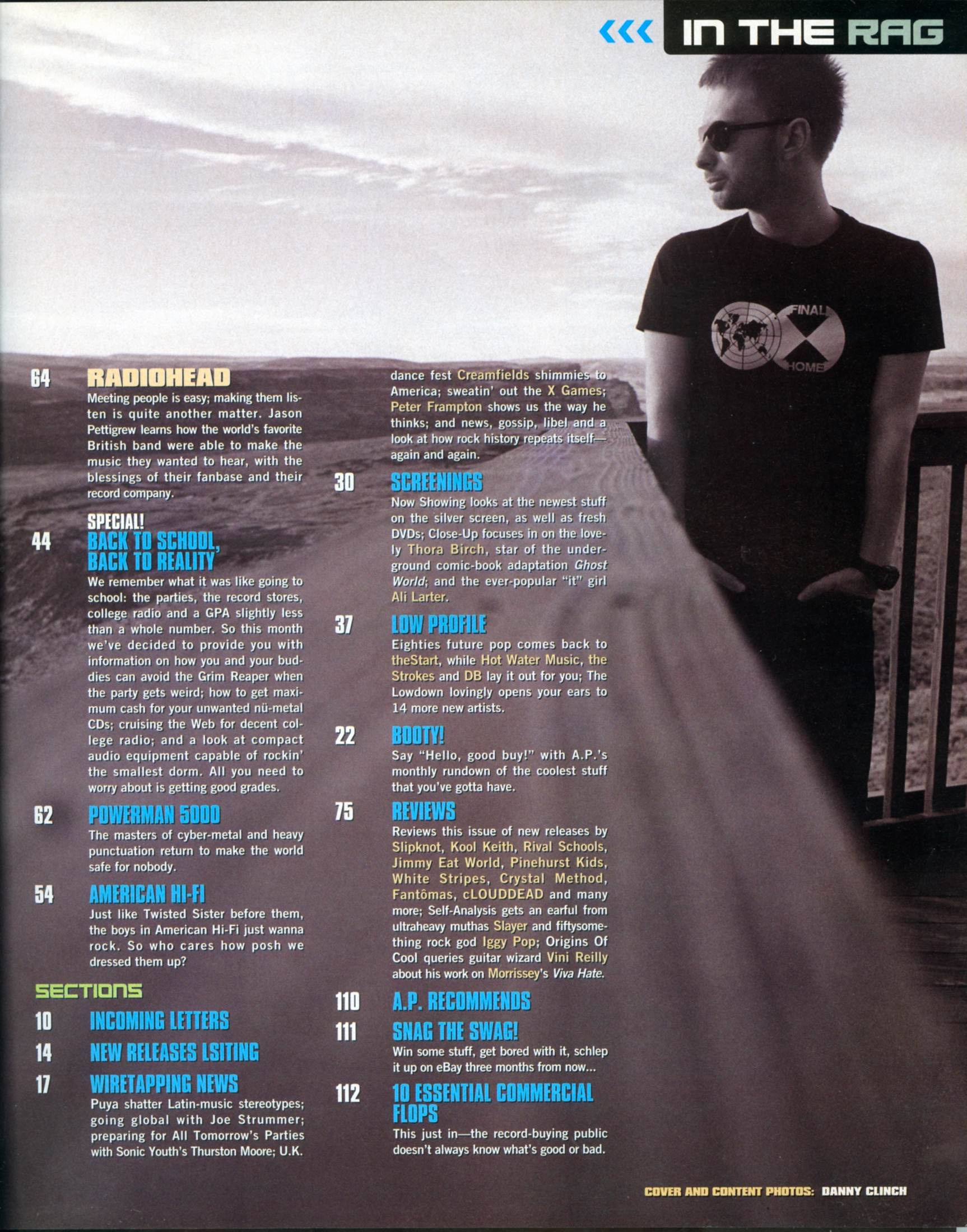
In 1999, British guitar loyalists Radiohead traded their axes to enter a sphere of electronics and keyboards over cries of commercial suicide. In reality, the double art-attack of Kid A and Amnesiac has seemingly invigorated music fans and many parts of the industry. Jason Pettigrew talks with the members of Radiohead and their inner circle and learns how a thoughtful band and open-minded audiences can work together to revive rock music.


Dear A.P.,
Thank you for the wonderful cover story on EMF (A.P. #87). I’m sure they will be making an “unbelievable” contribution to music for a long while. You losers.
- Letter to the editor regarding Radiohead’s first appearance on the cover of A.P., October 1995.
The above letter was emblematic of the hipster elitism inherent in America’s alternative-music climate six years ago. Underground indie-rock scenes were in full swing and the clubs were packed. Mom-and-pop record stores were the new meccas, while longtime college-radio faves could make new creative statements and be guaranteed the interest of a modicum of open-minded listeners.
Fast-forward to now: things are different. The word “alternative” is used to sell cars and tennis shoes. Alleged music fans once supportive of music not sanctioned by MTV and commercial radio are now liquidating their record collections on eBay. Scores of independently owned and operated businesses that supported the culture-record stores, labels-shuttered their doors. Many clubs changed their booking policies toward new bands because more people jam up to the bar to hear polished cover bands trot out their parents’ nostalgia. The enriching possibilities of rock music have been eclipsed for a world of rap-metal opportunists and tepid babyfood bands unworthy of attention, let alone derision.
As I think about this, Radiohead are playing a Can cover to a sold-out crowd of 25,000 passionate music fans, 60 percent of whom probably don’t know the maverick German rockers from a boy band. I have no idea what EMF are doing. And from where I’m standing, it doesn’t matter.
KEITH WOZENCROFT, Managing Director, Parlophone Records, Radiohead’s British label: By being true to themselves for over 10 years, it’s helped [Radiohead] cultivate a fan base and an audience that trusts and believes in them. They can still get respect, attention and record sales out of things that aren’t being rammed down people’s throats. People who have bought into them are willing to listen.
The Oxford, England, quintet Radiohead – Thom Yorke, Ed O’Brien, Phil Selway and brothers Jonny and Colin Greenwood – have always been contrary in their methods. The quintet were initially embraced by America in 1992, thanks to the detached, self-deprecating single, “Creep” and its parent album, the grunge-like Pablo Honey. Unlike most British bands – whose “extensive” American tours visit NYC, Chicago, L.A. and the airport – Radiohead played many a dive across America in front of guitar- rock loyalists, disciples of Nirvana and the last remaining pockets of Anglophiles. At first glance, it seemed as though the band were going to be the kings of “tax exile rock” – a sensation in America and other countries, but ignored in their homeland. The quintet were never aligned with any English movement (“Madchester” or Britpop) or fashion scene (i.e., you buy the clothes, then you decide which records go with the wardrobe). The influential British music papers finally came around and it wasn’t too long before England got smart and sent the band’s second album, 1995’s The Bends, straight up the charts. Radiohead had successfully avoided being mentioned in the same sentence with bands like the Fixx or Bush.
ED O’BRIEN, guitar: Everything we’ve done has always been about the timing. The reason we got signed was because of what was happening 10 years ago. We were doing the same kind of thing as Nirvana; we were a similar-sounding band doing something in Britain. The Bends came out as a reaction to Britpop. We were never part of a scene, although to me, OK Computer sounds like the sound of 1997. I think us and the Verve marked that time.
JONNY GREENWOOD, guitar/keyboards: All of the bands we were into at school – the Smiths, Throwing Muses, the Pixies – none of them had a look like the serious goth and punk bands.
COLIN GREENWOOD, bass: I don’t think we rose above it. We just weren’t interested in being fashionable, with clothing or music, really. Naturally, we were criticized for it by the British press. One of the first A&R people we ever met was from Polydor. He told us, “Before we sign you, it is very important that you have a manifesto and a look.” We were appalled and we didn’t sign. He wore clunky motorcycle boots, a black leather jacket and a ponytail.
The release of the band’s third album, 1997’s OK Computer, catapulted Radiohead into the realm of international pop stars. Many critics proclaimed them to be “the future of guitar rock.” Their arty, whimsical videos racked up an admirable chunk of airtime. Creatively, the band had hit upon a formula that was truly their own, with singer Yorke’s emotional falsetto and a guitar interplay that reflected pop craftsmanship (e.g., the Smiths) and a significant amount of heft (e.g., the Pixies).
At the height of Compumania, filmmaker Grant Gee followed the band on tour to create Meeting People Is Easy, a joyless tour documentary that found the band dealing with dullard journalists, demanding fans and all of the other invasive things that a successful rock band deals with regularly. The film shows stress fractures that clearly threaten the band’s existence, creatively and emotionally.
CHRIS HUFFORD, longtime manager, Courtyard Mgmt.: I think there was some confusion to a certain extent. Since they signed to the label in 1992, they’ve put their personal lives on hold and they just went for it. But after OK Computer, they were weary. The film is very psychologically honest as to where their heads were at. As their manager, it was depressing to me: seeing that going on where there should have been pride and joy. I knew they were readdressing how they looked to themselves, each other and the outside world. And that’s quite a painful process.
PHIL SELWAY, drums: We weren’t personally coloring the tone of [the film). That is how Grant perceived that period for himself. There were other periods of touring that were much lighter. And those are the ones we choose to emulate a bit more.
O’BRIEN: There was the hype, but there was the sheer exhaustion that unmasks the negative aspects of what you are doing. Ten years ago, we talked about being in a situation like the one we were in with OK Computer, and it was something that we wanted to get to. But being in a rock band now is [more] difficult than being in one, say, 15 years ago. It’s so much more of a media circus now. I don’t think we minded being heralded for doing good things in music. The problem was the pressure to feed the machine. You have to do certain things.
Radiohead countered this pressurized atmosphere with Kid A and Amnesiac, two records released nearly a year apart from each other, yet recorded during the same period of time. Once considered to be a two-disc set, the band and producer Nigel Godrich felt the best way to go was to release two separate albums. “The future of guitar rock” had been experimenting with samplers, arcane analog keyboards and new technology, crafting atmospheres and non-linear song structures. And unlike previous albums, the promo machine was left dormant for Kid A. There were no singles released, videos were eschewed in favor of quarter-minute blips, interviews were limited to a handful (with Yorke participating strictly through email) and the band’s entire North American tour consisted of New York City, Toronto and Los Angeles. They made an appearance on NBC’s Saturday Night Live playing two of Kid’s best tracks, the Charles Mingus-inspired ‘‘The National Anthem” and the clicking, electro-based “Idioteque” (which, by the way, rhymes with “robotic,” not “discotheque”). Yorke twitched, squirmed and leapt his way through the songs while “guitar heroes” Greenwood and O’Brien spent their stage time playing an obscure French electronic instrument called the Martenot and manipulating a bevy of pedals, respectively.
NIGEL GODRICH, producer of the band’s last three records and Radiohead’s unofficial sixth member: They knew they had to try something new. Initially, it was Thom’s idea. He was listening to a lot of electronic music and that’s what inspired [the records]. He wanted to change things, but he really didn’t know what. [The music] took a lot of time to record. At some point, everybody went through a phase of “What am I doing here,” but we had arrived at something. But to be honest, coming from OK Computer, Kid A doesn’t sound that different to us.
THOM YORKE, guitars, keyboards and vocals: I think drum & bass should have been the next punk. It should have been all over the radio, straight after Nirvana. It never happened because people were frightened by it and the people making it had no desire to get in front and sell the product. In Britain’s ecstasy culture, a circle of DJs who do jack shit, sell themselves and create a celebrity culture and therefore they’re getting somewhere. That’s what kills every interesting idea in music. Hey, I’d love to have been in the [Sex] Pistols and gone on television and swore and got in loads of trouble. It would have been great at the time. The point is, you’re not supposed to repeat it.
SELWAY: When things aren’t working, you have to find ways of dealing with the worries that go around it. “God, have we completely lost it as a band?” It was a valuable experience to go through, to throw away the comfort blanket and come away with something that excited us.
JONNY: In all honesty, we’re really quite conservative. We’re not driven by being experimental, we’re driven by the boredom of what we’ve already done. I think if we were really trying to do something truly experimental, we could probably do a much better job of it. I think the music we like might have that side to it but it isn’t just that. It isn’t purely about interesting sounds that hold your attention briefly, but don’t make you want to come back to them. But then you hear the same bass, drums and guitar as stuff that sounds like watered-down Nirvana that is still being played now. And that’s wrong, too. You have to find the middle ground, which I think might be the conservative thing to do.
COLIN: A lot of these songs started out as b-sides. It’s a really liberating mentality knowing you are going into a studio for two days and you can’t overthink things. The song “Lucky” from OK Computer started like that.
YORKE: I had terrible stomach pains and couldn’t eat most of the way through Kid A. It was really bad. As soon as Amnesiac came out, and people understood a bit more where Kid A was coming from – the two instruct each other a bit – the pain went away. The aftermath of OK Computer finally disappeared. I’m not trying to piss anybody off. [The anti-marketing stance] was all done to keep my own personal sanity. That is more important to me in making music with this band than it is trying to sell it to people.
Everybody had an opinion about Kid A: fans and critics were polarized, loving it or violently hating it. Shirley Manson trashed the disc on the Garbage Web site. Sugar Ray’s Mark McGrath asked me what I thought of Radiohead’s seeming commercial suicide. McGrath – a huge R-head fan – admitted that even he didn’t know what to think and wondered whether to mockingly call his band’s next record Kid B. later that same week, I witnessed a fan trading in Kid at a local used-CD store. When asked why he was trading it, he responded, “I don’t know. I’m not smart enough to like it.”
YORKE: I would go out to get a sandwich in Oxford, and end up having a five-minute chat with the bloke who made me the sandwich on how Kid A really didn’t do it for him. I said to him, “You’re expecting us to do what we’ve done before. What’s the point?” He was completely cool about it. “My favorite is The Bends, but this one confuses me.” And I’d ask him what about it confuses him. And it turns out it was the horns on “The National Anthem.” What we were trying to convey was the sound of people this far away [spreads thumb and index finger] trying to kill each other, but trapped in a lift or in traffic. And everyone knows what that feels like – they just don’t want to hear it on a record.
JONNY: That kid in the record store... that’s really sad. Some listeners have decided that they like one kind of music and that’s it. But it’s completely our problem and not theirs. Maybe we’re wrong and the pinnacle of great music is songs like [The Bends’] “Just.” I mean, I hope it isn’t – you can’t keep copying the Pixies your whole life. You’ll go crazy.
GODRICH: Of course Shirley Manson didn’t get [Kid A]. She’s in Garbage. That’s the kind of music she makes. She misses the songs. You have to live with that album for quite a while. I think a big problem was that journalists weren’t allowed to have it for a while, due to [the fear of it being uploaded to] Napster. Time will tell. Hopefully, stuff that is new and challenging will provoke discussion and make bands set a course of not making a record that people want, but making a record people don’t know they want. It’s an egocentric concern, but good bands should have it.
YORKE: When critics go, “Ha-ha-ha,” like they did in Britain, we didn’t have an answer to that. And that was kind of uncool. But also, why can’t people make up their own mind? All of that went away when Amnesiac came out.
Between the two discs, Amnesiac fares much better because it offers traditional song structure for pop fans and nourishing amounts of sonic discovery for those with more discerning tastes. The acute electra-desperation of “Packt like Sardines In A Crushd Tin Box” could not be conveyed by Britain’s guitar militia. Conversely, the desperado vibe of “I Might Be Wrong” is powered by a grimy guitar that’s half Ennio Morricone movie music and half Duane Eddy twang. Amnesiac’s track listing offers resonating songs imbued with possibilities and asides (like the Beefheartian offspring “Hunting Bears”) which maintain the record’s mysterious atmosphere.
Reactions to the latest disc aren’t as extreme as the verdicts dropped on Kid A. The reviewer for the British avant-garde magazine The Wire complained that Amnesiac wasn’t enough and that Radiohead had held back. Radiohead have never been about appealing to a particular stratum or subculture. For them to compromise-in-reverse in order to appeal to beard-scratching hipsters would be more than pointless.
But as comedienne Lily Tomlin once said, “It’s not called ‘show art.’ It’s called ‘show business.’” There are a lot of disillusioned people who work in the record business. Due to the fiscal mentality of the corporations that own major labels, profit rules everything. Because the demands from shareholders and the bean-counters are ridiculously high, there is no more artist development. In today’s climate, the Beatles might have a hard time releasing Sgt. Pepper’s. Today, new bands consider themselves lucky if they’ve been kept on long enough to make a second or third record without achieving massive sales. This is extremely disconcerting to many music-industry professionals, who entered this business solely because they loved music. It is no secret that all of these people (especially the ones who don’t work for Radiohead’s U.S. label, Capitol) want Radiohead to succeed massively.
YORKE: As far as I’m concerned, the only reason why we are doing this is because I think the music we make is pop music, exactly in the same way that Missy Elliot is pop music. The best pop music makes you stop what you are doing and just turn it up because you’ve never heard anything like that before. It’s not about some asswipe radio programmer trying to fit something in. Those people wouldn’t know music if it hit them across the face.
SELWAY: The great thing about Kid A was the response from everybody who worked on [its success]. A lot of people at the record company felt they had a new lease on life.
HUFFORD: People have realized that’s how Radiohead work. The record company understands the way we operate. Fortunately, we have a great team of people at the label working for us all over the world. I’m sure there was some fear on behalf of some people at the record company, but, ultimately, they had faith in the band. There were things on OK Computer that terrified the record company, but they told us to go for it. Obviously, things don’t reach a stupid sales level, but it has worked commercially well enough that the record company makes money, we make money and everyone feels proud that we’ve done something that’s worthwhile and makes people think.
O’BRIEN: OK Computer did sell four-and-a-half million, but when you think in terms of middle-of-the-road records, we’re not “big unit shifters.” When U2 do a poor-selling album, it’s about three million copies.
GODRICH: Kid A entered [the charts] at No. 1. Maybe it was a slow-selling week, but it’s proof that the music industry doesn’t know ass about tit, really. People are interested in new things. They just buy what they’re given. Quite sad, really.
Lately, music and commerce haven’t been mixing well, and it’s music fans who endure the violent hangover. A textbook case would be Nine Inch Nails. Trent Reznor spent five years recording the follow-up to his breakthrough record, The Downward Spiral. The album was hotly anticipated by fans, critics and his record label. When The Fragile was finally released in 1999, the critics praised the breadth of its sonic diversity. Unfortunately, America’s youth were in the throes of rap-metal hysteria, and decided to side with the decidedly mook-rocking likes of Fred Durst’s Limp Bizkit. The Fragile entered the charts at No. 1, dramatically fell several positions the following weeks and was completely off the charts in three months’ time. Executives at Reznor’s record label were less than pleased and suspended any kind of promotional monies marked for the project, including videos and tour support, leaving Reznor to bankroll the subsequent tour out of his own pocket.
WOZENCROFT: I would say that the timing was wrong for [Reznor]. But from a commercial point of view, you have to take risks. Pop music isn’t a dirty word to me. It can be exciting, cutting edge and all of the things I want it to be. You’ve got to find a way to sell it. If it is true, it’s got a life. We have the ability to break records with having an understanding of the artist. The indie labels do this well; most of the majors have lost the plot.
O’BRIEN: There’s always been big business in entertainment. If we were in the same situation as Trent Reznor, we would’ve said, “Fuck you, we’ll release records on the Internet,” or we’d find a way to do it ourselves.
JONNY: [Our way of working] wasn’t like a pop singer that comes out with a dance album with no vocals on it. That’s when people start worrying because there’s lots of money involved already, which I’m not sure was ever the case with us. The crossover really hasn’t happened – which is when people start to panic. But maybe all we are doing is irrelevant bollocks. Who knows? The other point is just when you think you are doing good music which means something, you could wake up a year later and find out that you’re Genesis. I think it’s healthy to have no real sense of permanence at the time. Be a moving target: That’s a healthy way to make music.
YORKE: The way things work in our camp, if the record company were to call up and say we were a failure, we’d just laugh and say, “Bye.” We would put the shutters down and carry on, even if it meant starting all over again. The record company has no reason to ever, ever, ever tell us what to do. We’re lucky to have a great relationship with our label; every other artist we know has had it worse. Like any large corporate structure, the music business relies on fear. Something’s got to change. It’s no good to anybody.
This evening, San Francisco’s Shoreline Amphitheater is packed with music fans who are down with the visiting delegation from Oxford. There are few empty seats in the pavilion: Likewise, you cannot see any grass in the lawn area, as it is completely covered. If somebody were to throw a toothpick in the middle of it, an epic scuffle might ensue. And it’s probably the kind of crowd a band would ever want: young; multicultural; coed; teens co-existing with J. Crew-shoppers and aging tie-dyed hippies. The most memorable concertgoer is the slightly overweight guy wearing a Pat Metheny concert shirt, who sings along with every song the band play from Amnesiac. (I tell this to Yorke after the show and he yells “Pat Metheny?” in mock horror, before smiling, secretly impressed that the scope of his audience extends to jazz guitarists.)
After DJ sets from Mo Wax artist Andrea Parker and the Beta Band’s groove-based quirk-out, Colin plucks out the driving bass line to “The National Anthem,” and the band jam into high gear. Selway drives the song with metronomic precision, O’Brien and Jonny manipulate a corps of effects pedals while Yorke thrashes away on his guitar like he’s playing an all-ages hardcore matinee at CBGB. Surprisingly, the more esoteric aspects of the recent discs are tightened up and roughed up in the live arena. The icy detachment of “Packt Like Sardines” comes off as an edgy, sweaty groove-fest. Selway deftly slams drum & bass percolations through “Idioteque,” and “Morning Bell” conveys an energy and warmth that just glow in comparison to their studio counterparts. Before the last encore, a stage invader makes it over the barrier and gives Yorke a big hug. The singer smiles and reciprocates.
As captivating and evocative as the music is, it is the audience that validates it. During the two encores, the band offer inspired versions of the familiar (“Fake Plastic Trees,” “The Bends,” “Talk Show Host”) and the arcane (“How To Disappear Completely” and the previously mentioned Can cover, “Thief,” which Yorke dedicates to our president, “Georgie-boy.”). At the end of “The Bends,” the roadies make the final gear switch of the evening, setting up another exotic keyboard center-stage. Yorke and the Greenwoods come out and deliver the lush, droning “Motion Picture Soundtrack” as their final farewell. Naturally, this doesn’t generate a Bic-flicking sing-along like a rendition of “Creep” obviously would. As the trio play, I check the crowd to see if there’s a mass exodus for the parking lot. The aisles remain clear.
YORKE: I don’t relish playing gigs to huge crowds of people. I resign myself to hoping we can get across what we need to get across to them. I don’t even watch videos of us playing live because I find them too disconcerting. Did you see that guy jump onstage tonight and give me a hug? I wanted to say to him, “What would you do? Go on, then.” But he was sweet.
A recent story in a British music magazine reported that Radiohead were playing guitars again. Jonny Greenwood had said in the interview that during rehearsals for the tour, they jammed on a cover of Neil Young’s “Cinnamon Girl.” Young’s career is a good analogy for Radiohead’s: In the years following his multi-platinum Rust Never Sleeps and attendant concert document Live Rust, Young went on a creative journey, releasing albums embracing electronics, rockabilly, big-band blues and traditional country music. If Amnesiac were to only sell 200,000 copies worldwide, everybody involved would stay deliriously happy. Radiohead can go in any direction they choose. And if the music scene is going to thrive creatively, their fans should use them as a catalyst to discover new things.
O’BRIEN: Yeah, but that’s no guarantee that nine months down the road that’s what we’ll be recording. What we are is true to ourselves. We’re not bored as musicians and we’re not bored as music fans.
WOZENCROFT: [Amnesiac is] already at two million [in sales]. I consider this body of work [Kid A and Amnesiac] to be a complete success. It’s freed [the band] up. They’ve released five albums that people like to discuss at bars and restaurants. And that’s something that great artists do.
SELWAY: We’ll stand by everything we’ve done as a band so far. If we get to a stage where we get slightly embarrassed by what we’re doing, we’ll know at that point that we’ve gone too far.
COLIN: One of the things I’d like to do is to release a compilation of our favorite b-sides and things where everyone’s letting their hair down. They also act as an indication of where we might go next.
JONNY: I suppose our music could go in any direction. [Our new music] will just go into the direction of whatever records one of us brings into the studio and says, “Hey, that song we’ve got called ‘Baby Alligators’ or whatever, we should try to do it like this,” and that record will be something we’re all obsessed by. It’s all down to what records we buy, whether it’s new stuff or old jazz. But I know I can’t play [the Pixies’] Doolittle or [Neil Young’s] After The Gold Rush and keep on stealing things.
GODRICH: At the moment, they’re just reeling from this. [Their new music] is still in the gathering stage: Everybody will go away and think about what happened last time and think about what they want to do. There’s been this enlightenment that they don’t have to work as a conventional band, but they use their relationships as a band to develop their ideas further. You never want to assume anything with Radiohead.
YORKE: The reason why I did a lot of e-mail interviews is because I was trying to keep a distance and maintain control. But then it got worse because you can have those questions rattling around in your head for weeks. It’s much nicer to meet people. But not a lot. [laughs] Some days are sunny, some are cloudy. Right now, it’s sunny. [laughs] There’s just mosquitoes.