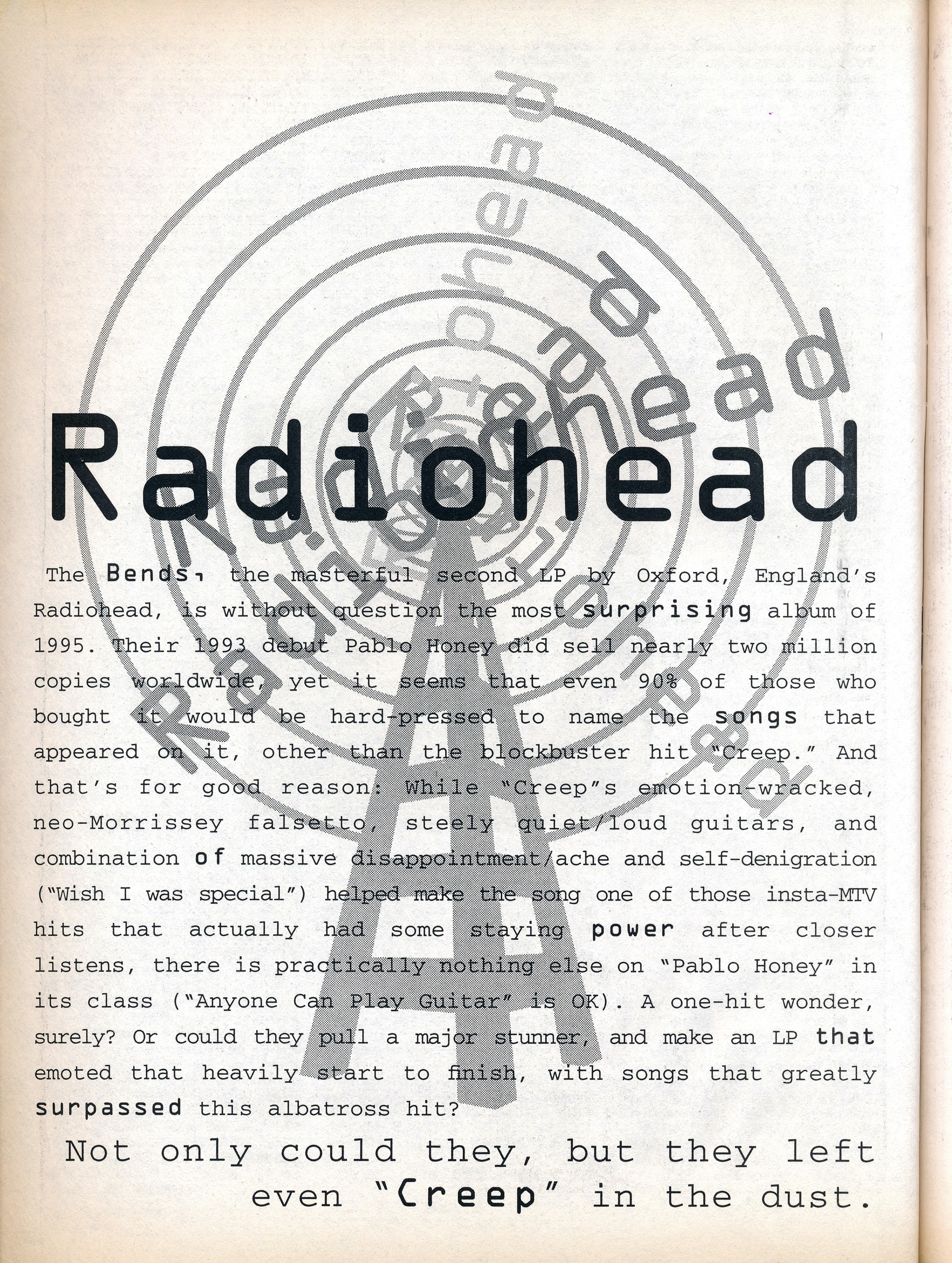
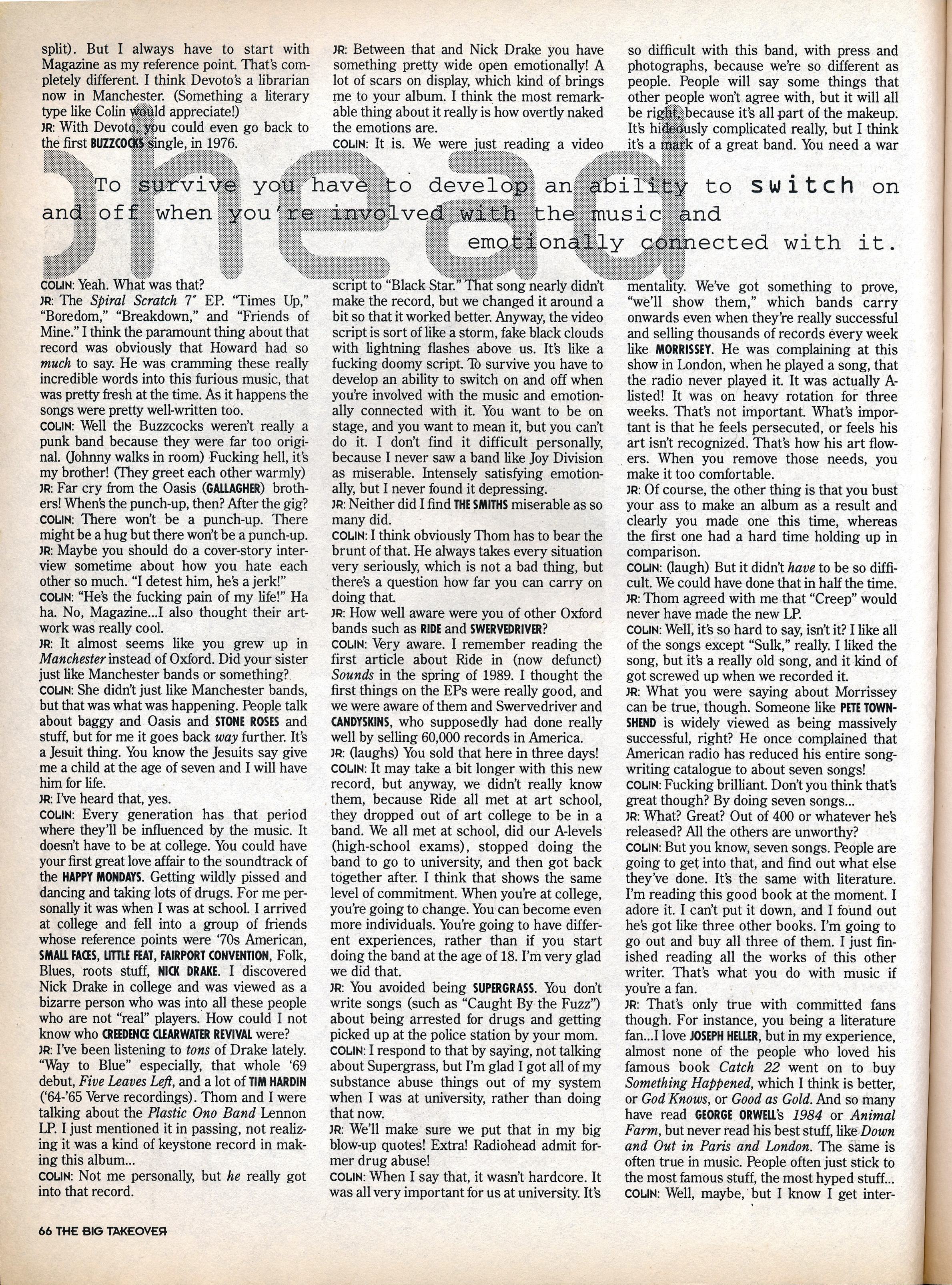
Radiohead
The Bends, the masterful second LP by Oxford, England's Radiohead, is without question the most surprising album of 1995. Their 1993 debut Pablo Honey did sell nearly two million copies worldwide, yet it seems that even 90% of those who bought it would be hard pressed to name the songs that appeared on it, other than the blockbuster hit "Creep". And that's for good reason: While "Creep"'s emotion-wracked, neo-Morrisey falsetto, steely quiet/ loud guitars, and combination of massive disappointment/ ache and self-denigration ("Wish I was special") helped make the song one of those insta-MTV hits that actually had some staying power after closer listens, there is practically nothing else on "Pablo Honey" in its class ("Anyone Can Play Guitar" is OK). A one hit wonder, surely? Or could they pull a major stunner, and make an LP that emoted that heavily start to finish, with songs that greatly surpassed this albatross hit?
Not only could they, but they left even "Creep" in the dust.
Where its predecessor was timid, tentative, and sometimes even tepid, "The Bends" is the sound of a band raging against the very idea of any hint of superficiality, of being a flash in the pan, easily forgotten as fast as they rose. Called upon its relase by the U.K. press "The U2 it's OK to like"- yes, one can defintely hear a simialr windswept air to that band's Joshua Tree era, but minus the pomposity- they mix a witch's-cauldron of angry and somber moods to set up one of the scariest lyric sheets in recent memory.
Are you the type to gawk at car wrecks? The questioning, reaching, cynical, enormously naked lyrics penned by singer Thom Yorke are perhaps the most direct attempted by a "Top-40" act in years. while confessional-type lyrics have been ho-hum-common since Joni Mitchell was a young woman, and more often than not, they smack of self-absorption and indulgence, Yorke supercedes even this convention. In fact he stomps all over it, until one seems to have entered an actual ventricle of his slow-pumping heart, a nerve ending in his nervous system, a chamber in his lungs, and sometimes, a canal in his bile duct, and each place seems like a very blackened place indeed, as filtered by his see-through-it-eyes. Even the LP title and the lyrics to "The Bends" and "My Iron Lung" fully suggest a thickening of the blood, and an alarming loss of oxygen. The human patient is ripe for surgery.
"The Bends" is thus not a "confessional" tantrum of ego-bruised slights, real and imagined, nor an Ian Curtis-like excursion into the shadows; it's an attempt at honest examination of the truth behind the bullshit we tell ourselves, the kind that as Morrissey once observed in "Will Never Marry", "Comes around to your place at 5am, wakes you up and laughs in your face." Nascent observation on "Planet Telex": "Everything is broken/ Everyone is broken."
And even if you can somehow manage to miss Yorke's war with himself, disposable culture, and not-so-disposable feelings in an anesthiszed, overly-glamour-conscious "Fake plastic" culture, Radiohead's sympathetic soundtrack of this distaste is a minor marvel in itself, with fully-realized songs that shiver in their solitude ("Street Spirit" and "Bullet Proof... I Wish I Was"), or push you around ("Planet Telex", "My Iron Lung", "The Bends"). They can even stop you in your tracks with subtle power, like "Fake Plastic Trees", with its mixture of icy guitar beauty and dark, lip-curled sarcasm about our vicarious escapist attitudes, our marginalization of culture, our obsession with the facade of beauty (the song sneers at elective plastic surgery in particular, cheers), and the crass veneer of media-manufactured "pop stars" as observed in the final line "If I could be who you wanted all the time..."
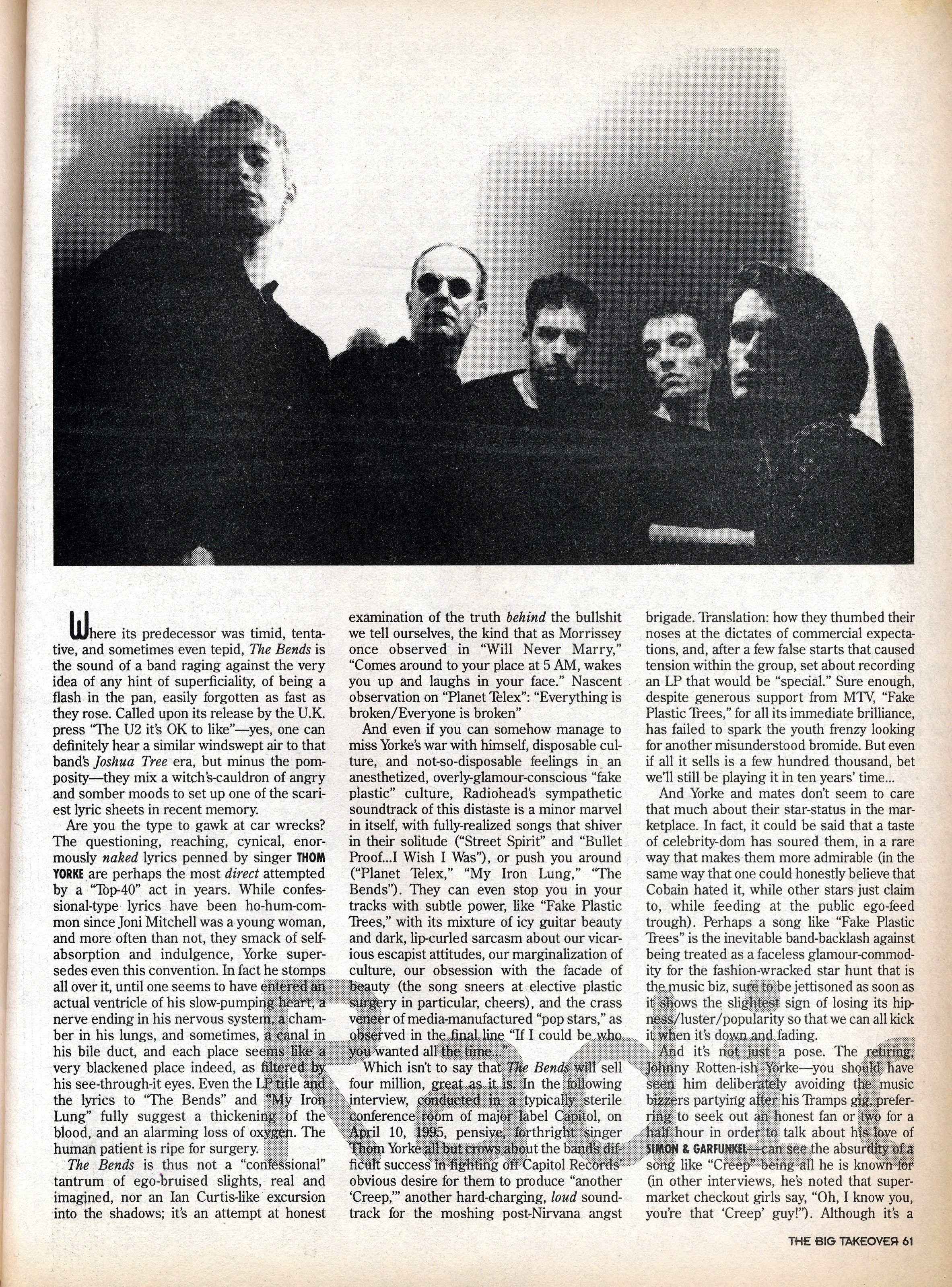
Which isn't to say that The Bends will sell four million, great as it is. In the following interview, conducted in a typically sterile conference room of major label Capitol, on April 10, 1995, pensive, forthright singer Thom Yorke all but crows about the band's difficult success in fighting off Capitol Records' obvious desire for them to produce "another 'Creep'", another hard-charging, loud soundtrack for the moshing post-Nirvana angst brigade. Translation: how they thumbed their noses at the dictates of commercial expectations, and, after a few false starts that caused tension within the group, set about recording an LP that would be "special". Sure enough, despite generous support from MTV, "Fake Plastic Trees", for all its immediate brilliance, has failed to spark the youth frenzy looking for another misunderstood bromide. But even if all it sells is a few hundred thousand, bet we'll still be playing it in ten year's time...
And Yorke and mates don't seem to care that much about their star-status in the marketplace. In fact, it could be said that a taste of celebrity-dom has soured them, in a rare way that makes them more admirable (in the same way that one could honestly believe that Cobain hated it, while other stars just claim to, while feeding at the public ego-feed trough.) Perhaps a song like "Fake Plastic Trees" is the inevitable band backlash against being treated as a faceless glamour-commodity for the fashion-wracked star hunt that is the music biz, sure to be jettisoned as soon as it shows the slightest sign of losing its hipness/ luster/ popularity, so that we can all kick it when it's down and fading.
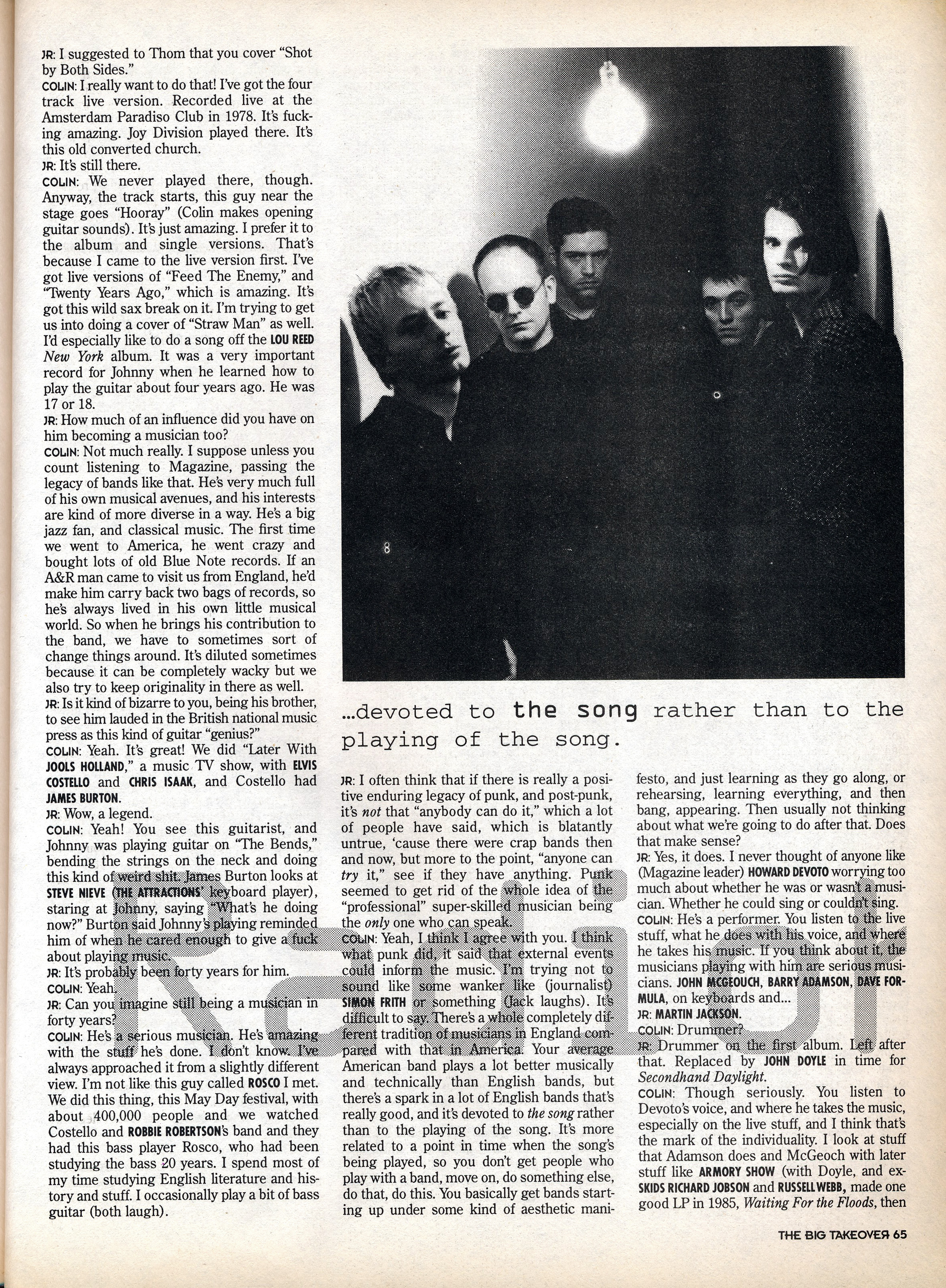
And it's not just a pose. the retiring, Johnny Rotten-ish Yorke- you should have seen him deliberately avoiding the music bizzers partying after his Tramps gig, preferring to seek out an honest fan or two for a half hour in order to talk about his love for Simon and Garfunkel- can see the absurdity of a song like "Creep" being all he is known for (in other interviews, he's noted that supermarket checkout girls say, "Oh I know you, you're that 'Creep' guy!). Although it's a song about the horrible, vulnerable feelings of personal worthlessness one exoeriences after being keft behind by someone (or something), it's catapulted him into being an object of transposed desire, by thousands of people he never met, merely because fame has suddenly touched him. He spells out for us below his loathing for the so-called perks and star-mongering attention that such fake, phony admiration has given him. After twenty minutes with him are up, bassist Colin Greenwood enters to show us the music-fan side of the band that backs up their frail, smart singer, a happy yin to Yorke's more acerbic yang.
Thanks to Daralyn adams at Capitol for setting this up, and to Ben Szporluk for the transcription. Not present: guitarist/ brother Jon Greenwood, guitarist Ed O' Brien, and drummer Phil Selway.
JR: I bet you're thrilled with doing your 8,000th photo shoot?
THOM: I don't mind really. Normally it's alright.
JR: Have they released "Fake Plastic Trees" here yet? Sent it to radio and all that?
THOM: they've done that I think. I don't really follow it.
JR: I rememeber reading a while ago that your reord company, Capitol, did a remix of that song, made it louder and heavier, and they wanted to release that as both a single and the MTV video, and you were damantly fighting that. Did you prevail?
THOM: Yeah, we did. That remix was not used. the video and the single are the same as the LP mix.
JR: this is something that has really interested me. Here you've had so mcuh success with your first record, yet your record company is still trying to monkey around with you. Trying to change your sound.
THOM: Well, it's because our situation in a sense is unique, they want another big hit from us. the whole thing about having to kill the beast with the first track really meant that other poeple's opinions counted for something, rather they thought they did, and (derisively) who are we to argue. We're only a fucking band, you know.
JR: Don't you think it's ironic a song called "Fake Plastic Trees"- about plastic-iaztion of culture- would be one that the label would choose to tart up for the American radio?
THOM: Probably not. I think basically a lot of it was down to the fact that people at the label were nervous about the fact that "Fake Plastic Trees" doesnt really fit into the old commercial-alternative genre sound, whatever, which we took as a compliment.
JR: How is it that "Creep" did?
THOM: It's got a really loud guitar in it. It's fucking obvious, isn't it? So they were trying to make it slightly more like The Offspring, I think.
JR: Punk is in.
THOM: Obviously.
JR: Whereas I think "Fake Plastic Trees" is the most important song on the whole record, both lyrically, and in terms of the brooding quality of the music. for them to try to make it louder and heavier would destroy what makes it unique.
THOM: I kind of agree. It was certainly the most important when we were making it, because it was the hardest one to make. And I think for us, especially for me, it was a real breakthrough, because up until that point in the recording I wasn't really happy with anything we had done. It seems that the way we operate is through a series of crisis points. that's the way that we exist creatively and other ways as well, and "Fake Plastic Trees" was one of the biggest ever. So I agree in that sense that it was important, because it wasn't meant to mean anything. It was really what it doens't say which was important to me, and what lay behind it which was really important to me, and whether people sort of took it as ironic... I didn't really care about the interpretation. I just cared about the act of making the song itself. that was the really important bit to me. the fact that we actually did it. It was that far away from sounding like Guns 'N' Roses.
JR: (laughs) You had to walk a tight rope to balance it?
THOM: Right. that's how it should all be. It should all be that difficult.
JR: Well, from what I"ve been reading, when you were younger, you used to have a pretty good taste in music.
THOM: Yeah, well, that's beacuse I've hidden the fact that I listened to Dire Straits.
JR: Dire Straits! I hate Dire Straits!
THOM: There you go, you see.
JR: Is it true you used to be an impromptu DJ at a lot of parties you used to go to?
THOM: No. Well, I used to actally do it as a college thing. That was great. I think the main criteria of thatw as power, though, really. that power over the fact that you can play whatever the fuck you like, ball dance or not. Yeah, I used to buy a lot of records but I think when people ask who your influences are, that's sort of a weird question as well, because obviously they change all the time, don't they? I think when we were making The Bends, we weren't listening to anything at all deliberately. I wasn't. I kind of stopped listening to other poeple's music completely because I wasn't able to get any distance.
JR: It becomes harder to listen to other people's music when you become a full-time touring and recording musician, doesn't it?
THOM: Yes. In phrase, yeah. If people are doing similar things to you, then yeah, I don't really listen to any of our contemporaries at all, because that way it's much easier to function. You don't worry about it, because you don't hear it.
JR: Well I was interested to see you picked John Leckie to produce this LP. Were you ever into some of those older records he did by bands such as XTC and Magazine, as opposed to his better-known, more recent work (Stone Roses in particular?)
THOM: I think Colin and Jonny were the principle XTC freaks in the band. I actually really liked the fact that he worked with The Fall, and actually could work with the Fall. Anybody who could work with Mark E. Smith and come through the end of it actually still liking them has obviously got something going for him.
JR: He did a number of records with them, didn't he?
THOM: Bend Sinister (1986) being the best. He did the Wonderful and Frightening World of The Fall (1984) for them as well. If we were going to get a producer, he was the only one we were going to use. Other than that we'd do it ourselves, really. He seemed to be a very hands-off geezer.
JR: He's got a sort of a well-documented prominent spiritual side to him, doesn't he? I think I've heard some other bands he's worked with say that.
THOM: He's got this thing about Middle Earth which is quite funny. We used to take the piss out of him for it rather badly. That the center of the Earth is not actaually solid at all, but is in fact popluated by a different set of creatures.
JR: Who stay down there.
THOM: Oh yeah. Obviously they stay. They never come up. (both laugh). He and I sort of hit it off in that way.
JR: In fact though, for all his eccentricities, he still has the reputation of being among the calmest producers in the world, which is crucial during the nerve-wracking process of making a new album.
THOM: He'd have to be with us. He was very calm. I don't think anybody else would have satyed in the atmosphere that was there at the beginning of the album.
JR: so things were really breaking down when you began recording. what sort of crises are you guys specifically referring to?
THOM: Just of our own making, really. After the first album, on the one hand, we didn't really feel any connection with it anymore because it was so old, and we weren't given a chance to ever rehearse it until we were finally dropped back on planet Earth after the big circus. I'm not really sure what the crisis was, though. that was probably part of the problem. the principle thing was at the label telling us what they expected us to do, and not having complete artistic freedom. Until I started running around the studio disconnecting the phones (Jack laughs), and telling people in reception that no one was allowed in the studio. That was when we actually started to work. It was that bad.
JR: Like I said earlier, you would think it would be the other way around. You almost expect a label to dick around a new band whose first LP sold poorly, but you'd think they'd have some confidence in you, that you sold a million and a half, you've proven you can be successful on your own.
THOM: Oh no. they're right, you know. I mean, this album hasn't got another "Creep" on it, so we probably won't sell another million and a half, and that's just tough shit. you can't just shake someone up and down and ask them to do it again. why should we? We didn't think it was that good anyway.
JR: the song you mean?
THOM: Yeah. We think we've written better songs, but it's pointless telling people that.
JR: I actually think "Creep" was the weakest track if it apperared on your new album.
THOM: Yeah! It wouldn't get on at all!
JR: (laughs) So you agree with me then?
THOM: Oh yeah. Totally! It wouldn't fit, you know. It wouldn't make sense, especially being in the context of what's happening around us now. this album was very much a conscious reaction against all the stuff we really hate at the moment.
JR: For instance?
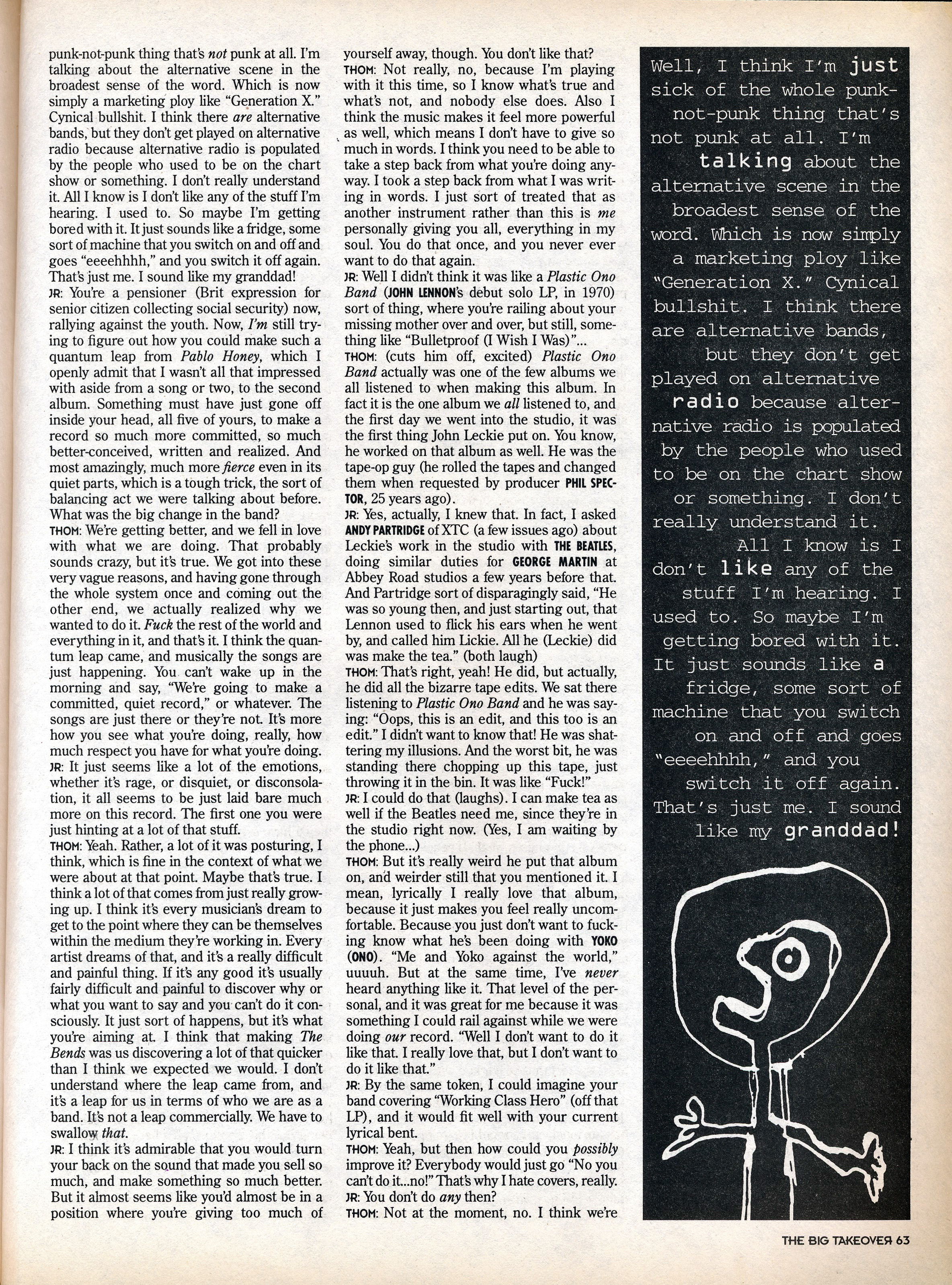
THOM: Well, I think I'm just sick of the whole punk-not-punk thats not punk at all. I'm talking about the alternative scene in the broadest sense of the word. Which is now simply a marketing ploy like "Generation X." Cynical bullshit. I think there are alternative bands, but they don't get played on alternative radio because alternative radio is populated by the people who used to be on the chart show or something. I don't really understand it. All I know is that I don't like any of the stuff I'm hearing. I used to. So maybe I'm getting bored with it. It just sounds like a fridge, some sort of machine that you switch on and off and goes, "eeeehhhhhh," and you switch it off again. That's just me. I sound liike my grandad!
JR: You're a pensioner (Brit expression for senior citizen collecting social security) now, rallying against the youth. Now, I"m still trying to figure out how you could make such a quantum leap from Pablo honey, which I openly admit that I wasn't all that impressed with aside from a song or two, to the second album. Something must have gone off inside your head, all five of yours, to make a record so much more committed, so much better-conceieved, written and realized. And most amazingly, much more fierce even in its quiet parts, which is a tough trick, the sort of balancing act we were talking about before. What was the big change in the band?
THOM: We're getting better, and we fell in love with what we are doing. That probably sounds crazy, but it's true. We got into these very vague reasons, and having gone through the whole system once and coming out the other end, we actually realized why we wanted to do it. Fuck the rest of the world and everything in it, and that's it. I think the quantum leap came, and musically the songs are just happening. You can't wake up in the morning and say, "We're going to make a committed record," or whatever. the songs are just there or they're not. It's more how you see what you're doing, really, how much respect you have for what you're doing.
JR: It just seems like a lot of emotions, whether it's rage ,or disquiet, or disconsolation, it all seems to be just laid bare much more on this record. the first one you were just hinting at a lot of that stuff.
THOM: Yeah. Rather, a lot of it was posturing, I think, which is fine in the context of what we were about at that point. Maybe it's true, I think a lot of that comes from just really growing up. I think it's every musician's dream to get to the point where they can be themselves within the medium they're working in. Every artist dreams of that, and it's a really difficlt and painful thing. If it's any good, it's usually fairly difficult and painful to discover why or what you want to say and you can't do it consciously. It just sort of happens, but it's what you're aiming at. I think that making The Bends was us discovering a lot quicker than I think we expected we would. I don't understnad where the leap came from, and it's a leap for us in terms of who we are as a band, It's not a leap commercially. We have to swallow that.
JR: I think it's admriable that you would turn your back on the sound that made you sell so much, and make something so much better. But it almost seems like you'd almost be in a position where you're giving too much of yourself away, though. You don't like that?
THOM: Not really, no, because I'm playing with it this time, so I know what's true and what;s not, and nobody else does. Also I think the music makes it feel more powerful as well, which means I don't have to give so much in words. I think you need to be able to take a step back from what you're doing anyway. I took a step back from what I was writing in words. I just sort of treated that as another instrument rather than tis is me personally giving you all, everything in my soul. you do that once, and you never ever want to do that again.
JR: Well I don't think it was like a Plastic Ono Band (John Lennon's debut solo LP, in 1970) sort of thing, where you're railing about your missing mother over and over, but still, something like "Bulletproof (I Wish I Was)"...
THOM: (cuts him off, excited) Plastic Ono Band actually was one of the few albums we all listened to when making this album. In fact it is the one album we all listened to, and the first day we went into the studio, it was the first thing John Leckie put on. You know, he worked on that album as well. He was the tape-op guy (he rolled the tapes and changed them when requested by producer Phil Spector, 25 years ago.)
JR: Yes, actually, I knew that. In fact I asked Andy Partridge of XTC (a few issues ago) about Leckie's work in the studio with The Beatles, doing simialr duties for George Martin at Abbey Road studios a few years before that. And Partridge sort of disparingly said, "He was so young then, and just starting out, that Lennon used to flick his ears when he went by, and called him Leckie. All he (Leckie) did was make the tea." (Both laugh)
THOM: that's right, yeah! He did, but actually, he did all the bizarre tape edits. We sat there listening to Plastic Ono Band and he was saying, "Oops, this is an edit, and this too is an edit." I didn't want to know that! He was shattering my illusions! And the worst bit, he was standing there chopping up this tape, just throwing it in the bin. It was like, "Fuck!"
JR: I could do that (laughs). I can make tea as well if the Beatles need me, since they're in the studio right now. (Yes, I am waiting by the phone...)
THOM: But it's really weird he put that album on, and weirder still that you mentioned it. I mean, lyrically I really love that album, because it just makes you feel really uncomfortable. Becuase you don't want to fucking know what he's been doind with Yoko (Ono). "Me and Yoko against the world," uuuuh. but at the same time, I've never heard anything like it. That level of the personal, and it was great for me becuase it was something I could rail against while we were doing our record. "Well I don't want to do it like that. I really love that, but don't want to do it like that."
JR: By the same token, I could imagine your band covering "Working Class Hero" (off that LP) and it would fit well into your current lyrical bent.
THOM: Yeah, but then how could you possibly improve it? Everybody would just go, "No you can't do it...no!" That's why I hate covers, really.
JR: You don't do any then?
THOM: Not at the moment, no. I think we're going to do some, but if we do, it would be like Frank Sinatra songs, and really awful stuff. That way we could only improve it.
JR: Have you ever done any in the past?
THOM: Yeah. they're always awful (both laugh) and we always chicken out with putting them on tpae becuase they're so bad.
JR: Care to name any names?
THOM: No (laughs). What was it we tried? We tried to do (Blondie's) "Union City Blue" once and that was so bad. I think we still do some.
JR: Why don't you try something like (Magazine's) "Definitive Gaze" or "Shot By Both Sides"?
THOM: It would be Colin's dream to do "Shot By Both Sides". Probably Jonny's as well, actually.
JR: Do you get asked too much about the vulnerablilty aspect of the new record? Coming from you being a remotely successful pop act it's rare I should think, that people say the things you say in interviews and in your lyrics about the distasteful aspects of being a singer/ songwriter.
THOM: Yeah, I think my main problem is I never wanted this to become an extension of someone's marketing campaign. I've never thought in that way. How can I explain it? Once you've experienced the pop phenomena... you've been around the system once like we have with "Creep"... It was so embarrassing the way we were put foward. I hated it so much. The only way I could fight it was to say "No, look this is not us."
JR: you seemed, in the space of a half a year, a million miles removed from the band I saw at CGBG's to the band I saw at Roseland. By far my favorite moment at the Roseland show was when you came out with Tanya Donelly alone with an acoustic and sang (Belly's) "Untogether". It seemed like it was the real you in a strange kind of touching way. Like it was a chance to bring everything down to a more personable level for you. Even more than the way that you'd been at CBGB's, that being much more of an intimate occasion.
THOM: Just simply because it was acoustic and quiet?
JR: No, becuase it was somebodythat wasn't part of your band and the whole usual aspect of the big bew hot band's show. It wasn't like this is part of the show you all expect. It sounded somehting like you could reach out to another artist and perform this kind of fragile song that way. Let me clarify. It almost seems that, as an artist, as you get really popular like you have,, it becomes harder and harder to reach out and have a direct connection to people, both live 'cause you end up playing such huge places, and in general. Do you find that?
THOM: A lot of the songs in The Bends are really like that, really intimate, things like "Bulletproof." We play "Bulletproof" live now and it's the same thing I think.
JR: That's sort of what I'm driving at, what I like so much about the new album, it's such a naked connection.
THOM: We were all really fucking nervous about it. Once we finished the record we were thinking, "How are we going to do this on stage? everyone's going to expect us to jump around." And it was brilliant to actually discover we could do what the fuck we wanted, and actually we could go on and do "Bulletproof", or the last song ("Street Sprirt", another super-quiet one), or "Planet Telex". We're a good enough band that we can actually translate a song from an album into a live context and just do it in a slightly different way, and what the fuck, and not worry about it. I mean, we did this British tour and it was just amazing for the whole tour to be sold out, and for people to stop and not say anything during quiet songs like "Fake Plastic Trees" and "Bulletproof". to just stand there and just listen to a Radiohead gig, and not jump up and down and mosh. This is great. It was a real revelation for us.
JR: That reminds me of Kurt Cobain, one thing I thought about him was that it was amazing to me how much he started to dislike most of his audience when Nirvana became so huge. It almost seem like with the sort of lyrics that you're writing, you're making a conscious attempt to sort of weed out the whole element of people who are there just for the shenanigans. though, of course, if you get frequent MTV exposure, you're doomed to have the cretins who never listen, who are only there to slam and mosh and throw their weight around with no regard for the music being emoted.
THOM: That's basically it. I'd love to put posters on the door saying, "If you came here to mosh, fuck off home."
JR: Do you make statements from the stage to that effect? You should.
THOM: No, because the stage is absolutely the wrong place to do it. It's not fair to create a bad atmosphere any more than has already been created unless it's really out of hand. I'm sure people (in the audience) do at the moment, especailly with these songs. It's sort of like comedy, but it's not. Last night, the Boston show, opening night on the U.S. tour, it was really out of control. A lot of people getting hurt. I don't understand it, playing "Fake Plastic Trees". In the back of my head, I always knew it was going to be like this. I'd be singing wiht my guitar, the bit where it goes down. It's always emabarassing and always quite awkward to sing that part, and the video was agin embarassing and awkward. I get off on it, because I think that's what good art is about. Good creativity is basically embarassing to the creator. It's like pulling your pants down in public. And you do it forever more. But in the back of my mind I was always awarethat you were just getting these fucking morons who were just pounding up and down on each other. You know they should go listen to The Offspring instead. I think we were always aware when recording "Fake Plastic Trees" that we would get people moshing all the way through it, and the comedy of that, and how ridiculous that would seem, and not caring. We finished the song thinking, "why do we have to pander to that?" there's a sense of complete freedom of some sort. this sin't about supply and demand. you don't set up the supply and give it to all these people in the first place. they used to come for the first U.S. tou and fuck off after we played "Creep" mid-set. I wish they never fucking turned up in the first place! What's the point! It's an insult to the rest of the people who came to see the show. Fuck 'em, you know.
JR: I agree with every word you just said. (They shake hands; Thom leaves to talk to a different journalist, Colin enters.) Thom said you're a fan of old Leckie-produced groupd like XTC and Magazine...