Under Pressure: Just What Do You Want From Radiohead?
"You're God, Thom! You're God!"
There he is, the man with the guitar and the crooked stare, standing amidst the fog and spooky lighting, set to begin another anguished sermon on the endless pain, embarassment and occasional triumphs of daily life. It's an excerise Thom Yorke has learned to endure and even to enjoy. Tonight the crowd is swooning at his feet, erupting with every burst of guitar and mournful lyric Radiohead has to offer. But here in the front row, standing crushed against the barrier with his arms reaching to touch the stage, is some wild-eyed pilgrim with razor-sharp sideburns, looking up at young Thom not as some fabulous rock'n'roll hero, but as God himself.
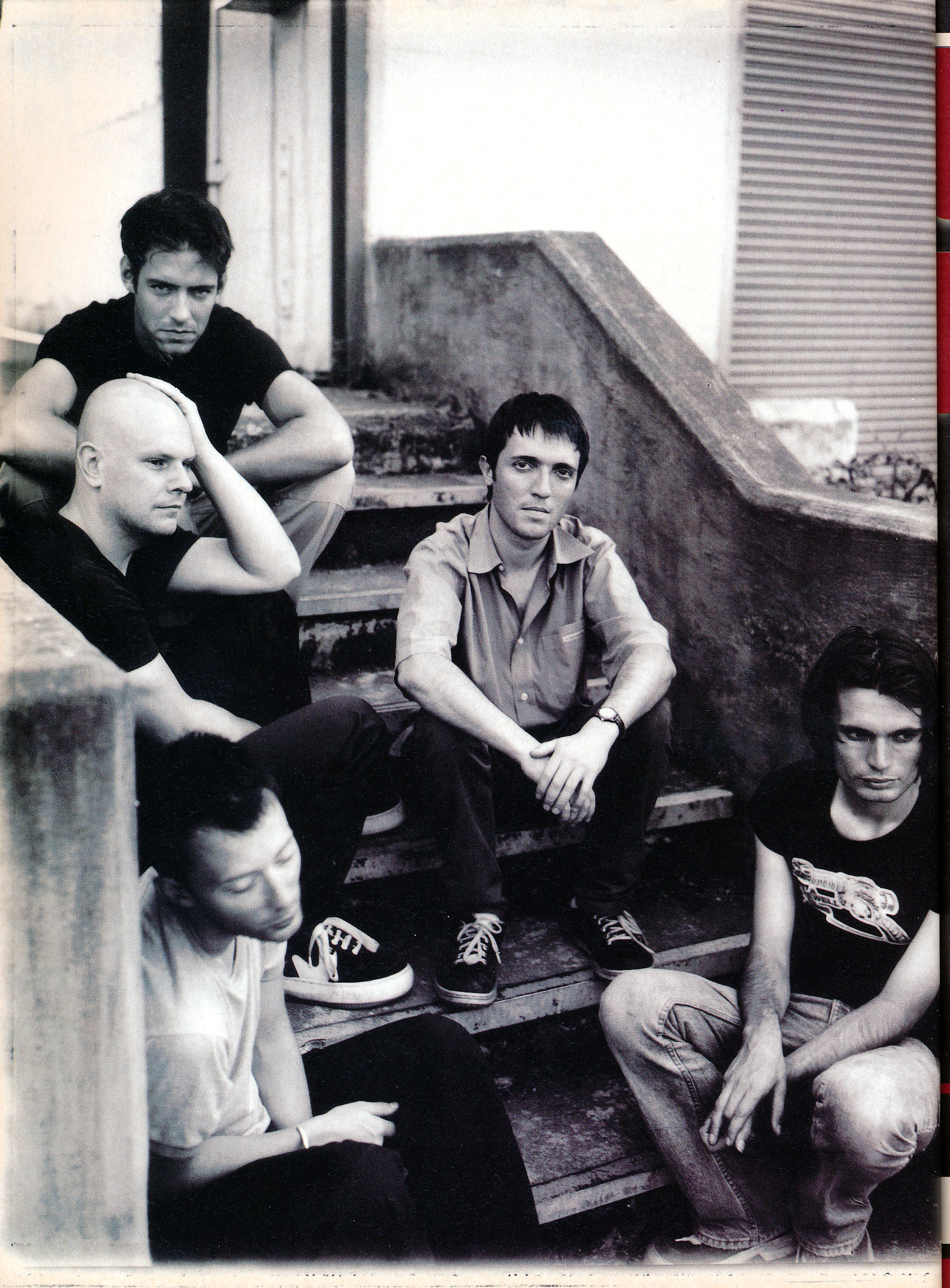
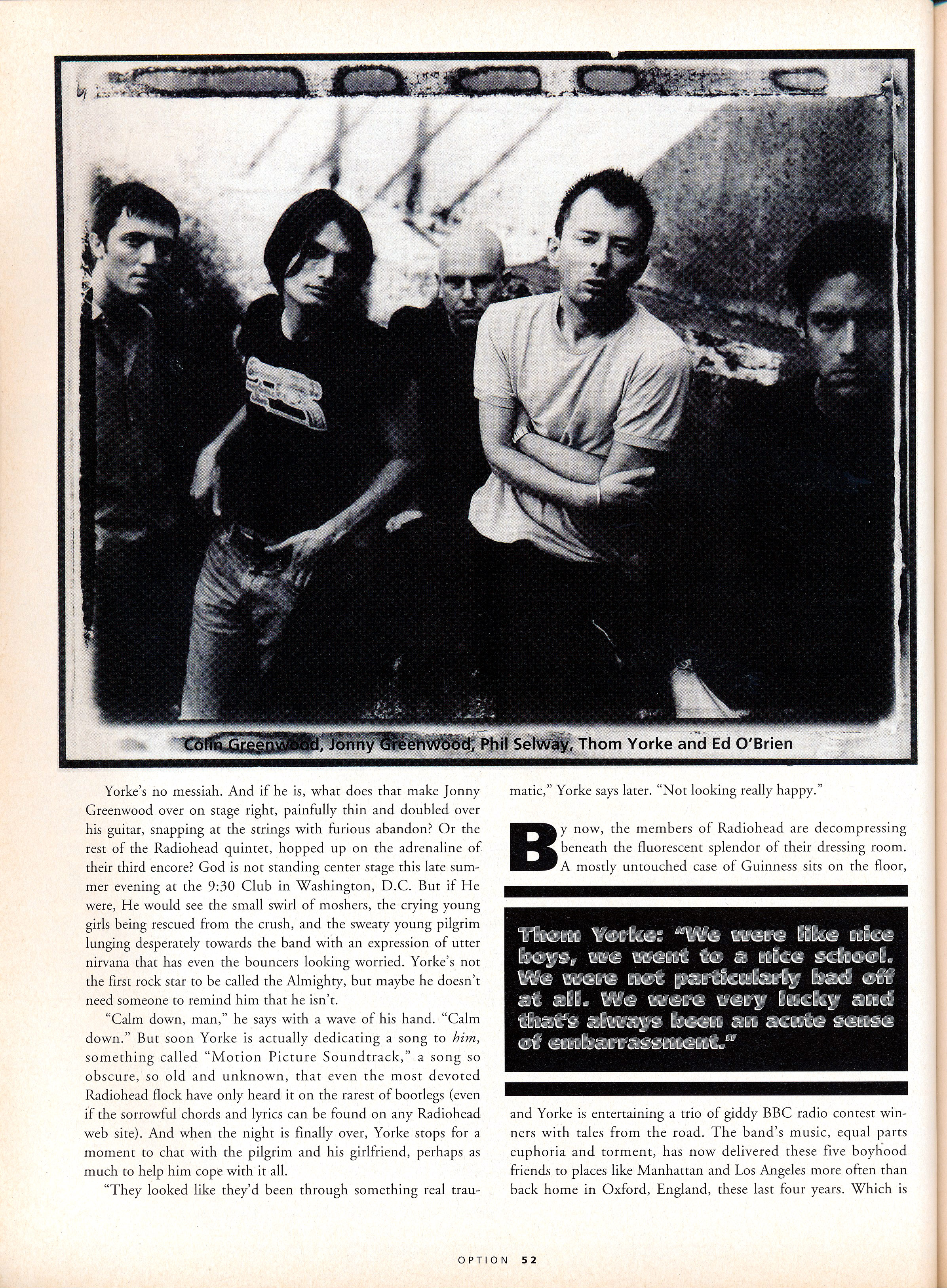
Yorke's no messiah. And if he is, what does that make Jonny Greenwood over on stage right, painfully thin and doubled over his guitar, snapping at the strings with furious abandon? Or the rest of the Radiohead quintet, hopped up on the adrenaline of their third encore? God is not standing center stage this late summer evening at the 9:30 Club in Washington, D.C. But if He were, He would see the small swirl of moshers, the crying young girls being rescued from the crush, and the sweaty young pilgrim lunging desperately towards the band with an expression of utter nirvana that has even the bouncers looking worried. Yorke's not the first rock star to be called the Almighty, but maybe he doesn't need someone to remind him that he isn't.
"Calm down, man," he says with a wave of his hand. "Calm down." But soon Yorke is actually dedicating a song to him, something called "Motion Picture Soundtrack," a song so obscure, so old and unknown, that even the most devoted Radiohead flock have only heard it on the rarest of bootlegs (even if the sorrowful chords and lyrics can be found on any Radiohead web site). And when the night is finally over, Yorke stops for a moment to chat with the pilgrim and his girlfriend, perhaps as much to help him cope with it all.
"They looked like they'd been through something real traumatic," Yorke says later. "Not looking really happy." By now, the members of Radiohead are decompressing beneath the fluorescent splendor of their dressing room. A mostly untouched case of Guinness sits on the floor, and Yorke is entertaining a trio of giddy BBC radio contest winners with tales from the road. The band's music, equal parts euphoria and torment, has now delivered these five boyhood friends to places like Manhattan and Los Angeles more often than back home in Oxford, England, these last four years. Which is quite all right for now, and Yorke is marveling with his guests at the impressive array of weaponry so readily available across these United States. "In practically every truck stop in America you can buy a handgun magazine," he says, leaning forward, "and it tells you how to pull it faster from your holster, and how to hide it in your boot."
That hasn't yet scared the band away, even if America remains an unpredictable environment for Radiohead. Their newest album, OK Computer, is a sprawling epic of dark, aching intensity, ready to soothe and increase your stress about the accelerating chaos of modern existence. The album's nearly eight-minute suite, "Paranoid Android," sets Yorke's words of longing and contempt against layers of guitar, electronic effects and psychedelic flourishes that suggest a depth of feeling '70s art rock once claimed but rarely achieved. None of it was exactly what the master tacticians at Capitol (their U.S. label) wanted or expected from a band that had once hit the lucrative Top 40 with the melodramatic "Creep."
"When the record company heard the album, they downgraded their expectations," says guitarist Ed O'Brien, laughing now of the label's sales predictions. "Down from two million to 500,000."
Adopting a dim American accent, Yorke says: "'Oh God, it's weird, no one's going to buy that shit!"' That blend of expectation and uncertainty from the proper authorities is an ongoing concern to the band. "I don't think you ever get used to it. It's still sort of like arguing with your parents or something. You just try to see beyond it."
The wine bottle by the window is conspicuous by its presence. It's a wonder to behold, all tinted glass and golden foil, the unpopped cork a monument to great expectations. But Room 535 of the Hollywood Roosevelt Hotel isn't exactly the happiest place on earth tonight. It's December 1995, and not even Yorke's smile can hide the weariness on his face, as he sits by a window overlooking the seedy glamour of Hollywood Boulevard. This is just another stop on the endless Radiohead roadshow, and now he's facing yet another unannounced interview, squeezed in before the night's gig across town, where Radiohead will again work to put the curse of too much success too soon finally behind them.
Yorke looks at the bottle, a special gift from Capitol Records president Gary Gersh. The argument for Radiohead's seriousness, ambition and growth was already made via 1994's The Bends, their second album. Nothing less was needed after Radiohead's massively popular 1993 debut single, "Creep," a tale of utterly believable self-loathing that somehow connected so deeply with mainstream listeners that the quintet were perversely branded a nice little pop act or worse, a one-hit-wonder: a band destined for nothing more than a spot on the inevitable Hits of the Nineties! compilations to come. But The Bends redefined Radiohead, taking them beyond the mixed blessing of that first album, Pablo Honey, with new tracks that were wrenchingly beautiful.
"It's exciting to have people coming up and saying that they really like a record you've made. It was great for a while with 'Creep,"' says Yorke, the band's singer and lyricist, who remembers how crowds would thin out as soon as they had played the big hit. On the bed behind him sits a mountain of clothing awaiting to be picked through for tonight's show. "But to have an album means I can sleep at night. And it feels like I can let go more. The next record will have a sense of release."
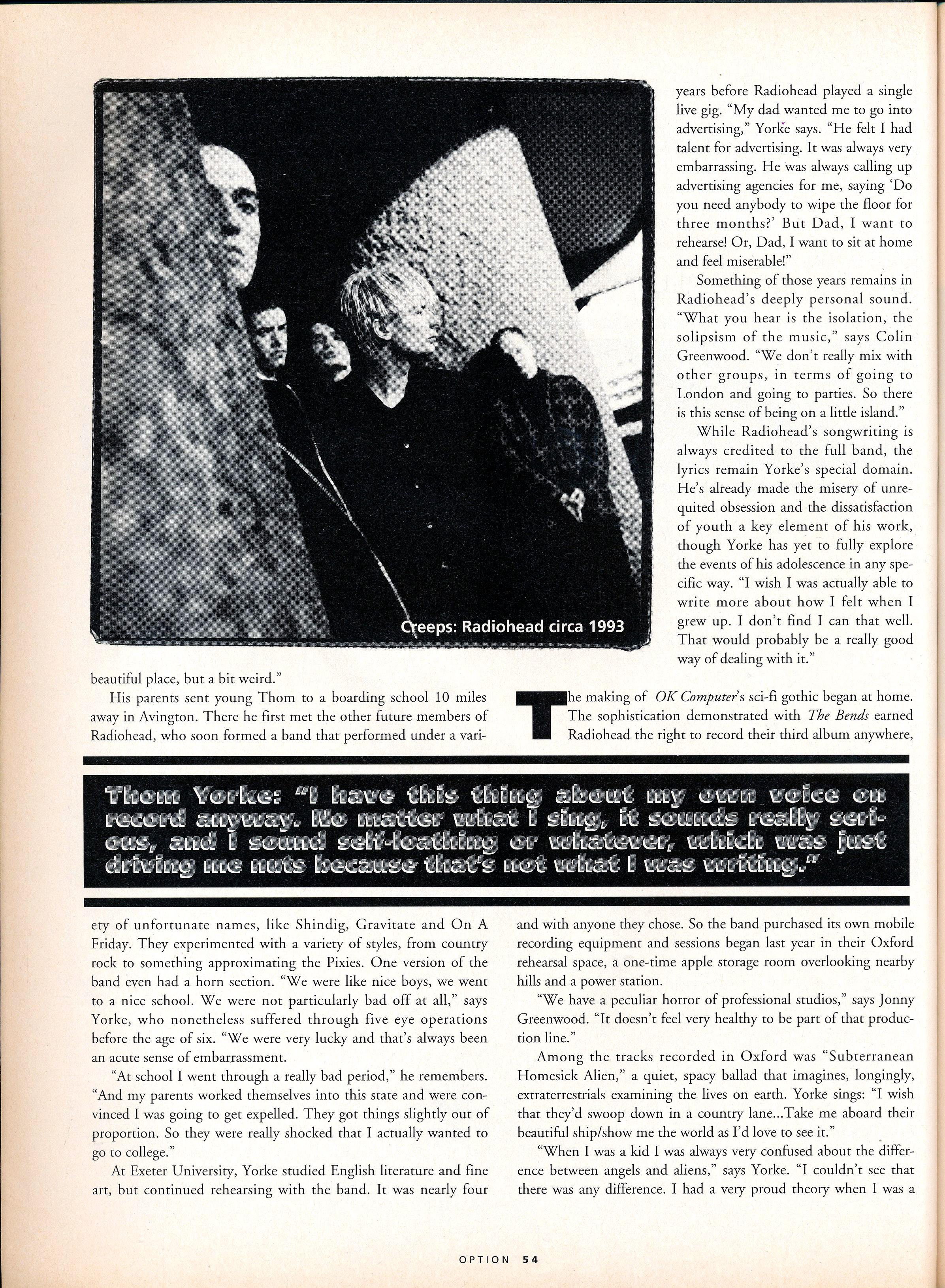
Gone now is the sensitive blond boy that Yorke seemed when Radiohead first arrived in Los Angeles in 1993, for what the band generally remembers as a disastrous gig at the Whisky A Go Go in front of the assembled press and record company execs. Today Yorke seems harder-edged, his hair sculpted into short red spikes, as if fighting off the polite media image that's dogged them from the beginning: foppish, bridge-playing tea-drinkers.
By now, both the Pretenders and Tears For Fears had helped turn "Creep" into a modern standard of obsessive, hopeless love by making it a regular part of their shows. The pressure to repeat, or at least approach the success of "Creep" had sent the band into a panic during early sessions for The Bends. What bogged them down wasn't a lack of material, but direction. The most dread for Yorke, Greenwood, O'Brien, drummer Phil Selway and bassist Colin Greenwood Jonny's elder brother), came from worrying about taking the wrong step, playing the wrong note. The stakes were now too high: the pressures of their own expectations and those of fans hoping for a dozen more "Creeps" on the next LP.
Amid rumors in the U.K. music press that the band was on the verge of a breakup, Radiohead created a harsh, expressive brew. New songs like "Bulletproof .. I Wish I Was" and "Bones" were more wrenching than anything they had done before, setting the vaguely industrial tone of Greenwood's lead guitar against the band's grim pop swirl. If Oasis was about pure escapism, then this was something closer to confession and disorientation.
"The Bends was an incredibly personal album, which is why when it came out I spent most of my time denying it was personal at all," Yorke says with a laugh. "Since then people have regularly accused us of being miserable fucks from hell. I don't really mind that."
Yorke spent his early childhood in Scotland, but by age 7 Oxford, where all of Radiohead has mixed feelings about the place, its privileged student population, its fading industry and his solidly middle class upbringing. "I hated Oxford for a long time," says Yorke, now 28. "I still do, actually, a little bit. It's a very beautiful place, but a bit weird."
His parents sent young Thom to a boarding school 10 miles away in Avington. There he first met the other future members of Radiohead, who soon formed a band that performed under a variety of unfortunate names, like Shindig, Gravitate and On A Friday. They experimented with a variety of styles, from country rock to something approximating the Pixies. One version of the band even had a horn section. 'We were like nice boys, we went to a nice school. We were not particularly bad off at all," says Yorke, who nonetheless suffered through five eye operations before the age of six. "We were very lucky and that's always been an acute sense of embarrassment.
"At school I went through a really bad period," he remembers. "And my parents worked themselves into this state and were convinced I was going to get expelled. They got things slightly out of proportion. So they were really shocked that I actually wanted to go to college."
At Exeter University, Yorke studied English literature and fine art, but continued rehearsing with the band. It was nearly four years before Radiohead played a single live gig. "My dad wanted me to go, into advertising," Yorke says. "He felt I had talent for advertising. It was always very embarrassing. He was always calling up advertising agencies for me, saying 'Do you need anybody to wipe the floor for three months?' But Dad, I want to rehearse! Or, Dad, I want to sit at home and feel miserable!"
Something of those years remains in Radiohead's deeply personal sound. "What you hear is the isolation, the solipsism of the music," says Colin Greenwood. "We don't really mix with other groups, in terms of going to London and going to parties. So there is this sense of being on a little island."
While Radiohead's songwriting is always credited to the full band, the lyrics remain Yorke's special domain. He's already made the misery of unrequited obsession and the dissatisfaction of youth a key element of his work, though Yorke has yet to fully explore the events of his adolescence in any specific way. "I wish I was actually able to write more about how I felt when I grew up. I don't find I can that well. That would probably be a really good way of dealing with it."
The making of OK Computer's sci-fi gothic began at home.
The sophistication demonstrated with The Bends earned Radiohead the right to record their third album anywhere, and with anyone they chose. So the band purchased its own mobile recording equipment and sessions began last year in their Oxford rehearsal space, a one-time apple storage room overlooking nearby hills and a power station.
"We have a peculiar horror of professional studios," says Jonny Greenwood. "It doesn't feel very healthy to be part of that production line."
Among the tracks recorded in Oxford was "Subterranean Homesick Alien," a quiet, spacy ballad that imagines, longingly, extraterrestrials examining the lives on earth. Yorke sings: "I wish that they'd swoop down in a country lane ... Take me aboard their beautiful ship/show me the world as I'd love to see it."
"When I was a kid I was always very confused about the difference between angels and aliens," says Yorke. "I couldn't see that there was any difference. I had a very proud theory when I was a child that they were the same people. I just loved the idea of someone observing how we live from the outside and running home with home movies to show their friends at parties and sitting there pissing themselves laughing at how humans go about their daily business."
Yorke denies any unifying theme for the lyrics to OK Computer, but the dehumanization of society from encroaching technology is a recurring motif. On "Fitter Happier," a computer voice reads a Yorke poem that hauntingly spells out the logical, productive behavior expected of the ideal human. ("Not drinking too much... regular exercise at the gym... getting on better with your associate employee contemporaries... no paranoia ...")
"It's the most upsetting thing that I've ever written. The reason we used a computer voice is that it appeared to be emotionally neutral," explains Yorke. "In fact, it wasn't because the inflections that it uses made it to me incredibly emotional. It brought out something that I thought was essentially flat, it brought it to life in a really fuckin' eerie way.
"I have this thing about my own voice on record anyway. No matter what I sing, it sounds really serious, and I sound self-loathing or whatever, which was just driving me nuts because that's not what I was writing."
Sessions for OK Computer ultimately left the band's apple shed at the outskirts of Oxford ("There was nowhere to eat or defecate, which are two fairly basic human drives," says Jonny), and moved to the library of an 18th century manor just outside Bath. The entire recording process took about three months, spread over the course of a year, with the band entering the studio only when inspiration dictated. Binding the album together is the often harsh, melodically expressive sound from Radiohead's formidable trio of guitars played by Greenwood, O'Brien and Yorke.
The subversive elements emerge from a mix dense with ideas: the found radio signals, the vaguely bossa nova passage within "Paranoid Android," the melancholy vocal melodies suitable enough for string quartet.
In this era of electronics, Radiohead is notably a band that understands the emotive power of electric guitar. Jonny Greenwood comes closest to filling the role of lead guitarist. He remains a skinny, wiry presence onstage, but with arms rippling with strange new muscles, a brace on his right wrist from repeated abuse.
"It's a very difficult thing to do well, to use volume and noise, and white noise, says Greenwood. "It's a very easy thing to overuse. We're very careful how and where we use dynamics."
Greenwood is standing backstage after a short charity set in Los Angeles, but he's still wired. As he talks, his arms move nervously, almost spider-like up and down his rail-thin torso. "I never listened to guitar playing in any band, ever," he says. "I still don't, really. Worshiping guitarists is all buying guitar magazines. Anybody can play guitar, but writing songs is a far harder challenge. I'd rather idolize someone like Elvis Costello than I would Steve Vai."
That dismissive attitude towards guitar heroism hadn't stopped Greenwood from helping shape a desperate beauty within the chaotic pop of OK Computer. "You knew you were on to something, because I started to get this fear, probably some induced paranoia, that the tapes would be lost or stolen," Greenwood says. "I was really worried about it, which suggests that I knew it was good. That was a good sign.
It's only a short, quiet drive from their hotel to the 9:30 Club, but the members of Radiohead are not wasting a moment. The quintet is rolling through the capitol, past the monuments and the boarded-up apartments, in a rented tour bus with scenes of tropical paradise painted on each side. Inside, assorted plans and schedules are being considered, discussions about some requested EP for Japanese fans, about some T-shirt designs gone wrong.
Resting on the shelf above Yorke's head is an alien doll, slouching in the summer heat. "It's so hot!" moans Colin Greenwood. "I can't believe this is your legislative center!"
The show is still hours away when the bus pulls up to the club, but already awaiting Radiohead on the sidewalk is a quartet of teen girls, who will keep a respectful distance with their snapshot cameras as the band exits the bus.
As the driver guides the bus up towards the door, Jonny Greenwood stands behind him, urging him closer to the old brick building. There are customs to uphold, appearances to consider. Move ever closer to the door, Jonny jokes,
"So that we don't have to touch the ground."
Steve Appleford is the editor of this magazine.