
Fitter. Happier. More Productive.
Letting loose on its confident new album and jazzed to be back on the road, Radiohead is looking on the bright side.
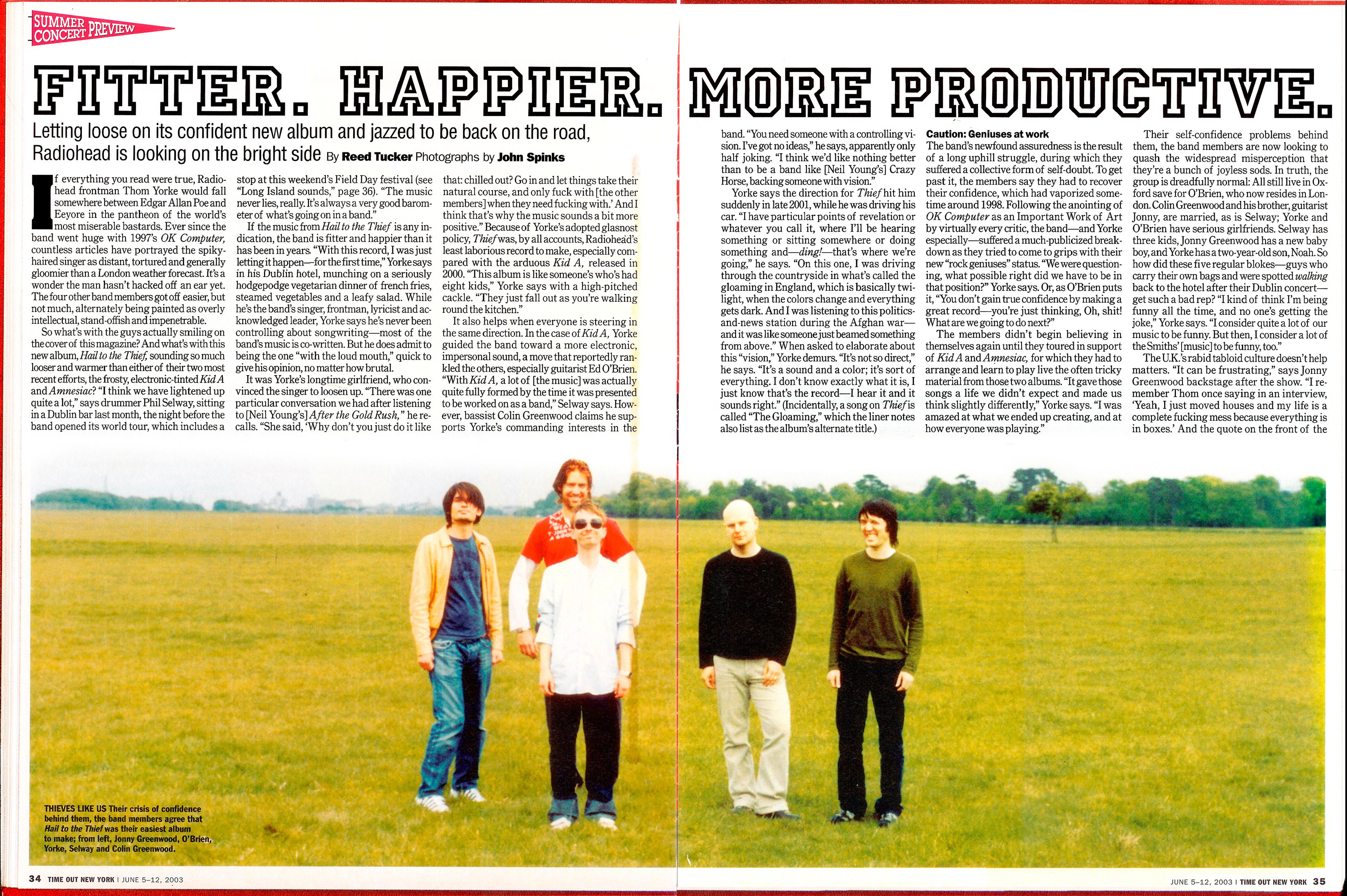
If everything you read were true, Radiohead frontman Thorn Yorke would fall somewhere between Edgar Allan Poe and Eeyore in the pantheon of the world’s most miserable bastards. Ever since the band went huge with 1997’s OK Computer, countless articles have portrayed the spiky-haired singer as distant, tortured and generally gloomier than a London weather forecast. It’s a wonder the man hasn’t hacked off an ear yet. The four other band members got off easier, but not much, alternately being painted as overly intellectual, stand-offish and impenetrable.
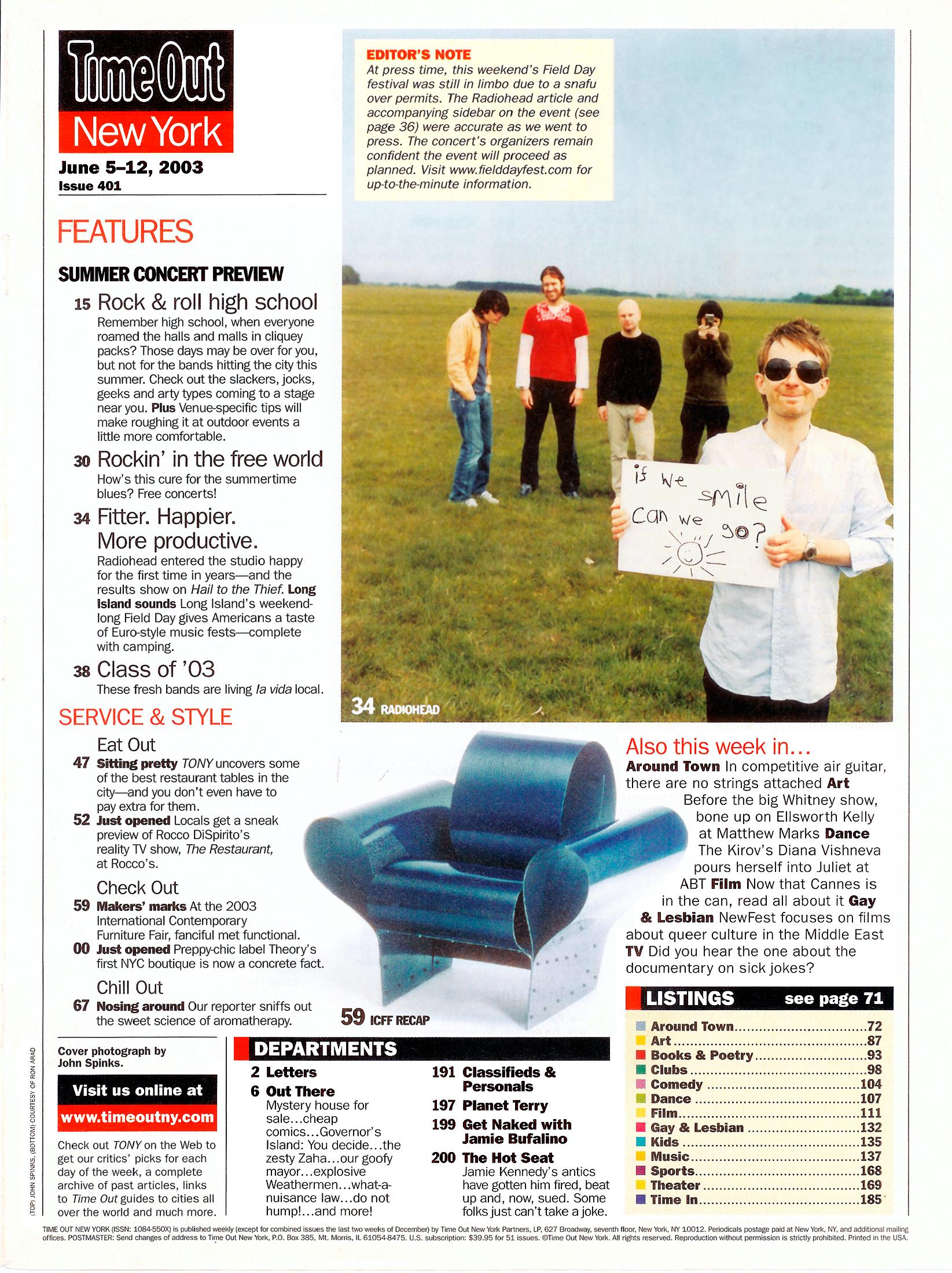
So what’s with the guys actually smiling on the cover of this magazine? And what’s with this new album, Hail to the Thief, sounding so much looser and warmer than either of their two most recent efforts, the frosty, electronic-tinted Kid A and Amnesiac? “I think we have lightened up quite a lot,” says drummer Phil Selway, sitting in a Dublin bar last month, the night before the band opened its world tour, which includes a stop at this weekend’s Field Day festival (see “Long Island sounds,” page 36). “The music never lies, really. It’s always a very good barometer of what’s going on in a band.”
If the music from Hail to the Thief is any indication, the band is fitter and happier than it has been in years “With this record, I was just letting it happen – for the first time,” Yorke says in his Dublin hotel, munching on a seriously hodgepodge vegetarian dinner of french fries, steamed vegetables and a leafy salad. While he’s the band’s singer, frontman, lyricist and acknowledged leader, Yorke says he’s never been controlling about songwriting – most of the band’s music is co-written. But he does admit to being the one “with the loud mouth,” quick to give his opinion, no matter how brutal.
It was Yorke’s longtime girlfriend, who convinced the singer to loosen up. “There was one particular conversation we had after listening to [Neil Young’s] After the Gold Rush,” he recalls. “She said, ‘Why don’t you just do it like that chilled out? Go in and let things take their natural course, and only fuck with [the other members] when they need fucking with.’ And I think that’s why the music sounds a bit more positive.” Because of Yorke’s adopted glasnost policy, Thief was, by all accounts, Radiohead’s least laborious record to make, especially compared with the arduous Kid A, released in 2000. “This album is like someone’s who’s had eight kids,” Yorke says with a high-pitched cackle. “They just fall out as you’re walking round the kitchen.”
It also helps when everyone is steering in the same direction. In the case of Kid A, Yorke guided the band toward a more electronic, impersonal sound, a move that reportedly rankled the others, especially guitarist Ed O’Brien. “With Kid A, a lot of [the music] was actually quite fully formed by the time it was presented to be worked on as a band,” Selway says. However, bassist Colin Greenwood claims he supports Yorke’s commanding interests in the band. “You need someone with a controlling vision. I’ve got no ideas,” he says, apparently only half joking. “I think we’d like nothing better than to be a band like [Neil Young’s] Crazy Horse, backing someone with vision.”
Yorke says the direction for Thief hit him suddenly in late 2001, while he was driving his car. “I have particular points of revelation or whatever you call it, where I’ll be hearing something or sitting somewhere or doing something and – ding! – that’s where we’re going,” he says. “On this one, I was driving through the countryside in what’s called the gloaming in England, which is basically twilight, when the colors change and everything gets dark. And I was listening to this politics-and-news station during the Afghan war – and it was like someone just beamed something from above.” When asked to elaborate about this “vision,” Yorke demurs. “It’s not so direct,” he says. “It’s a sound and a coIor; it’s sort of everything. I don’t know exactly what it is, I just know that’s the record – I hear it and it sounds right.” (Incidentally, a song on Thief is called “The Gloaming,” which the liner notes also list as the album’s alternate title.)
Caution: Geniuses at work
The band’s newfound assuredness is the result of a long uphill struggle, during which they suffered a collective form of self-doubt. To get past it, the members say they had to recover their confidence, which had vaporized sometime around 1998. Following the anointing of OK Computer as an Important Work of Art by virtually every critic, the band – and Yorke especially – suffered a much-publicized breakdown as they tried to come to grips with their new “rock geniuses” status. “We were questioning, what possible right did we have to be in that position?” Yorke says. Or, as O’Brien puts it, “You don’t gain true confidence by making a great record – you’re just thinking, Oh, shit! What are we going to do next?”
The members didn’t begin believing in themselves again until they toured in support of Kid A and Amnesiac, for which they had to arrange and learn to play live the often tricky material from those two albums. “It gave those songs a life we didn’t expect and made us think slightly differently,” Yorke says. “I was amazed at what we ended up creating, and at how everyone was playing.”
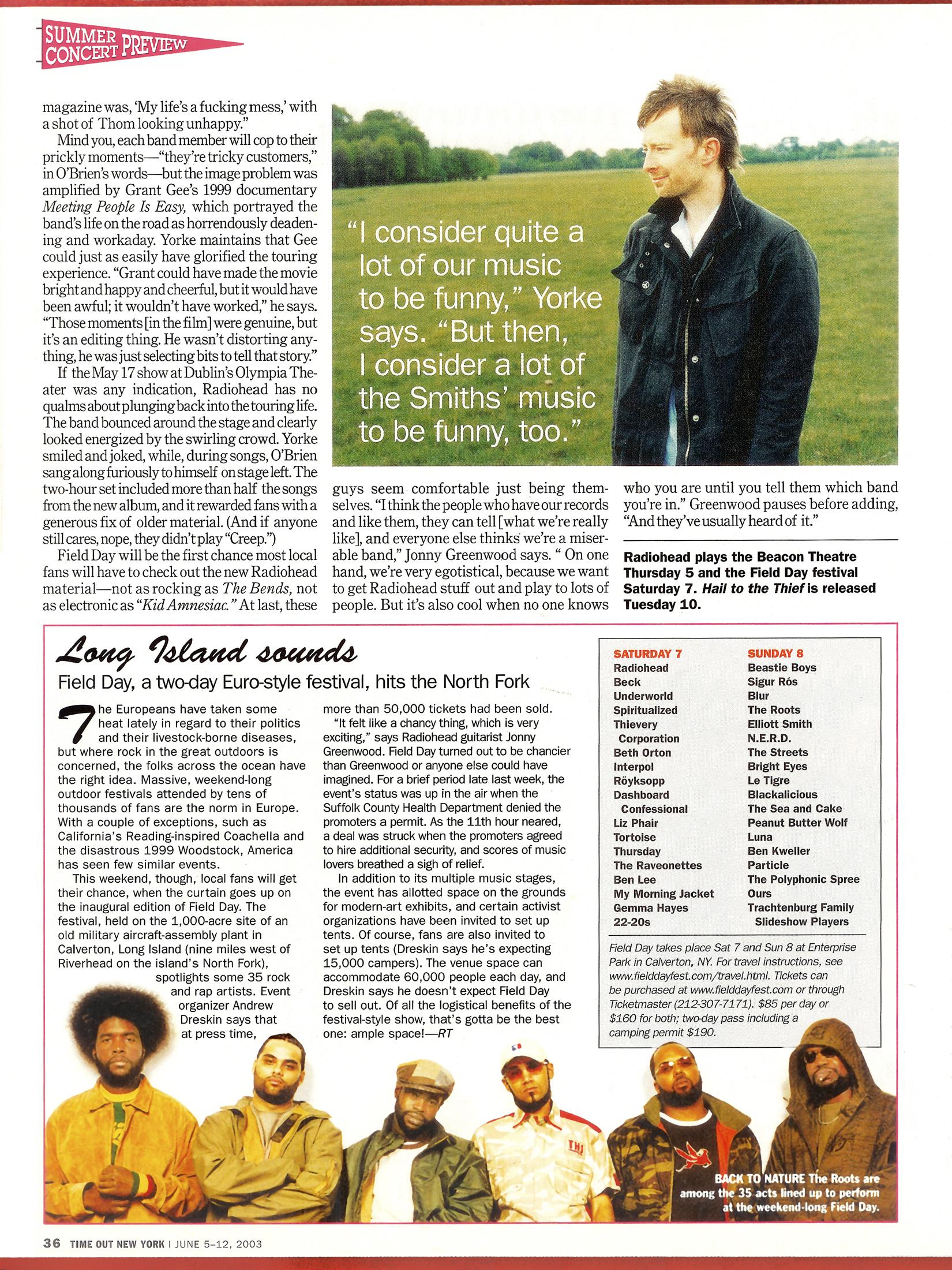
Their self-confidence problems behind them, the band members are now looking to quash the widespread misperception that they’re a bunch of joyless sods. In truth, the group is dreadfully normal: All still live in Oxford save for O’Brien, who now resides in London. Colin Greenwood and his brother, guitarist Jonny, are married, as is Selway; Yorke and O’Brien have serious girlfriends. Selway has three kids, Jonny Greenwood has a new baby boy, and Yorke has a two-year-old son, Noah. So how did these five regular blokes-guys who carry their own bags and were spotted walking back to the hotel after their Dublin concert get such a bad rep? “I kind of think I’m being funny all the time, and no one’s getting the joke,” Yorke says. “I consider quite a lot of our music to be funny. But then, I consider a lot of the Smiths’ [music] to be funny, too.”
The U.K.’s rabid tabloid culture doesn’t help matters. “It can be frustrating,” says Jonny Greenwood backstage after the show. “I remember Thom once saying in an interview, ‘Yeah, I just moved houses and my life is a complete fucking mess because everything is in boxes.’ And the quote on the front of the magazine was, ‘My life’s a fucking mess,’ with a shot of Thom looking unhappy.”
Mind you, each band member will cop to their prickly moments – “they’re tricky customers,” in O’Brien’s words – but the image problem was amplified by Grant Gee’s 1999 documentary Meeting People Is Easy, which portrayed the band’s life on the road as horrendously deadening and workaday. Yorke maintains that Gee could just as easily have glorified the touring experience. “Grant could have made the movie bright and happy and cheerful, but it would have been awful; it wouldn’t have worked,” he says. “Those moments [in the film] were genuine, but it’s an editing thing. He wasn’t distorting anything, he was just selecting bits to tell that story.”
If the May 17 show at Dublin’s Olympia Theater was any indication, Radiohead has no qualms about plunging back into the touring life. The band bounced around the stage and clearly looked energized by the swirling crowd. Yorke smiled and joked, while, during songs, O’Brien sang along furiously to himself on stage left. The two-hour set included more than half the songs from the new album, and it rewarded fans with a generous fix of older material. (And if anyone still cares, nope, they didn’t play “Creep.”)
Field Day will be the first chance most local fans will have to check out the new Radiohead material – not as rocking as The Bends, not as electronic as “Kid Amnesiac.” At last, these guys seem comfortable just being themselves. “I think the people who have our records and like them, they can tell [what we’re really like], and everyone else thinks we’re a miserable band,” Jonny Greenwood says. “On one hand, we’re very egotistical, because we want to get Radiohead stuff out and play to lots of people. But it’s also cool when no one knows who you are until you tell them which band you’re in.” Greenwood pauses before adding, “And they’ve usually heard of it.”
Radiohead plays the Beacon Theatre Thursday 5 and the Field Day festival Saturday 7. Hail to the Thief is released Tuesday 10.