

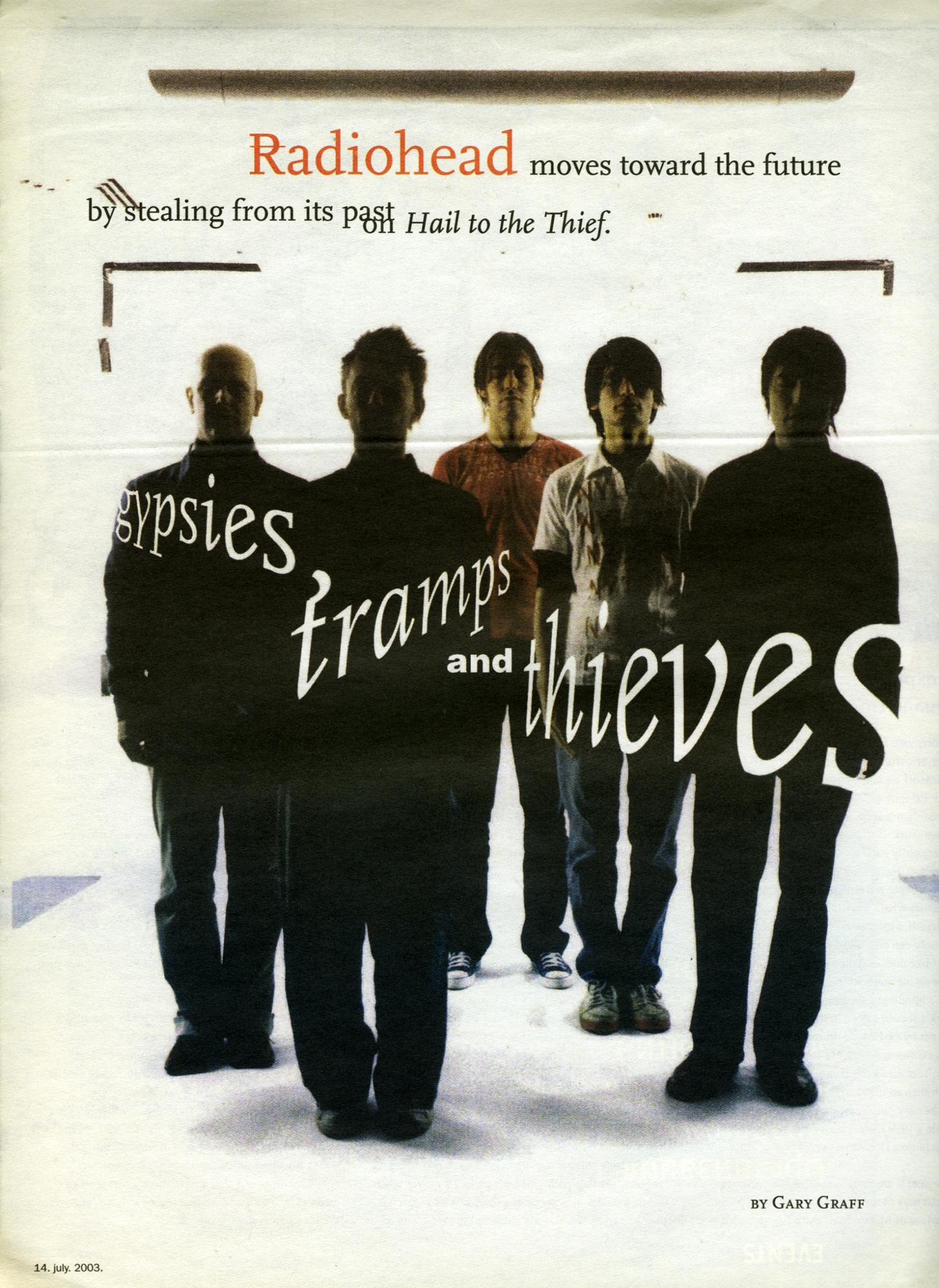
gypsies, tramps and thieves
Radiohead moves toward the future by stealing from its past on Hail to the Thief.
IF THERE’S A RADIOHEAD MANIFESTO, IT’S THAT NOTHING GETS DONE THE SAME WAY TWICE. So it’s not surprising when guitarist Ed O’Brien explains that “our goal is really not to do what we’ve done before – it’s really as simple as that – and not to go over old ground. A lot of the time it didn’t feel right to pick up the guitar and do kind of what we’ve done before.
“There wasn’t mass amounts of thinking behind it; it was just ‘We’re not gonna go over old ground.’”
And during the past decade of recording, from 1993’s Pablo Honey to the new Hail to the Thief, Radiohead has – or hasn’t – done just that.
It’s been quite a ride for the quintet, which formed in 1991 in Oxford – and for its fans, who have witnessed a shiftless creative history that’s been as challenging as it has been aesthetically rewarding. On Pablo Honey and its 1995 successor The Bends, Radiohead emerged as another moody British pop band, albeit a top-shelf one thanks to frontman Thom Yorke’s evocative lyricism (sample “Creep,” “High and Dry” and “Fake Plastic Trees”) and the unusual textural attack crafted by O’Brien and guitarist/keyboardist Jonny Greenwood.
The stakes went up exponentially on 1997’s OK Computer, however. A loosely thematic work examining the impact of technology on society, the album was a consensus choice as one of that year’s best releases – not to mention the best headphone listening experience – and even prompted comparisons to classic prog-rockers such as Pink Floyd. OK Computer also won a Grammy Award for Best Alternative (Rock) Performance and prompted director Grant Gee’s melancholy documentary “Meeting People is Easy.”
The film, in fact, offered the first glimpse into the discomfort Radiohead was feeling about its popularity surge – particularly as the music industry began to roll for bands that, on the surface at least, were coming from a similar sonic mold, such as Coldplay, Doves and Travis. “The media was building us up to be the next sort of U2 or R.E.M.,” notes bassist Colin Greenwood. “But some of our experiences on OK Computer made us very uncomfortable with that career trajectory.
“The last thing we wanted to do was go into the studio and make another version of OK Computer.”
They didn’t. Instead Radiohead and producer Nigel Godrich began the contentious, nearly band-splitting sessions that would yield Kid A in 2000 and Amnesiac the following year. Short on guitars and traditional song structures and long on electronic-oriented experimentation, they were a polarizing pair of releases that certainly bolstered Radiohead’s artistic integrity but, in some critical and audience quarters, fell short of the magical mark set by their predecessors.
No apologies from Radiohead, however. “We bought out of a lot of things that were a sort of ‘successful career strategy’ and bought into something that made us a lot happier as a band and insured that we carried on,” Greenwood explains. “We would have split up after OK Computer if we hadn’t done those two albums.”
O’Brien, meanwhile, notes that “If you tend to do something that’s different and new, it’s not going to be easy ‘cause you’re challenging your own preconceptions. I’m not surprised some people have found listening to [Kid A and Amnesiac] quite difficult; we did as well. It took us awhile to get our heads into that space, and we’re the people making the records.
“But it’s always like that – it was like that on The Bends and it was like that on OK Computer. So it never really changes in that respect. If you’re gonna do something new, it’s going to be difficult. It should be difficult, ‘cause the notion of doing something new implies that, really.”
In that regard, however, Hail to the Thief sounds like a bit of a retrenchment. Again produced by Godrich and recorded in both Oxfordshire and Los Angeles, it brings back the guitars and, in many instances, a warmer and more melodic tone. But it doesn’t entirely abandon the adventures of Kid A and Amnesiac.
Greenwood says that the idea of Thief as a synthesis of all things Radiohead “is fair enough. We decided to sort of be equitable about all the things we’d learned about making music, whether with a sampler, a computer or a guitar. We just treated everything more equally.”
Hail to the Thief was put in motion in 2002, when Radiohead played a series of summer shows in Spain and Portugal that included a rash of new songs that group had been working on back in Oxford. “It was all about playing the new songs in front of an audience,” Greenwood says of those concerts, “and playing them until they got the right reaction, and then going in and recording them in the studio.
“Hail to the Thief sort of came out of that experience of listening to the songs from Kid A and Amnesiac that were then sort of transmuted into something else live in concert. After doing that, we started thinking ‘What if we play these [new] songs live before recording them, rather than just writing them in the studio?’
“It seems like a very simple idea, but we were happy with it.”
Greenwood says the creative process for Hail to the Thief was “very democratic” and that the group knew it was onto something good when not only audiences but also its crew reacted favorably to the new material. “When we used to soundcheck, everyone would stop work and watch us, then go back to work,” he recalls. “That’s always a good sign – unless it’s ‘cause you’re all playing naked or something.”
He says that some of the songs, such as “The Gloaming” and “Backdrift,” changed markedly after being played live, while others were merely tweaked and tightened up. “It’s really cool when my brother [Jonny] builds a mad machine out of some Mac programming, so everything’s looped live,” Greenwood says. “Then you mix it with some live jazz breaks on guitar and drums and bass, and it turns into something new.”
Ultimately, the songs for Thief were in such ready shape that the group and Godrich were able to get them down in two weeks at Ocean Way Studios – a land speed record for Radiohead.
The mellow vibes of Southern California also made the process more pleasurable, he says. But spending time in Los Angeles, and America, also stoked Radiohead’s social-political consciousness.
“Being in L.A. and making it in America, you’re quite conscious that there’s not a lot of places that relate to American names,” the bassist explains. “What used to be called something 200 years ago by people who lived there is not there anymore. It resonated with us in lots of different ways.”
But, Greenwood adds, Thief’s title does not come strictly from political concerns – specifically the 2000 election of U.S. President George W. Bush. The album’s original title, “The Gloaming,” was deemed “a bit too much like prog-rock,” so Radiohead decided to grab a line from the album’s opening song, “2+2 = 5.”
“We wanted something colorful and bold, as well as the usual concerns of what’s going on in the world,” Greenwood says. “I wouldn’t want to pin it on one individual when it takes in a lot of boxes, really – even the Internet, to our music being stolen, burnt and downloaded by everyone. It had all these multiple meanings in it we enjoyed.”
Thief made its mark quickly, debuting at No. 1 on the U.K. charts in its first week of sales and scaling the Billboard Top 200 to No. 3.
All of that means Radiohead is still a big deal a decade after its first album. But Greenwood professes to be stumped when asked about where he feels the band fits these days in the pantheon of pop music.
“It’s funny, isn’t it; you get older and you think about playing together, being in a band and what it all means,” he says. “There are so many different answers to that question. I suppose the most important thing is to get to the stage where we enjoy what we’re doing in front of an audience who enjoys it, too.
“That sounds really cheesy, but it’s not meant to. We just try not to insult or bore the intelligence of our audience, ‘cause we’re aware their tastes are moving on as well as ours with music, and it’s exciting to be part of that. All we’re trying to do is to keep it interesting and fresh so that we can carry on doing it and keep coming back.”