Android Sangfroid
On seventh studio album, iconic post-rock band trades alienation for populism
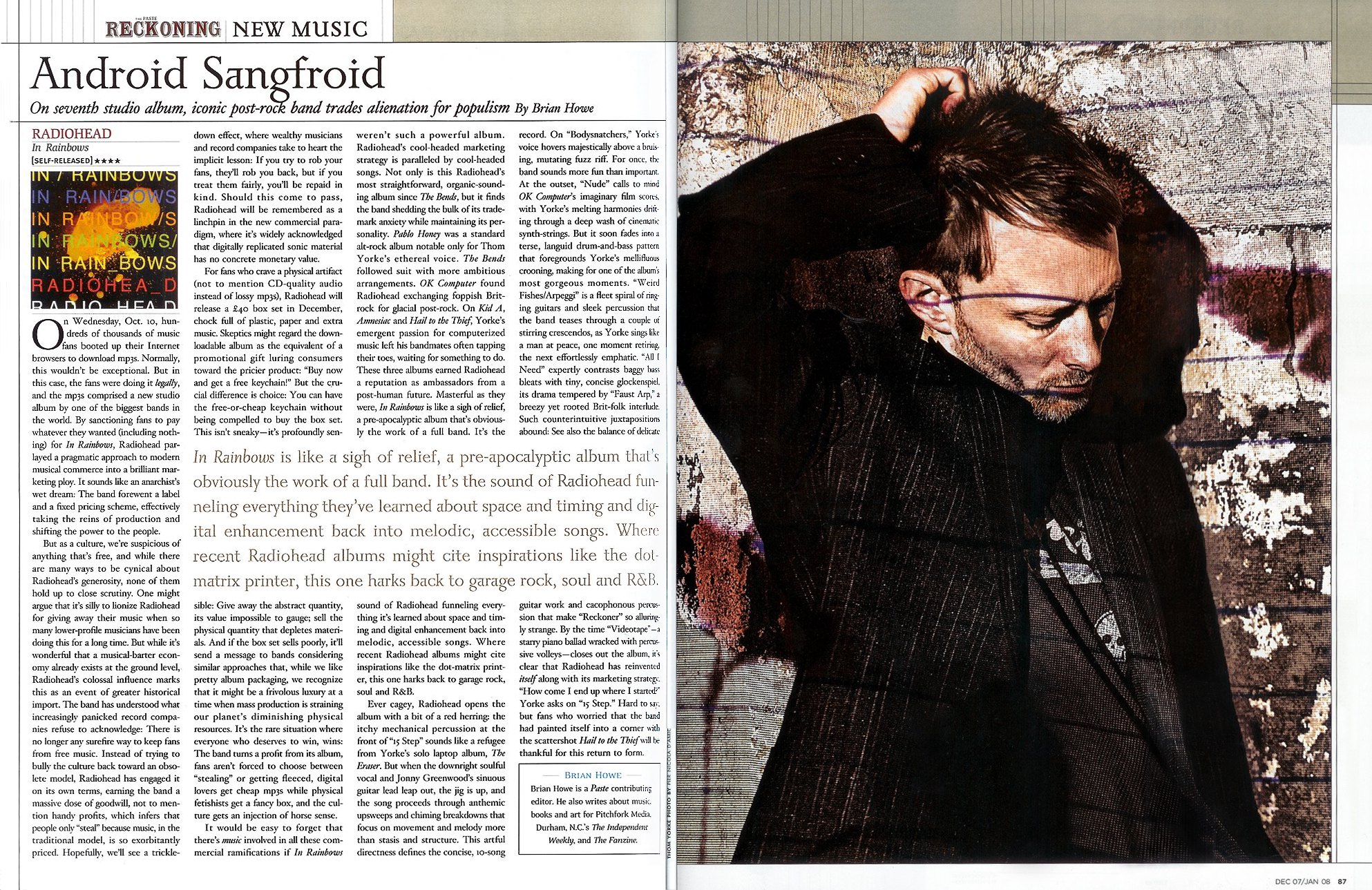
RADIOHEAD
In Rainbows
[SELF-RELEASED] **** (4/5)
On Wednesday, Oct. 10, hundreds of thousands of music fans booted up their Internet browsers to download mp3s. Normally, this wouldn’t be exceptional. But in this case, the fans were doing it legally, and the mp3s comprised a new studio album by one of the biggest bands in the world. By sanctioning fans to pay whatever they wanted (including nothing) for In Rainbows, Radiohead parlayed a pragmatic approach to modern musical commerce into a brilliant marketing ploy. It sounds like an anarchist’s wet dream: The band forewent a label and a fixed pricing scheme, effectively taking the reins of production and shifting the power to the people.
But as a culture, we’re suspicious of anything that’s free, and while there are many ways to be cynical about Radiohead’s generosity, none of them hold up to close scrutiny. One might argue that it’s silly to lionize Radiohead for giving away their music when so many lower-profile musicians have been doing this for a long time. But while it’s wonderful that a musical-barter economy already exists at the ground level, Radiohead’s colossal influence marks this as an event of greater historical import. The band has understood what increasingly panicked record companies refuse to acknowledge: There is no longer any surefire way to keep fans from free music. Instead of trying to bully the culture back toward an obsolete model, Radiohead has engaged it on its own terms, earning the band a massive dose of goodwill, not to mention handy profits, which infers that people only “steal” because music, in the traditional model, is so exorbitantly priced. Hopefully, we’ll see a trickle-down effect, where wealthy musicians and record companies take to heart the implicit lesson: If you try to rob your fans, they’ll rob you back, but if you treat them fairly, you’ll be repaid in kind. Should this come to pass, Radiohead will be remembered as a linchpin in the new commercial paradigm, where it’s widely acknowledged that digitally replicated sonic material has no concrete monetary value.
For fans who crave a physical artifact (not to mention CD-quality audio instead of lossy mP3s), Radiohead will release a £40 box set in December, chock full of plastic, paper and extra music. Skeptics might regard the downloadable album as the equivalent of a promotional gift luring consumers toward the pricier product: “Buy now and get a free keychain!” But the crucial difference is choice: You can have the free-or-cheap keychain without being compelled to buy the box set. This isn’t sneaky – it’s profoundly sensible: Give away the abstract quantity, its value impossible to gauge; sell the physical quantity that depletes materials. And if the box set sells poorly, it’ll send a message to bands considering similar approaches that, while we like pretty album packaging, we recognize that it might be a frivolous luxury at a time when mass production is straining our planet’s diminishing physical resources. It’s the rare situation where everyone who deserves to win, wins: The band turns a profit from its album, fans aren’t forced to choose between “stealing” or getting fleeced, digital lovers get cheap mp3s while physical fetishists get a fancy box, and the culture gets an injection of horse sense.
It would be easy to forget that there’s music involved in all these commercial ramifications if In Rainbows weren’t such a powerful album. Radiohead’s cool-headed marketing strategy is paralleled by cool-headed songs. Not only is this Radiohead’s most straightforward, organic-sounding album since The Bends, but it finds the band shedding the bulk of its trademark anxiety while maintaining its personality. Pablo Honey was a standard alt-rock album notable only for Thom Yorke’s ethereal voice. The Bends followed suit with more ambitious arrangements. OK Computer found Radiohead exchanging foppish Britrock for glacial post-rock. On Kid A, Amnesiac and Hail to the Thief, Yorke’s emergent passion for computerized music left his bandmates often tapping their toes, waiting for something to do. These three albums earned Radiohead a reputation as ambassadors from a post-human future. Masterful as they were, In Rainbows is like a sigh of relief, a pre-apocalyptic album that’s obviously the work of a full band. It’s the sound of Radiohead funneling everything it’s learned about space and timing and digital enhancement back into melodic, accessible songs. Where recent Radiohead albums might cite inspirations like the dot-matrix printer, this one harks back to garage rock, soul and R&B.
Ever cagey, Radiohead opens the album with a bit of a red herring: the itchy mechanical percussion at the front of “15 Step” sounds like a refugee from Yorke’s solo laptop album, The Eraser. But when the downright soulful vocal and Jonny Greenwood’s sinuous guitar lead leap out, the jig is up, and the song proceeds through anthemic upsweeps and chiming breakdowns that focus on movement and melody more than stasis and structure. This artful directness defines the concise, 10-song record. On “Bodysnatchers,” Yorke’s voice hovers majestically above a bruising, mutating fuzz riff. For once, the band sounds more fun than important. At the outset, “Nude” calls to mind OK Computer’s imaginary film scores, with Yorke’s melting harmonies drifting through a deep wash of cinematic synth-strings. But it soon fades into a terse, languid drum-and-bass pattern that foregrounds Yorke’s mellifluous crooning, making for one of the album’s most gorgeous moments. “Weird Fishes/Arpeggi” is a fleet spiral of ringing guitars and sleek percussion that the band teases through a couple of stirring crescendos, as Yorke sings like a man at peace, one moment retiring, the next effortlessly emphatic. “All I Need” expertly contrasts baggy bass bleats with tiny, concise glockenspiel, its drama tempered by “Faust Arp,” a breezy yet rooted Brit-folk interlude. Such counterintuitive juxtapositions abound: See also the balance of delicate guitar work and cacophonous percussion that make “Reckoner” so alluringly strange. By the time “Videotape” – a starry piano ballad wracked with percussive volleys – closes out the album, it’s clear that Radiohead has reinvented itself along with its marketing strategy. “How come I end up where I started?” Yorke asks on “15 Step.” Hard to say, but fans who worried that the band had painted itself into a corner with the scattershot Hail to the Thief will be thankful for this return to form.