“The Follow-up” is a series in which musicians walk us through the making and release of their sophomore albums. Here, Radiohead guitarist Ed O’Brien explains the creative process and recording of his solo record Blue Morpho and the “shit economics” of trying to tour it.
Ed O’Brien had to have his own metamorphosis to create his hauntingly beautiful sophomore album, Blue Morpho. It took four years to write and record its seven songs, which were spurred by the Radiohead guitarist’s experience of falling into a deep depression and navigating decades of emotional trauma exacerbated by the pandemic lockdowns. O’Brien learned that being immersed in nature is where he felt the strongest — the title Blue Morpho refers to a rare species of butterfly he encountered with his family. “Part of my healing journey was walking in the trees and in the river, feeling the light, and recalibrating there,” he explains. “My cathedral is in the woods.” The album contains mossy psych-folk beats, self-recorded bird chirps, perfectly tuned flutes, and jazzy string arrangements waiting to enchant your ears, not unlike another rocker’s recent solo project. “I couldn’t listen to any more alternative guitar music,” he says. “It got to a point when I was like, I never need to hear this again. It doesn’t interest me anymore.”
Besides a few tour dates planned overseas in October to support Blue Morpho, O’Brien — despite the financial cushion from being in one of the most successful rock bands of all time — doesn’t think it’s feasible to bring the show over to the U.S. in the near future. “It’s shit economics,” he admits. “It’s so expensive to tour.” He’s currently unsure which city or venue Radiohead will select for its 2027 slate of performances, but the Sphere doesn’t interest him much. “It’s funny how when a band goes away for a long time and you don’t hear their music, you really miss them and realize, God, that was so good,” he says with a smirk. “When you go away, people miss you. Which is bizarre.” Now, though, O’Brien guides us through his personal landscape for Blue Morpho, which is out May 22.
The artist name
On the first album, I was hiding and used the initials “EOB.” There was a huge deal of uncertainty that went along with it. The whole process of making the second record is I’m no longer hiding from myself or from the world. This is who I am — take it or leave it. It has been my modus operandi for a long time. The journey that I’ve been through is one of truth, learning to understand what I really feel, and being honest about it. So in that sense, I couldn’t be more truthful than go under my own name.
The backstory
The identity of the record started to form in the summer of 2022. I decided I no longer wanted to be, say, the controller that controls everything, but rather let go and see what emerges. It’s really difficult because a lot of it comes from this initial “dark night of the soul.” It’s like a death of the ego, but it’s also when you descend into a dark place. When you’re in that dark place and sit in it long enough, you feel there’s a moment — well, certainly for me — or a sense of grace. I’ve always had a spiritual connection to these kinds of feelings, particularly in nature. I taught myself meditation 20 years ago. I call myself a mongrel meditator. So I’ve been seeking this connection with the divine in that period of depression. When you fall down, that’s often where grace and a connection with the divine come out like a well-warn root.
It’s been quite a hard thing for me to talk about. I’ve hidden my spiritual connection in the past because I’m a boy from Oxford. Oxford is a very academic and intellectual place. There isn’t much room to talk about transcendent moments or the connection with the divine because it’s not empirical and you can’t measure it. Academia wants things to be measured. I love academia, but I also find it incredibly limiting because it can’t account for what I feel. I love the writings of William Blake and a lot of these poets and sages because they managed those feelings beautifully. I’m on that journey, and I don’t know how I do it; it comes through me. If you ask me how these riffs came about, I’ve got no idea. I get into a semi-meditative state when I play or sing. The first few times I listened to “Blue Morpho,” I was like, How the fuck did that track happen?
The sounds
I sort of stopped listening to music in that first lockdown. I’d had enough. I was suddenly aware of this extraordinary birdsong. All of the birds were so happy when our world shut down — you could hear it. They were like, Finally. The idiots have stopped running around. Nature was just delighted with what we were doing. I got the Merlin app so I could start identifying all of the bird sounds. We had a particularly beautiful summer in Wales and had all the windows open. I had a microphone outside to record the birds, and I realized I wanted to make a track out of birdsong.
I was also interested in sacred music that has a transcendence within. Jeff Buckley, Ella Fitzgerald, John Coltrane, and Miles Davis all had that same connection with the divine. I listened to A Love Supreme a lot because I wanted to understand and feel John’s connection and his strength. Spirit of Eden, by Talk Talk, is an amazing record and I leant into that a bit. But I was really interested in Coltrane. I was inspired by a lot of Brazilian jazz, people like Jorge Ben and Joyce Moreno. I also listened to a lot of classical music. Up until the age of about 13, I had quite a formal classical-music education. I sang in a choir before my voice broke.
You get to the point where you go, Well, I’m a father and a husband and that’s my purpose, but what else is there? I never thought Radiohead would happen again. What do I do? I’m not going to do music for the sake of it. The thing that came through was: My purpose is I have to try and put beautiful things out there in the world. That’s my job. That’s it. The beauty that I feel feeds into me, as do the sadness and the joy.
The producer
I found a musical family through synchronistic events. I was a big Police fan and I was like, What’s synchronicity? With Paul Epworth, we’re both dads at the same school; he rang me up before we got into the studio, and we had this conversation for an hour. We had three days in this amazing studio of a church. I didn’t want to say, “Oh, I’d love to make a record with you,” because he’s Paul Epworth and he’s working with big artists. And if it’s not big artists, he’s working with people like Arlo Parks who are on the way up. I thought someone of his stature wouldn’t want to be involved with a side project of someone who had been in Radiohead. So a few weeks went by and I called him up and said, “Should we go for coffee?” I laid it out. “Paul, I’d love to work with you.” And he said, “I’d love to do exactly the same.” I couldn’t believe it.
The (lack of) Radiohead
Philip Selway plays drums on “Sweet Spot” and “Blue Morpho.” I just felt they needed Phil. He’s such a beautiful drummer — he always brings his full heart and soul to everything he does. So I asked him, “Do you fancy coming along?” He came for an afternoon and absolutely nailed it. Colin Greenwood played bass on “Brasil” from my first record. You ask because you want them to play on it, not because it’s some big deal or a marketing purpose. I love singing with Thom Yorke. I really enjoyed it on the tour we just did. It would be interesting for me to sing lead and him to sing backup on something. Maybe in the future he might be up for singing one of my songs. My bandmates are all amazing musicians, and they’ve all got their own thing going. Each one of them is so unique in the way they play because they’re largely self-taught.
The artwork
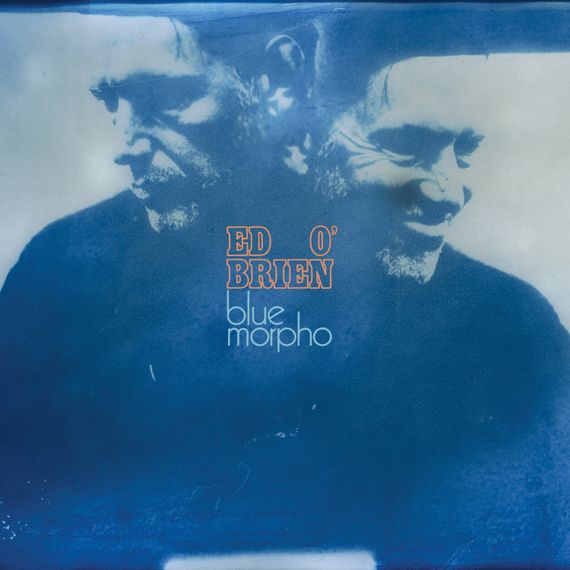
I knew I wanted it to be a certain shade of blue, funny enough. We took a bit of time to find the shade. I was very drawn to albums from about 1969 to 1974. Obviously, there’s Joni Mitchell’s Blue, which is seminal. I was also thinking about Bridge Over Troubled Water. It’s such a funny, grainy photo of Paul Simon and Art Garfunkel walking down a busy street. It’s kind of ordinary but still so powerful because of what’s in that record. I don’t have an artistic collaborator like Thom and Stanley Donwood — they’ve done all of these amazing covers for Radiohead and Thom’s stuff for the Smile. That’s a very, very lengthy process, but I don’t have time for that. If you get artwork for me, it needs to evolve.
Steve Gullick, an amazing photographer who’s done a lot of landscape art, came down to Wales. He had never done album covers or art direction, but I liked his process. We initially tried somebody, but it was too clean. I said, “This record has dirt under the fingernails. It needs mud; it needs the earth.” He did that whole process where he took copies of the photo, laid them outside in the sun for three days, and then they weathered. I guess I’m like a butterfly getting its wings.
The tour
I’d love to come to America, and I fully intend to bring this to America but it’s not feasible at the moment. We’re instead playing in very beautiful, intimate places in Europe this autumn. I don’t want to come to some nasty room and play this music. It has to be in the right environment. I think we’ll break even, but we won’t make any money with the tour. We’re lucky to just break even. If there’s demand for it, if people want it, then we’ll come. Of course, Radiohead is a whole other thing because the economies of scale work for the band. But smaller venues mean having a skeleton crew. We’re going to be packing up our own gear — all the stuff I haven’t done for years, but I’m quite happy to do it in this case.