O’Brien on overcoming depression, writing the most personal work of his life and the future of Radiohead.
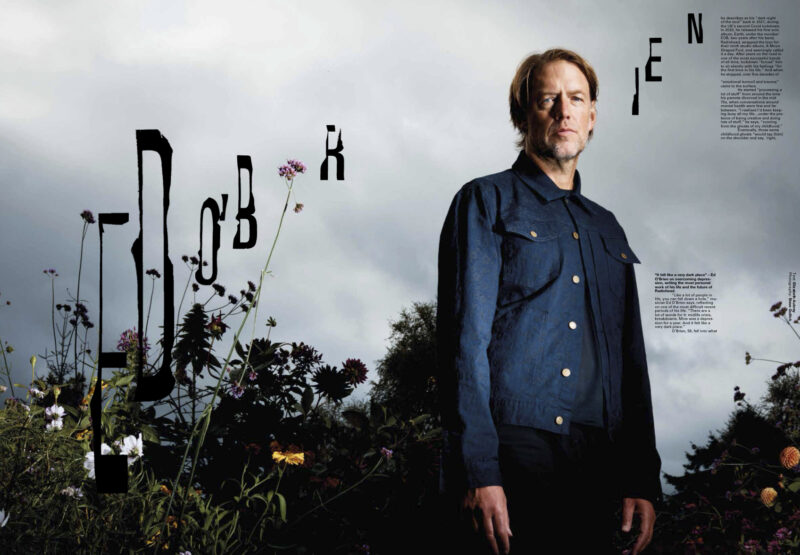
Captured by Steve Gullick
“Like a lot of people in life, you can fall down a hole,” musician Ed O’Brien says, reflecting on one of the most difficult recent periods of his life. “There are a lot of words for it: midlife crisis, breakdowns. Mine was a depression for a year. And it felt like a very dark place.”
O’Brien, 58, fell into what he describes as his “dark night of the soul” back in 2021, during the UK’s second Covid lockdown.
In 2020, he released his first solo album, Earth, under the moniker EOB, two years after his band, Radiohead, wrapped the tour for their ninth studio album, A Moon Shaped Pool, and seemingly called it a day. After years on the road in one of the most successful bands of all time, lockdown “forced” him to sit silently with his feelings “for the first time in his life.”
And when he stopped, over five decades of “emotional turmoil and trauma” came to the surface.
He started “processing a lot of stuff” from around the time his parents divorced in the mid 70s, when conversations around mental health were few and far between.
“I realised I’d been keeping busy all my life…under the pretence of being creative and doing lots of stuff,” he says, “running from the ghosts of my childhood.”
Eventually, those same childhood ghosts “would tap [him] on the shoulder and say, ‘right, you’re going to have to look at this stuff. You’re going to have to deal with this. You’ve been running, running away – you’ve been keep-ing busy.’”
Without lockdown, he says, “I’d have carried on deflecting and deflecting. I had to stop…I knew I’d been hiding for years and was not being truthful about myself or how I felt about things.”
A move from London to rural mid-Wales with his wife and two children was “huge” in his recovery: he went from being unable to function to finding solace in his new nature-filled surroundings.
He slowly found a way to structure his days – meditating felt like “a kind of spiritual practice” for him, which really helped,” he says, while playing the guitar for a few hours each morning gave him purpose.
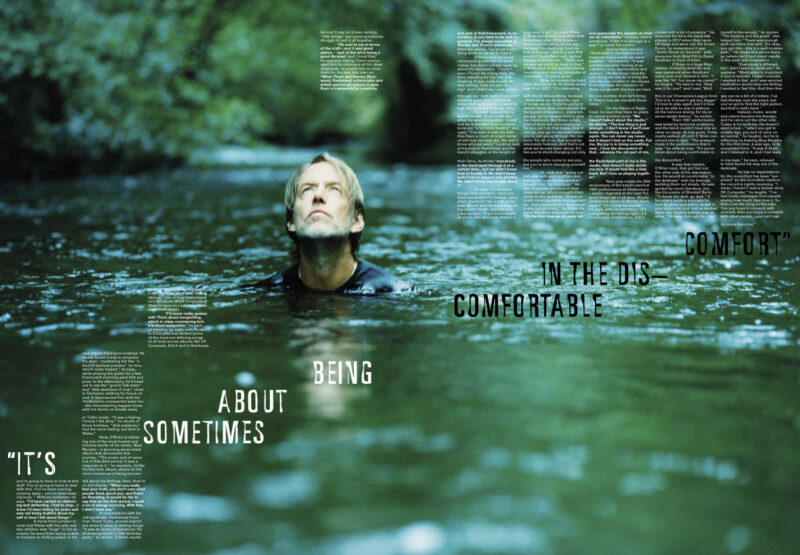
In the afternoons, he’d head out to see the “gnarly Oak trees” and “little stretches of river” close to his home, walking for hours on end. It reconnected him with his childhood in unexpected ways too– like remembering happier times with his family on breaks away in ‘Celtic lands’.
“It was a feeling I loved; I felt alive,” he recalls of those holidays. “And suddenly I had the same feeling out here in Wales.”
Now, O’Brien is releas- ing one of the most honest and emotive works of his career, Blue Morpho – a stunning seven-track album that documents this journey. “The music sort of came out of that dark period; it was a response to it,” he explains.
Unlike his first solo album, where he felt more conscious of being too candid about his feelings, here, they’re on full display.
“When you really feel your truth, you don’t care what people think about you, and that’s so liberating. It would be fair to say that on the first record, I spent a lot of energy worrying. With this, I didn’t have any.”
A conversation with his old bandmate, Radiohead frontman Thom Yorke, proved important when it came to writing songs.
“It was at Jonny [Greenwood, Radiohead guitarist]’s 50th birthday party,” he smiles. O’Brien recalls how he “got all these nuggets from Thom” in what was, astonishingly, one of their first proper conversations about songwriting (they’ve been in a band together since their teens).
“I’d never really spoken with Thom about songwriting, which is crazy considering he’s a brilliant songwriter,” he says of meeting up again with Yorke in 2022, who has written some of the most era-defining songs of all time across albums like OK Computer, Kid A and In Rainbows.
He told Yorke he’d been writing “little things” but could sometimes struggle to pull it all together.
“He said to me in terms of the craft – and it was great advice – ‘part of the art is being a good librarian’ and I loved that,” he explains, saying Thom encouraged him to catalogue all his ideas religiously, to enable him to mine them for the best bits later on.
“When Thom and Stanley [Donwood, Radiohead collaborator and artist] went to art school, it gave them a framework for creativity and part of that framework, to be creative, is you have to be well-organised. I’ve always marvelled at Stanley and Thom’s notebooks.”
After the advice, “he wrote everything down so as not to lose it.” O’Brien says he loved reconnecting with his old bandmates, but didn’t initially open up about his depression.
“I hadn’t seen [Thom] for a long time. We were standing by this fire, just chatting. It was really lovely. He was saying, ‘how are you doing?’ and I didn’t say I was going through my ‘dark night of my soul’ because guys don’t often [talk about that] and you don’t want to [talk about it] at a birthday party.”
He says approaches to mental health “back in the day” when he was young were “brutal”, and he is thankful now conversations are “a lot more healthy”and open.
“I’ve seen it with my kids – they have a much stronger sense of self than we ever did. We didn’t know who we were.”
Looking back at his time in Radiohead and the band’s struggles at the height of their fame, he thinks “everybody in the band went through it at a certain time…but we didn’t know how to handle it. We didn’t know quite how to support one another. We didn’t know how to talk about it.”
He says he’s thankful things have changed – and mentions bandmate Phil Selway (who plays drums on two tracks of his new album) and his work supporting mental health charities and crew on tour.
“It’s a much healthier place, but obviously there’s a long way to go,” he says. While O’Brien thought he was done with Radiohead after 2018, it was a huge surprise when, a year ago, the band decided to go back on tour in Europe – but in a way that wouldn’t burn them out – as had happened previously.
“There was no way we could go back to that,” O’Brien says of the band’s intense recording and touring schedules of yesteryear.
“It was a given.” Now, he reveals the band have decided to do 20 shows every year from 2027. “It’s interesting with the 20 shows thing, because I think what we do and the type of songs we do, if you’re going to deliver them, they need almost like the purest of intention…every single gig, we’ve always tried to give our maximum.
But those songs, a lot of them are very emotional. So you can’t do that many.
And if you do, you get to the point where you’re just going through the motions. For all of us, that would be absolutely hideous. And that’s not what we’ve ever been about. It’s like you’re short-changing not only the people who come to see you,
but you’re short-changing yourself too.”
He adds that “going out last year with your brothers and feeling the love for one another” brought him “so much joy.” He also loved the structure of their stage set-up, which brought them closer to the audience. “It was so much more equitable and egalitarian…and you could feel the energy: it was just glorious.”
He thinks the band felt closer than ever on tour. “It’s the first time we all really felt and appreciate the wonder of what we do collectively,” he says, clearly emotional. “I felt that strongly in a way I’ve never felt before.”
During their reunion, “there wasn’t one bad word in however many weeks we were together,” he explains. “It was just this beautiful feeling of acceptance, love, appreciation and respect…[At the time] I said the only thing we can do is bring the love for one another to the shows.
If we can raise the vibration of those songs with the love we have for one another, then let’s bring it. That’s how we elevated those notes.”
On the future of Radiohead, he says they have no plans to record anytime soon. “We haven’t talked about the studio,” he admits. “The live thing is just enough…I don’t know if we’ll ever make something in the studio again.
You can never say never, but it doesn’t feel on the cards. For me, the joy is in doing something new…I love the discomfort of that…whereas the old part of me, the Radiohead part of me in the studio, that doesn’t really excite me now. It would feel like a step back. But I love us playing together.”
Next year marks the 30th anniversary of the band’s seminal 1997 performance at Glastonbury– widely regarded as the best Pyramid Stage set of all time. Would Radiohead return to Worthy Farm again? “Oh I think we would,” he says, without hesitation. “It’s just getting the timing right…I’d love to play Glastonbury, but it comes with a lot of pressure.”
He recounts the time the band last played in 2017 when they came off stage and went into the Green Room, he remembers it was “Stella Street on Steroids” with everyone from Brad Pitt to David Beckham in front of them.
O’Brien is a huge Manchester United football fan and was starstruck when Beckham came over and chatted to him. “I was like ‘Hi! You know my name!’” he laughs. “He said to me, ‘How was it for you?’ and I said, ‘Well, this is our Champions League final.
This is it. It doesn’t get any bigger.’
I’d love to play again, but I’d love us to be able to play it without all the nervous energy for six or seven weeks before,” he smiles.
Their 1997 performance was beset by technical problems, and the band couldn’t hear one another on stage. At one point, Yorke nearly walked off until O’Brien convinced him to stay. “The pressure made it the performance that it was,” he reflects now. “It’s some times about being comfortable in
the discomfort.”
It was that mantra, O’Brien says, that got him out the other side of his depression too. He would sit comfortably “in the darkness” with his feelings, working them out slowly. He was guided by much literature, too,
like the poetry of Wendell Berry: “To know the dark, go dark.” It became a guiding principle for him: to allow yourself to sit still in your emotions until you’ve worked them out.
Dante’s Inferno was another. “Midway through life; I lost myself in the woods,” he quotes. “The mystics and the poets” also helped him. “There was enough stuff out there that said, ‘it’s okay, you got this – this is a well-trodden path.’” He chose this above therapy (where he’d had mixed results in the past) and medication.
“Everybody’s different, but I didn’t want to medicate,” he explains. “Medication is important if you’re suicidal. I wasn’t suicidal.
I wanted to feel, and I was worried medication would stop me feeling. I needed to feel this. And then therapy can be a bit of a lottery. I’ve had therapy over the years, but you’ve got to find the right person, and that’s really hard.”
Instead, music, words and nature became his therapy, and he came out the other side.
Today is his birthday (he doesn’t want a fuss – “when you get to middle age, you sort of carry on as normal,” he laughs), but he is reflecting on hearing Blue Morpho for the first time, a year ago, in its completed form. “It was 6:30am… and I listened to it, and I had tears in my eyes,” he says, relieved to have found his way out of the darkness.
He has no expectations for the record but has been “surprised” by the incredible reaction the record is rightly receiving. “I mean, I haven’t read a review since OK Computer,” he laughs. “I’ve had lovely messages from people saying how much they love it. So that’s just the icing on the cake.
You just hope it connects with yourself, then you hope it connects with other people…you can’t ask for more than that.”