Yes, we have no message
ROCK: As shown in one of the most talked about albums this year, Radiohead’s strange frequencies are ready to conquer pop music.
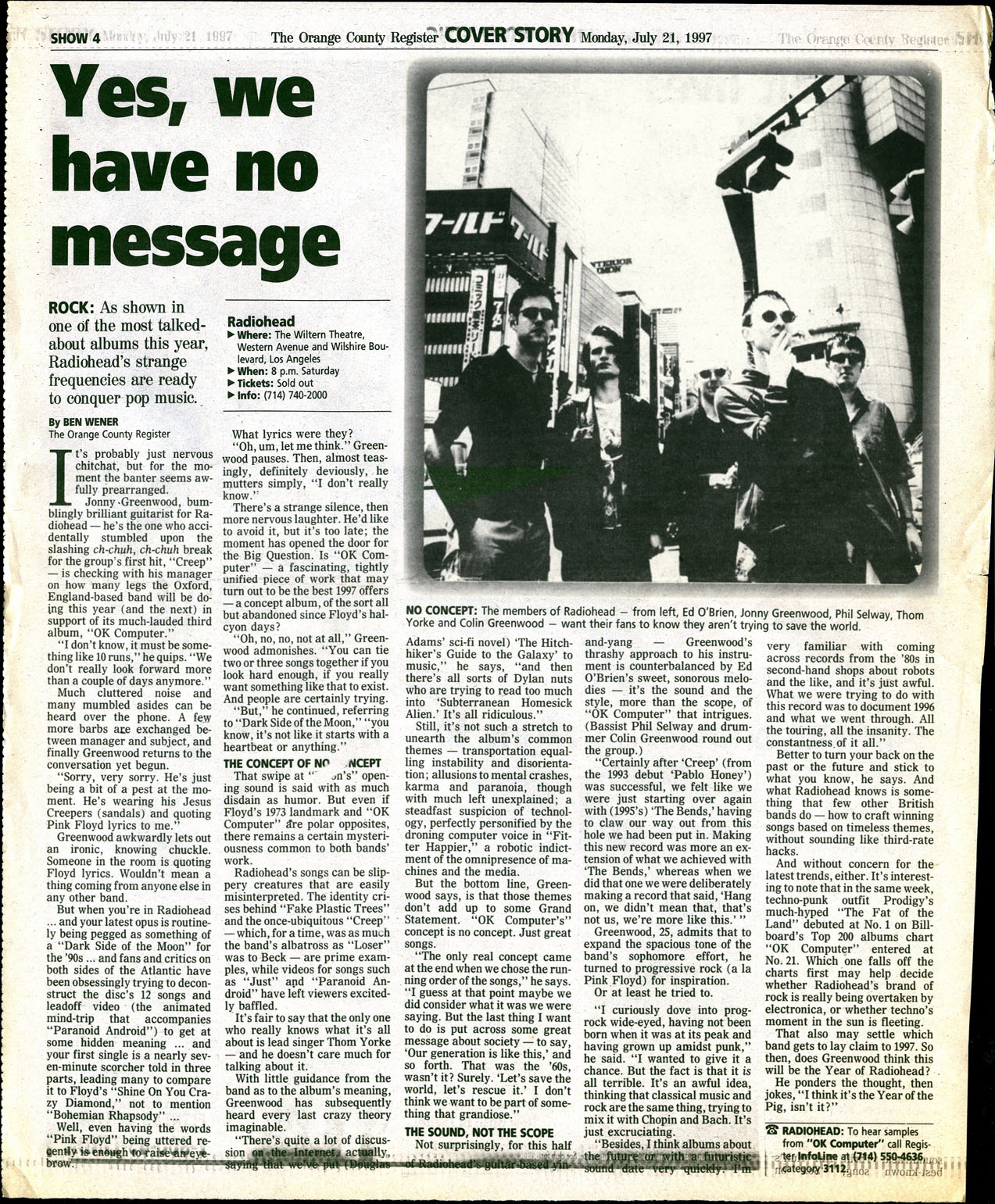
It’s probably just nervous chitchat, but for the moment the banter seems awfully prearranged.
Jonny Greenwood. Bumblingly brilliant guitarist for Radiohead – he’s the one who accidentally stumbled upon the slashing ch-chuh, ch-chuh break for the group’s first hit, “Creep” – is checking with his manager on how many legs the Oxford, England-based band will be doing this year (and the next) in support of its much-lauded third album, “OK Computer.”
“I don’t know, it must be something like 10 runs,” he quips. “We don’t really look forward more than a couple of days anymore.”
Much cluttered noise and many mumbled asides can be heard over the phone. A few more barbs are exchanged between manager and subject, and finally Greenwood returns to the conversation yet begun.
“Sorry, very sorry. He’s just being a bit of a pest at the moment. He’s wearing his Jesus Creepers (sandals) and quoting Pink Floyd lyrics to me.”
Greenwood awkwardly lets out an ironic, knowing chuckle. Someone in the room is quoting Floyd lyrics. Wouldn’t mean a thing coming from anyone else in any other band.
But when you’re in Radiohead… and your latest opus is routinely being pegged as something of a “Dark Side of the Moon” for the ‘90s... and fans and critics on both sides of the Atlantic have been obsessingly trying to deconstruct the disc’s 12 songs and leadoff video (the animated mind-trip that accompanies “Paranoid Android”) to get at some hidden meaning... and your first single is a nearly seven-minute scorcher told in three parts, leading many to compare it to Floyd’s “Shine On You Crazy Diamond,” not to mention “Bohemian Rhapsody”...
Well, even having the words “Pink Floyd” being uttered recently enough to raise an eyebrow.
What lyrics were they?
“Oh, um, let me think.” Greenwood pauses. Then, almost teasingly, definitely deviously, be mutters simply. “I don’t really know.”
There’s a strange silence, then more nervous laughter. He’d like to avoid it, but it’s too late; the moment has opened the door for the Big Question. Is “OK Computer” – a fascinating, tightly unified piece of work that may turn out to be the best 1997 offers – a concept album, of the sort all but abandoned since Floyd’s halcyon days?
“Oh, no, no, not at all,” Greenwood admonishes. “You can tie two or three songs together if you look hard enough, if you really want something like that to exist. And people are certainly trying.
“But,” he continued, referring to “Dark Side of the Moon,” “you know, it’s not like it starts with a heartbeat or anything.”
THE CONCEPT OF NO CONCEPT
That swipe at “Moon’s” opening sound is said with as much disdain as humor. But even if Floyd’s 1973 landmark and “OK Computer” are polar opposites, there remains a certain mysteriousness common to both bands’ work.
Radiohead’s songs can be slippery creatures that are easily misinterpreted. The identity crises behind “Fake Plastic Trees” and the once-ubiquitous “Creep” – which, for a time, was as much the band’s albatross as “Loser” was to Beck – are prime examples, while videos for songs such as “Just” and “Paranoid Android” have left viewers excitedly baffled.
It's fair to say that the only one who really knows what it’s all about is lead singer Thom Yorke – and be doesn’t care much for talking about it. With little guidance from the band as to the album’s meaning, Greenwood has subsequently heard every last crazy theory imaginable.
“There’s quite a lot of discussion on the internet actually saying that we’ve put (Douglas Adams’ sci-fi novel) ‘The Hitchhiker’s Guide to the Galaxy’ to music,” he says, “and then there’s all sorts of Dylan nuts who are trying to read too much into ‘Subterranean Homesick Alien.’ It’s all ridiculous.”
Still, it’s not such a stretch to unearth the album’s common themes – transportation equalling instability and disorientation; allusions to mental crashes, karma and paranoia, though with much left unexplained; a steadfast suspicion of technology, perfectly personified by the droning computer voice in “Fitter Happier,” a robotic indictment of the omnipresence of machines and the media.
But the bottom line, Greenwood says, is that those themes don’t add up to some Grand Statement. “OK Computer’s” concept is no concept. Just great songs.
“The only real concept came at the end when we chose the running order of the songs,” he says. “I guess at that point maybe we did consider what it was we were saying. But the last thing I want to do is put across some great message about society – to say, ‘Our generation is like this,’ and so forth. That was the ‘60s, wasn’t it? Surely. ‘Let’s save the world, let’s rescue it.’ I don’t think we want to be part of something that grandiose.”
THE SOUND, NOT THE SCOPE
Not surprisingly, for this half of Radiohead’s guitar-based yin-and-yang Greenwood’s thrashy approach to his instrument is counterbalanced by Ed O’Brien’s sweet, sonorous melodies – it’s the sound and the style, more than the scope, of “OK Computer” that intrigues. (Bassist Phil Selway and drummer Colin Greenwood round out the group. [sic])
“Certainly after ‘Creep’ (from the 1993 debut ‘Pablo Honey’) was successful, we felt like we were just starting over again with (1995’s) ‘The Bends,’ having to claw our way out from this hole we had been put in. Making this new record was more an extension of what we achieved with ‘The Bends,’ whereas when we did that one we were deliberately making a record that said, ‘Hang on, we didn’t mean that, that’s not us, we’re more like this.’”
Greenwood, 25, admits that to expand the spacious tone of the band’s sophomore effort, he turned to progressive rock (a la Pink Floyd) for inspiration.
Or at least he tried to.
“I curiously dove into prog-rock wide-eyed, having not been born when it was at its peak and having grown up amidst punk,” he said. “I wanted to give it a chance. But the fact is that it IS all terrible. It’s an awful idea, thinking that classical music and rock are the same thing, trying to mix it with Chopin and Bach. It’s just excruciating.
“Besides, I think albums about the future or with a futuristic-sound date very quickly. I’m very familiar with coming across records from the ‘8s in second-hand shops about robots and the like, and it’s just awful. What we were trying to do with this record was to document 1996 and what we went through. All the touring, all the insanity. The constantness of it all.”
Better to turn your back on the past or the future and stick to what you know, he says. And what Radiohead knows is something that few other British bands do – how to craft winning songs based on timeless themes, without sounding like third-rate hacks.
And without concern for the latest trends, either. It’s interesting to note that in the same week, techno-punk outfit Prodigy’s much-hyped “The Fat of the Land” debuted at No. 1 on Billboard’s Top 200 albums chart. “OK Computer” entered at No. 21. Which one falls off the charts first may help decide whether Radiohead’s brand of rock is really being overtaken by electronica, or whether techno’s moment in the sun is fleeting.
That also may settle which band gets to lay claim to 1997. So then, does Greenwood think this will be the Year of Radiohead? .
He ponders the thought. Then jokes, “I think it’s the Year of the Pig, isn’t it?”