unknown source, USA, circa late april 1993
[Interview with Thom & Colin]
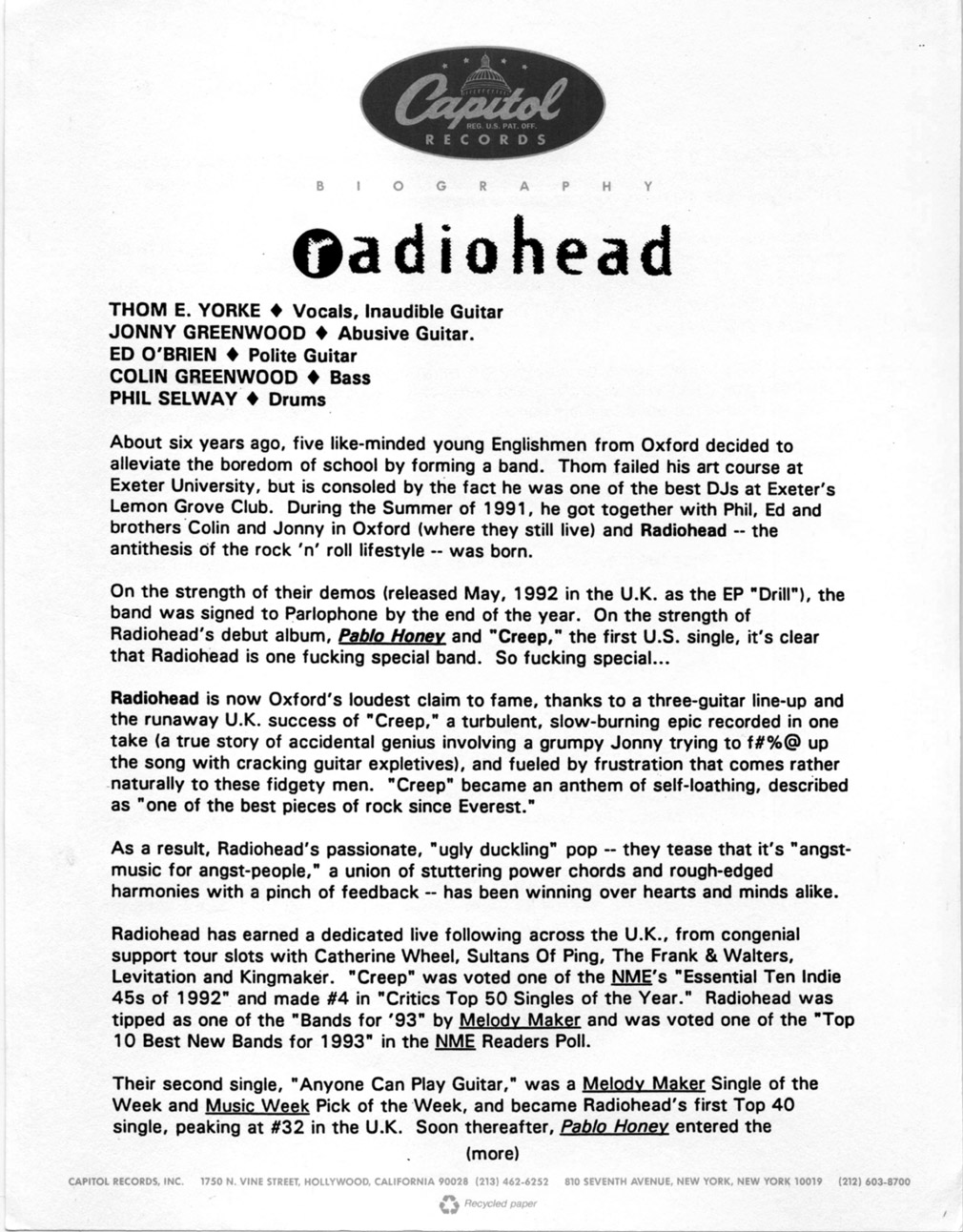
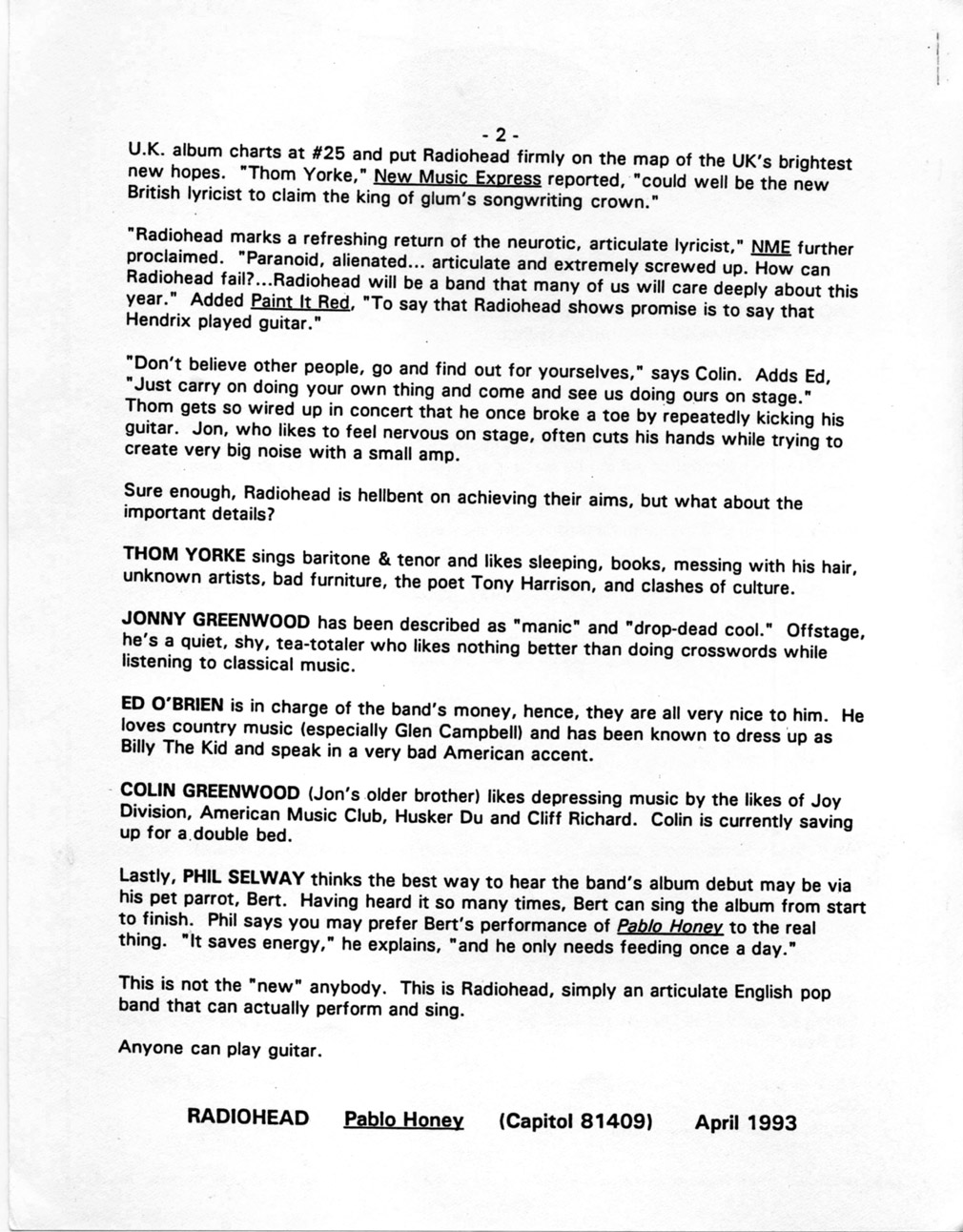
This is a transcript from an interview recording made for an unidentified magazine feature or newspaper article. The recording was later sold as Radiohead: The Interview as part of "The Interview Series" by Talking Music, which was the source for this transcript. The interviewer makes several references to a biography, which was issued by Capitol Records in april 1993. You can view scans of it here:
Interviewer: "Ok, for starters, give me each of your names, this is an interview with Radiohead, and I want to get both of your names with the voices, so go ahead and identify yourselves."
Colin: "Do you want to go first?"
Thom: "Yeah, I'm Thom."
Colin: "And I'm Colin."
Interviewer: "Ok, Thom, you're in the hot seat first, I'm going to start with you. What was your first musical memory, and what musicians did you listen to when you were young?"
Thom: "Well, my first musical memory was, erm... a friend of mine buying Queen's Greatest Hits. Well that was sort of... yeah. And I kind of decided that week that I wanted to be Brian May, so I went to school with my guitar and sort of sat down with my guitar teacher and said I wanted to be Brian May, and I was like eight, I think."
Interviewer: "And what did she say to that?"
Thom: "She laughed, and I got very angry."
Interviewer: "And at that point you said 'if you're going to laugh at me I'm really gonna do it!'"
Thom: "Yeah, I was gonna really do it anyway, I've been very obsessive all my life, so I decided that was what I was going to do with my life then."
Interviewer: "What other musicians did you obsess about when you were young?"
Thom: "Erm... Elvis Costello, erm... Japan, very into Japan when I was young. David Sylvian, I used to go around in make up a lot, and I dyed my hair blond and grew it long. And who else? REM, I was very obsessed by REM, but that was later on. They seemed to be very much out on a limb from everything else that was going on at the time, and sort of trying to remain so as well."
Interviewer: "Yeah, I know it's kind of hard to say exactly what it is about... you liked their music, what can you say?"
Thom: "Mmm hmm."
Interviewer: "What kind of a childhood did you have then, I mean was it a... were you well adjusted, or did you have your dysfunctional family members as everybody does?"
Thom: "I don't think that's the rest of the world's business."
Interviewer: "(laughs) Well, did you have a musical childhood? I mean, would your parents... No?"
Thom: "No, not really. I had a guitar when I was four, which was like a steel string guitar, and I tried to play it, but I cut my fingers, so I threw it against the wall and destroyed it. That's about as near as I got to music."
Interviewer: "Oh right, so you basically kind of started music out for yourself as opposed to having a lot of people say, 'well my parents were musical', or whatever."
Thom: "No... Yeah, it was no musical background at all in that sense."
Interviewer: "Really? You know, you... were your parents, you know, supportive in the sense that they had certain plans for you and I know that you failed art in college and was that..."
Thom: "I didn't actually, I didn't actually fail art, I got a degree in art."
Interviewer: "Really?"
Thom: "Yeah."
Interviewer: "So, what happened?"
Thom: "I failed in terms of the fact that they told me I couldn't paint, but I still got a degree."
Interviewer: "Oh, ok, well they implied in the bio that you failed... failed an art course."
Thom: "Yeah. (laughs)"
Interviewer: "So, you have a degree in art, then?"
Thom: "Mmm hmm. Art and English."
Interviewer: "You know, what kind of a background do you have to have to actually have degree in art?"
Thom: "You just have to... with this course you had to make your own art and justify your ideas and your actions, and it was more to do with teaching yourself a structure in which to work creatively... and be able to deal with criticism, and justify your existence on a creative basis, rather than your knowledge of history or criticism. After a year of art college, and occasionally going in to paint, and doing very little else, they said 'You can't paint, Thom' (laughs), and they were right. So I disappeared for a month or so, I didn't go to art college at all, and then I came back, and they'd just bought a whole load of Apple Macs, so I ended up working on those, and it was the perfect place for me to work, because it was... you could have an idea in the morning and go in, and by the end of the day, you could have finished it completely and have loads of different versions, and so on."
Interviewer: "Yeah, when you say Apple Macs, what were you doing on the computers?"
Thom: "Just erm... stealing images, scanning images, using bits of text... I don't know really, it's quite difficult to explain, but I was using something that nobody else that I knew was using as an art form, so that's why for me it was exciting."
Interviewer: "So you were using the computer to make art?"
Thom: "Yeah, although a lot of people said it wasn't. (laughs)"
Interviewer: "So then what - with this art and your art background - what then made you kind of turn to music, and really make that a career for yourself?"
Thom: "Oh, well art was always just an excuse to... I got into art college, and I kind of wanted to go, it was a good idea for me to form my own creative structure thing, and that's what I learned from art college, and that's what I came away with, but I was always gonna be with the band and that was always what we were gonna do, 'cause like we were in it before that, before we went to art college, before we went to college and stuff."
Interviewer: "When did you first say that you were gonna be in a band and do..."
Thom: "Well, sort of when I was eight, but then I met everyone at school."
Interviewer: "So you had the idea, and it took a little while to really..."
Thom: "Yeah."
Interviewer: "...get serious."
Thom: "Quite a while. (laughs)"
Interviewer: "That's alright, I mean you know, people... you can start later these days, you know, you don't have to be these young..."
Thom: "We didn't really start late, I mean... I think we probably started earlier than anybody else I've ever heard about in a band, really."
Interviewer: "Right, but you didn't have a specific band that you followed throughout, you know, the years of your life, starting from eight and moving on and..."
Thom: "Well, Radiohead was sort of... we met when we were sixteen, seventeen. I mean, we knew each other anyway, so I think that's pretty early. (laughs)"
Interviewer: "Do you recall, a kind of off the wall question here, do you recall the most trouble you ever got into as a child?"
Thom: "There was things, but they're very embarrassing, I don't like talking about my childhood."
Interviewer: "(laughs) Right. You also did some DJ-ing, at a club called, was it the Lemon Grove club?"
Thom: "Mmmm."
Interviewer: "Was that on campus?"
Thom: "Yeah, that was... that was an excuse to buy loads of records, spend loads of money on records and sort of be a cult figure or something, it was great, great for my ego."
Interviewer: "Well, you had quite a following, didn't you?"
Thom: "Yeah, well when I started to club, it was like we had 250 people coming every week, and it was quite embarrassing, and the first time I did it, you know, I just basically had like twenty odd albums of mine, and a few singles, you know, I had absolutely nothing, and I just kept having to play them. But I went out the next week and like borrowed 250 quid from the bank, and just went out and bought all these records (laughs), and the next thing I know, like about four months later, you know we were getting like a thousand plus people a week, and making a fortune."
Interviewer: "But still, rather than playing the music you wanted to be the one making the music."
Thom: "Oh, yeah, absolutely, that's what I used to say to people as well."
Interviewer: "'Someday somebody else will be playing my music up here.'"
Thom: "And that's what they're doing, yeah, they played all our records there."
Interviewer: "And you've had some formal vocal training. How has that helped your performances?"
Thom: "It just means that I can sing louder in tune, I can control it and I don't... it doesn't wear out. They... basically my teacher just... he listened to my voice and told me all the things that were gonna ruin it if I carried on doing it. (laughs)"
Interviewer: "Like what, smoking, and things like that?"
Thom: "Yeah, besides smoking. Yeah, he always used to give me a lecture because I was still smoking then, and he used to give me a big row whenever I went in for a lesson, because he could always smell it on me. He was great though, but I don't... we'd always run into problems because I couldn't really read music, and like he'd give me things to practice and I'd come back and I'd say 'you'll have to sing this to me, because I can't read it.'"
Interviewer: "Did you ever learn to read music?"
Thom: "Not really. I don't know why. I could never... I could never get the hang of it at all."
Interviewer: "Why exactly is it that you dub yourself playing 'inaudible guitar'? Explain what 'inaudible guitar' means."
Thom: "Well, when you get to guitar three in a mix, it's kind of a bit difficult to place it a lot of the time, because it just becomes complete chaos when you hear it, so that's what... 'inaudible guitar' is just a reference to the fact that often I'm playing the guitar, it's like my fingers are bleeding, but you can't actually hear it off the stage, but that's good. I don't mind that. It does add to the overall general noise level."
Interviewer: "But you do have audible voice for singing over all that stuff, so that's..."
Thom: "Oh, yes."
Interviewer: "...what really counts, of course."
Thom: "Oh yes."
Interviewer: "Ok, alright, Colin, let's move on to you now."
Colin: "Alright."
Thom: "Ha ha ha."
Colin: "Ha ha ha."
Interviewer: "Alright, what kinds of goals did you have when you were young, did your parents have specific plans for you..."
Colin: (sighs)
Interviewer: "...did you have a specific idea of what you wanted to be when you grew up?"
Colin: "I didn't really have any specific goals or plans other than playing - rather sadly - playing music with the people in Radiohead, when I was.... from the age when you start forming your goals and plans when you're about fourteen, I suppose, fifteen. I was really into certain kinds of music and I thought it would be really cool to... to play in bands, you know. Sometimes, you know, if you really like a band you have this dream that you're going to like maybe one day play bass guitar for them or something like their bassist falls sick just at that moment and you're the only person in the audience who knows the chords to their songs, so... but er... it never... that never happened. That's why when we did this gig in Israel, this guy wanted... asked if he could play bass on 'Creep' when we were doing a gig and he didn't play at the gig, but he did it on the soundcheck, and that was fine because, you know, I mean if someone in like New Order had have asked me if I'd have wanted to play bass on one of their songs, I'd, you know... it'd be great, great fun."
Interviewer: "Oh that's great, I know that means so much to a fan."
Colin: "Yeah, that's the ultimate fan thing, really, isn't it? Except maybe... (laughs) Sorry."
Interviewer: "Except for playing on stage! (laughs)"
Colin: "Yes..."
Interviewer: "Well it's important to keep that connection with your fans, and remember how you felt..."
Colin: "Sure."
Interviewer: "...or how you feel when you see the people that you enjoy."
Colin: "Yeah."
Interviewer: "So it's nice that you guys can keep that sensitivity. Did your parents, were they concerned when you were doing the music thing?
Colin: "(laughs) Yeah well... yeah, it's... me and Jonny... it's like Jonny's my brother, and he's in the band... our mother thinks that we're not doing proper jobs yet and she thinks... you see Jonathan's the youngest, so she thinks that Jonathan's like career in life has been perverted and she thinks... and our mother thinks that I should be getting into law or accountancy or maybe becoming an academic, but it's kind of... and she thinks it's all going to end tomorrow as well (laughs). But I find that quite a healthy attitude in a way 'cause like she doesn't... you know, she's not overly impressed by anything, and I kind of like that, so that's fine."
Interviewer: "Oh yeah, I think it's important that you have the people around you that kind of keep you grounded."
Colin: "Oh yeah, definitely, yeah."
Interviewer: "It's like 'Ah, you're not that special, you're just my son.'"
Colin: "(laughs) Yes."
Interviewer: "Did you ever....do you recall kind of announcing to either your parents or your friends, or kind of announcing to yourself 'I'm going to be a musician!'"
Colin: "(laughs) Coming out?"
Interviewer: "Out of the closet."
Colin: "I'm going to be a musician. (laughs) Yes."
Interviewer: "A closet musician."
Colin: "'Mum, I'm a musician.'"
Thom: (laughs)
Colin: "Well, it's hard to say, really, 'cause I'd been hanging out with the other idiots in the band for so long anyway that you know, it was kind of common knowledge and my mum said... our mum said 'well, at least it keeps you off the streets' (laughs). So, and... I don't really regard myself... well I suppose I'm a musician, but it's a very basic thing and it's like a very a personal thing so it's, you know... I know some people who are great musicians who haven't got any work in England and like our management has this 'losers theory' (laughs) about the way... how good you can play your guitar in relative to like how successful you become (laughs). It's kind of like a version of the punk rock theory, so if like you're not very good at your guitar, but you can hit it loudly, then you'll kind of probably do better."
Interviewer: "What attracted you then to playing bass, and how old were you when you began?"
Colin: "Well, what attracted me to playing bass? Well, I suppose my first... my two bass heroes were this guy called Peter Hook, who plays in New Order, and also I used to have this tape and on one side it had like Joy Division on it, which was an early New Order band, it's quite punky, and on the other side I had the best of Otis Redding, which I thought was amazing, and so I used to listen to like this guy Donald 'Duck' Dunn, who played with the Blues Brothers people and there's this other Staxx bass player called James Jameson who played with people like Isaac Hayes and William Bell, and all the Staxx people. So I really liked... the reason... the main reason why I liked both of them though is 'cause they both played really simply, and but it sounded really good so I thought, well, you know, I'm not very good, but I can like at least make it sound good."
Interviewer: "A lot of it is knowing when not to play."
Colin: "Yeah, that's what my brother drummed into me. He said, you know, 'listen to Kim Deal of the Pixies, she doesn't play very much and it sounds great'. So I was like 'alright then...'"
Thom: (laughs)
Interviewer: "Do you remember your very very first ever performance in front of an audience?"
Colin: "Yeah, we played this gig and we didn't have a drummer at the time, and I must have been about fifteen, and we had a drum machine to do the numbers, and it was a nightmare 'cause it kept breaking down like... or halfway through a song it would stop or we'd like start a song and it would like be in a waltz or something (laughs), so we had to kind of like rearrange it..."
Thom: "I just remember screaming obscenities down the microphone while the parents looked on."
Colin: "Yes, it was very embarrassing, very embarrassing."
Interviewer: "Right. (laughs)"
Colin: "God, you know I'd just started playing the bass, and it was like all really sort of simple stuff and this guy came up and complimented me on my bass playing, and I found out later he was tone deaf (laughs), so it was kind of like... (laughs) so that was very weird, that was very weird..."
Interviewer: "So, tell me about your musical influences, I know that in the bio it says you enjoy listening to depressing music."
Colin: (laughs)
Interviewer: "Joy Division, Hüsker Dü and Cliff Richard..."
Colin: (laughs)
Interviewer: "Why do you like these people and why depressing music?"
Colin: "Yeah, Cliff Richard's depressing, but I wouldn't listen to him really, but erm... why do I enjoy them? It's not so much... I mean you can say it's depressing music, but it just writes off a whole like genre of music and like the songs are all different as well within like those bands Hüsker Dü, and American Music Club and Joy Division. It's just really personal music, music where you feel the person who's singing it like feels he has to sing a song about something, and it's just really emotional and it's good, and it doesn't... and also there's a kind of link with them as well, as it doesn't come easy in terms of like a smooth AOR rock ballad where everything's played beautifully and produced really like rock production, so then you feel that like any kind of, you know, inarticulacy, any problems are smoothed out, and it's just too easy. So I like music that's a bit more sort of rough, and you have to get into it a bit harder."
Interviewer: "I like pop music though."
Colin: "It's great for what it is, like pop music is great, you know, good pop writing songs are the best."
Interviewer: "And I believe you are the one that compared Radiohead to Spinal Tap?"
Colin: (laughs)
Interviewer: "Is that right?"
Colin: "No I didn't. No, that's not true. Why's that? What was that?"
Thom: "We're staying at the same hotel."
Colin: (laughs)
Interviewer: "I think it was more a reference to the volume than anything else."
Colin: "Oh right, the guitars, yeah. It was like this thing, I was saying... common questions... you were asking Thom, except you asked it... you asked it a lot better, was about inaudible guitars, 'so why do you have three guitars?', and so, you know... I just usually say, well, you know, it's like Spinal Tap, you know you've got two guitars, and where do you go when you want to get a bit louder, and you see that's why we have the other guitar, it's like number eleven. (laughs)"
Interviewer: "Eleven."
Colin: "And you might say, 'why don't you just have two guitars and make one of them a bit louder?' or something, but you know, but we've got the other guitar, so..."
Interviewer: "But that's what Rob Reiner's character says."
Colin: "Yeah, 'but this one goes up to eleven', yeah, 'ten a bit louder', yes."
Interviewer: "Ok, well that marks the end of our individual portion of the programming."
Colin: "Great."
Interviewer: "We shall now move on to... I'm just gonna ask questions, and either one of you can feel free to respond, but just make sure that you're right on the mic when you do. Tell me just basically... six years ago, I guess, marks the creation of Radiohead, but it seems that you guys have been together longer than that, it said in the bio that it was six years ago, but... just tell me, when do you consider that Radiohead started, and how did you all come together to form the band?"
Thom: "Er, well it started at school, I can't remember when (laughs). Sometime when... at school..."
Interviewer: "You can't remember life without Radiohead?"
Thom: "It's kind of like that, yeah."
Colin: "It started at school, and the most important thing when you're in a band at school, is that you wanna play with your friends, and we'd just, you know, we'd just like hang out together and we discovered..."
Thom: "We discovered we didn't have any other..."
Colin: "...any other friends at school (laughs), and we were kind of a lot poppier then as well, and we used to like... you know, when you play in a band at school, and you want your friends to be in it as well, and we used to have like some saxophones, and some keyboards and things, just to like... because they were people we knew, and wanted to, you know, just to play with, but erm... I suppose properly in the public eye it kind of started about eighteen months, two years ago, after we left college, with the songs that we've been doing. In that sense, publicly, it started two years ago, but like privately, I mean we've known each other for years... about eight years now."
Thom: "We've been demoing and writing for years and years and years."
Colin: "Yeah."
Interviewer: "And how did you settle on the group's name, and were there any other names that you considered before you settled on Radiohead?
Thom: "Yeah, we were called On A Friday, which has got to be the worst name for a band ever."
Interviewer: "Why?"
Thom: "I don't know, it just was. (laughs)"
Colin: "There are loads of worse names than On A Friday."
Thom: "Alright then."
Colin: "I've got this theory about how if you've got... the more ridiculous your name, the more chance you're going to have success, because all the great bands seem to have people like saying in their career 'God, what a stupid name', or whatever, so..."
Thom: (laughs)
Colin: (laughs)
Interviewer: "It certainly seems that you need to do anything in your power to make yourself memorable."
Colin: "Yeah."
Interviewer: "Because there's no more common thing than a, you know, out of work virtuoso, I mean, it's not how talented you are, unfortunately, although that figures into it, when you have the opportunity, and if you don't have the talent obviously you're not going to go anywhere, but there are a lot of very talented musicians, as you mentioned, that are not working."
Thom: "But they're not talented. (laughs) I mean, they are, but they're not, you know?"
Interviewer: "Well, they may not..."
Thom: "It's a physical thing."
Interviewer: "Well, yeah, they're not talented in the means of knowing how to get to a position where they can play their music and make money for it. It's very difficult."
Thom: "But that's intuitive though, you do that... I think we do that intuitively. If you do it deliberately, then people see through it very fast."
Interviewer: "So what does 'Radiohead'... what does it mean to you guys? What made you settle on that name?"
Thom: "Oh, it's just got loads of great connotations, really."
Colin: "Especially at the moment."
Thom: "Yeah."
Colin: "In terms of the fact that we're being played on the radio a lot. I mean, it's kind of ironic in England, because we didn't get any radio play, and we're called Radiohead, but in other countries like America and France and Europe and Israel... one of the reasons why we're doing so well there at the moment is just 'cause we're on the airwaves all the time, so..."
Thom: "Yeah. But it's also about the way you take information in, the way you respond to the environment you're put in. You just become like a synapse in a long chain of other people's ideas, you know, you receive and you consume, you know, you buy things you're told to buy, you read things you're told to read, or you don't read things you're told to read, and it's very much sort of the passive acceptance of your environment."
Interviewer: "Now, your demo's been released in May of '92 as an EP called Drill..."
Thom: "Mmm hmm."
Interviewer: "...if I have all my information right. Tell me about that experience of, really, your first experience making an actual record that, you know, went out to the public."
Colin: "Well, half of that record was never supposed to go out to the... er... wasn't going to go out to the public in such a big way, because we were going to... like some of the tracks on Drill were like original rough demos that we'd done originally to... well, the original plan - before we signed to EMI - was that we were going to release a single on an independent label, funded by like the people who eventually now manage us. But there was so much interest from those initial recordings that we never got around to funding our own single, we ended up being funded by EMI."
Thom: "Bit of a shock."
Colin: "Yes. So there are four tracks on that single... on that EP, and it's very er... basic and rough, it's quite rough, isn't it?"
Thom: "Very, very difficult to get hold of."
Colin: "Yes, it's very hard to get hold of. It was a big learning experience record in terms of artwork, and organising layout, picture design..."
Thom: "Absolutely."
Colin: "And we paid a stupid amount of money to get a design company to do the sleeve, and..."
Thom: "The whole thing was like a big shock to the system."
Colin: "Yeah."
Thom: "And the best bit was, erm, they lost the first three thousand copies they'd pressed. They lost them."
Colin: "Yes."
Interviewer: "They lost them?"
Thom: "They lost them, and they had to delay the release by two weeks, it was like 'this is getting really silly'..."
Colin: "Yes."
Interviewer: "How do you lose that?"
Colin: "Ah, there was a warehouse with millions of Iron Maiden records..."
Thom: "Yeah, and it all went down. It was supposed to be automated."
Colin: "Yes."
Thom: "And they did press a... no, saying that though, the actual physical record was getting out... there was a promotional one going around that said 'Radiohead Drill' on it, but actually had Joe Cocker..."
Interviewer: "Joe Cocker?"
Colin: "Yeah."
Interviewer: "Why? It just..."
Colin: "It was the wrong... because he's on EMI, and they just pressed it wrongly."
Thom: "Printed it, or whatever."
Colin: "Yeah."
Interviewer: "You didn't have a good first experience there, did you?"
Thom: "It was quite spectacularly bad."
Colin: "No, but it was a good learning experience, I suppose. I mean it sold quite well for England. I mean, if we'd have been in the independent chart, which is kind of like the alternative R&R chart here, it would have been top five."
Thom: "Yeah."
Colin: "So, but I mean it was a major chart, it's like Billboard, so it was like seventy two, seventy something, but it's still quite a good debut..."
Thom: "It's not bad really, considering."
Colin: "Yeah."
Interviewer: "Was money coming in, I mean, were you making a living doing this when you were selling that?"
Thom: "Oh, it never works like that. Record... the record business doesn't work in terms of bands making money."
Colin: "You're paid money in anticipated future earnings."
Thom: "Yep. Your life is offset against your loan. So it's like taking out the most hideous mortgage of your life, creatively speaking."
Colin: "It was put really well by this guy, Sean Slade, who co-produced the album, and said... and compared like getting a loan from a record company with getting a loan from a bank. So you get a loan from a bank, if you can persuade them to lend you, say, two hundred thousand dollars for a year, like a record company advance and they'd like charge twelve percent interest on the loan, or whatever. Once you've paid... if you pay the loan back, then you don't have to pay any money after that, whereas if you're like lent two hundred thousand pounds from a record company, then after that, the money that you earn is just the twelve percent, so you don't actually (laughs), you know, make any profit."
Thom: "Yeah, we're a band of accountants."
Interviewer: "So, tell me then, you know, from recording your current album, Pablo Honey, how did that differ from Drill, and obviously, you know, what did you learn that you brought to the mix when you went to do this album?"
Colin: "We didn't learn very much... (laughs)"
Thom: "No. (laughs)"
Colin: "...at all, given the basis that we'd never worked with like two different... completely different people before, they were two Americans, and in a completely different studio before, although we'd been in there - this time last year - before, to record 'Creep', but the experience was alien and new and short. Three weeks concentrated, you know, we recorded it very quickly."
Thom: "I was unbearable, apparently."
Colin: "Yeah."
Thom: "According to..."
Colin: "You were, yeah."
Interviewer: "What was he like? Tell me what you really wanted to say to him that you couldn't at the time because it was so..."
Colin: "Oh well, you know, it's just one of those things, it's just, you know... it's best to file under experience and move on."
Interviewer: "So, is it... I mean, it must get kind of stressful when you're trying to put something together, especially when you have a limited amount of time to work in. How do you guys, you know, keep from... really keep from getting on each other's backs and..."
Thom: "Because we're friends."
Colin: "Yeah, that's the bottom line."
Thom: "Otherwise we would have split up years ago."
Colin: "Yeah, and we're all prepared to like... get like, you know... to say, you know, there's no point like... if you're in a situation with your group of people, and you don't say what's on your mind, and what you're pissed off about, or something, then it just gets worse, and the situation like festers, and you can see that with groups..."
Thom: "Quite famous bands."
Colin: "Certain famous bands who... especially bands who come over to America, because it's such a completely different alien culture and experience and workload, that if they weren't very close together when they were in England, they'd get a lot more distant - even more distant - coming over here."
Interviewer: "People who don't like each other ultimately don't last, so..."
Colin: "Yeah."
Interviewer: "No matter how successful their music is."
Thom: "Mmmm."
Interviewer: "Well, let me... tell me about 'Creep', the first single, tell me about... just give me a little insight into how that got written, or what it's about, and how it got chosen as the first release from the album."
Thom: "Well, over here it was the first release. Was it over there? In Britain it was..."
Colin: "Second release."
Thom: "In Britain? What was the first one?"
Colin: "The first release from the album?"
Thom: "Oh, I don't know, I get confused. Oh yeah, it was, yeah. Well, erm... how did it get written? Well, you know, there's a story that like - which is true - that we were warming up for another song, and the tape was rolling, and Sean and Paul hit the intercom button and said 'we're doing that one, we're not doing the other one, we're doing that one', but we did the other one as well, and we kind of kept a hell of a... most of that tape, actually, on the finished record, and it taught us a lot... it taught... I mean, the actual recording of it taught us a lot. 'Hang on, we actually sound quite good when we don't know the tape is rolling...', things like that. Em... err..."
Colin: "It's one of those things that if you don't think it's important, you always play better, because if you realise that the money is ticking, and the tape is running, and the producers are sitting at the console like tearing their hair out, then it's like, it's just an experience thing. It's learning to realise that it doesn't matter and it's not... you just have to have fun, you should just have fun all the time."
Thom: (laughs)
Colin: "And you know, it'll be alright, rather than like having... getting 'the fear'."
Thom: "Mmmm, if you get the fear then you might as well stop."
Colin: "Yeah."
Interviewer: "What's it about?"
Thom: "The song?"
Interviewer: "Tell me in your own words. A brief synopsis of the song."
Thom: "I'm not very keen on sort of... just sort of... I'd rather people just interpret it how they interpret it. You know, we've been asked all week about it, and I can say loads of things, but it's actually just better to... for people to dig it up how they want to dig it up, and whether it was anything to do with me or not is irrelevant, I think. It's the age old thing, you just read any... you know, old painters and stuff, you know, and they'd be asked time and time and time and time and time again 'what does this bit mean?', 'what does that bit mean?', and they always used to... you know, they always - now as well - they always just say, you know, 'well, it's up to you, you know, it's yours, it's not mine anymore'. Well, it is, but it isn't! (laughs)"
Interviewer: "No, but that's nice, to give it to your fans, basically, 'this is yours, you interpret it.'"
Thom: "Yeah, and we as a band take whatever we want from it as well."
Colin: "Yeah, I mean, your favourite songs are like songs that mean something to you, and like... and the way they become part of you, rather than the actual songwriter, they're passed over in ownership to you, and sometimes you can't make out the words of your favourite song and so you put in... you fill in the blanks with what you think the singer is saying, and all that kind of stuff."
Thom: "It's so funny like sometimes, you know, when we're playing it live, it just feels like we're playing a cover version of someone else's song."
Colin: "(laughs) Yeah, it's true."
Thom: "We just happen to have written it, it's very surreal."
Colin: "In a sense, it's not like... it's not that it's not fun playing it live, but it's kind of... it's more of a different mind game... mind thing to playing that song live, compared to like some other songs, where you can really feel that you can let loose and really get... just take off with the music, like the song 'Blow Out', which we play."
Thom: "Each song creates a different mood as you start it anyway, I think."
Interviewer: "Now, is the follow up single here 'Anyone Can Play Guitar'?"
Thom: "Pass. Don't know."
Interviewer: "You don't know?"
Thom: "Do you know?"
Colin: "It is, it's 'Anyone Can Play...'. The repro's being finalised for it, yeah."
Thom: "Really? There's going to be a lot of very pissed off hairbands."
Colin: (laughs)
Thom: "Great. Oh, I didn't know that."
Interviewer: "Is that just a kind of parody of that whole thing?"
Thom: "Oh, yeah. No? Yeah. Maybe."
Interviewer: "If you want it to be."
Thom: "If you want it to be."
Colin: "Well, that's kind of different, because it's... I mean, it's a song that's more of an externalised thing, it's like talking about like a situation that's outside the singer and what he thinks, rather than the extreme personal statement of 'Creep', so..."
Thom: "Yeah, offset 'Creep' a bit."
Colin: "Yeah."
Interviewer: "Well, that's good, give a variety."
Colin: "Yes."
Interviewer: "Keep your fans guessing... 'what are they going to do next?'. How... is there any story behind that, how that one either came to be written, or what caused, I guess, the choice to make it the second single, as a lot of people have a hand in that decision, but... is there anything to say about the song itself?"
Thom: "Er... it's a song that I think we all wanted to write. We had a vague idea for the chorus for a while, and then we just hammered away at it, didn't we, for ages, and got all these nice clever bits in it. And we thought 'this is good', you know. The 'Anyone Can Play Guitar' thing... I mean, I was going to change that, I didn't like that title, I was ready to sort of... but everyone else said 'nah, that's the best bit, keep it', so we did."
Interviewer: "Ok, do you know what the third single is?"
Thom: "Don't know."
Colin: "Don't know. I mean, the thing is that each of the songs are different, like quite a few people seem to have like different favourite songs. So it could be like 'Vegetable', or maybe..."
Thom: "Or 'Thinking About You', that's another radio friendly one."
Colin: "Or 'Stop Whispering', or 'Lurgee'... erm, it's... those are the kind of songs that are being looked at at the moment, so..."
Interviewer: "Sounds like you've got a lot to choose from."
Thom: "Yeah, and there's new stuff as well, I mean, you know... the third song from the album..."
Colin: "Yeah, there's a chance of... for college, a limited edition thing being done of a new single we're releasing in England, called 'Pop Is Dead', which isn't on the album."
Thom: "Which is corking, it's very, very good indeed, I think."
Interviewer: "Well, that's what matters, that you guys like your music, and that you like what you've done."
Colin: "Yeah, otherwise we wouldn't have hung out together so much and done it so much at school for so long, you know."
Thom: "And bored all our friends stupid."
Colin: "Yes! (laughs)"
Interviewer: "Now, you guys... I mean, you haven't been, you know - like you were saying - in the public eye, you've been together for like two years really seriously where you're out, you know, making the music that people can hear and buy, but already you have a lot of catchphrases that have been used to describe your music, for example 'Ugly Duckling Pop', and 'Angst Music For Angst People'."
Thom: "I think we were taking the mick there."
Interviewer: "Is there any way that you guys describe your music, any term that you call it, or how do you explain it to people?"
Thom: "Er... Difficult Pop... er... I mean, there's a whole load of phrases. It's not Heavy Rock, it's not AOR, it's not Indie, it's not Grunge, it's not... mmmmm... it's the other thing. I mean, you know, remember when kind of pop was good, you remember the last time pop was good in, you know, like the early eighties and stuff, and there's a kind of reference point for us there, like rather than us being the eighties revival band..."
Colin: (laughs)
Thom: "I don't think somehow that'll happen. I'm sure someone else will do that for us."
Colin: "I mean, there are like those whole hosts of good bands that just sound like themselves, like Talking Heads, you know, Depeche Mode, or whoever..."
Thom: "Yeah, and whenever you hear them, you just sort of think..."
Colin: "'Oh, that's them!'"
Thom: "Yeah, that's them, it's totally them, it's like you don't get that now, it really pisses me off. (laughs)"
Interviewer: "Do you worry at all about the effect your music might have on your fans? I mean, it is fueled a lot by frustration and, I guess, you know, self loathing..."
Thom: "Some of it, not all of it."
Interviewer: "Does it concern you at all, or is it more of an outlet for your fans?"
Thom: "Er... they'll take it how they want to take it, and well... we'll put a legal disclaimer on the record if people try and top themselves."
Colin: "Implying sort of that Judas Priest Painkiller scenario."
Thom: "Mmmmmm."
Colin: "Well..."
Thom: "Although we do put a lot of lyrics backwards."
Colin: "Yes, like, what was it? 'Fornicate with a goat' and er... 'Vote Republican', and they're all backwards."
Thom: "That's right."
Colin: "Stuff like that."
Thom: "On 'Stop Whispering'."
Colin: "Yes."
Thom: "If you listen to it backwards."
Colin: "But you people can't do that now anyway, because you can't get vinyl, it's all CDs."
Thom: "What's vinyl? We're experimenting with fax machines at the moment. I think that people should sort of just be able to fax songs as well as listen to them. You should be able to plug your fax into your hi-fi, and a picture should come out."
Interviewer: "You guys have a kind of a history of injuring yourselves in performances, I know the bleeding fingers, and somebody broke their foot kicking an amp or something..."
Thom: "Yeah."
Interviewer: "Tell me... tell me about some of the injuries you've incurred because of your very high energy performances."
Thom: "A gig we did in Israel... I got like loads of clumps of my hair ripped out, and someone stole my favourite bangle in the whole world, like they... and they didn't just steal it, they like broke it in half (laughs) on my hand, and there's always like... our guitar tech loves it, because there's always loads of blood on all the guitars at the end of the night, but it varies from night to night, you know, we don't do that because, you know, we don't do that every night."
Colin: "It's not like a performance 'thang' every night."
Thom: "No, performance for us means we don't know what we're going to do."
Colin: "Yes. (laughs)"
Interviewer: "Have you ever injured yourself?"
Colin: "Only my pride."
Thom: "Colin's more the... the... Bill Wyman performance within the band."
Colin: "(laughs) Not as boring though, I hope."
Thom: "No."
Interviewer: "What's injured your pride? Have you ever tripped and fallen over?"
Colin: "Like starting to play the bass in the beginning of a song, and something's been switched off (laughs), and nothing comes out of the speakers, you know..."
Thom: "That's actually happened quite a lot."
Colin: "Yeah, and it happens quite a lot to us actually (laughs). Like our guitar tech like ran across the stage and switched all the amps off at the end of the set, which is the professional thing to do, but we didn't know, because we're not professionals, and so we came back on stage to play, and everyone turned their amps on except Jonathan - Jonny - who'd forgot, and like he just played that power chord in 'Creep', and he raised his hand - because he doesn't play until then - and silence... (laughs)"
Thom: "Complete silence."
Colin: "And he was so upset. (laughs)"
Thom: "And we all just cracked up."
Colin: "Yeah."
Thom: "It was really funny."
Colin: "It was really funny. (laughs)"
Interviewer: "Would you ever write a happy-go-lucky kind of tune and really mean it?"
Thom: "Yeah, possibly. I'm open to anything, you know, miracles do happen sometimes. It depends on what I've taken, I think, probably."
Colin: "Thom gets very cuddly when he's drunk, yes."
Thom: "I'm very sweet when I'm drunk."
Colin: "He's very sweet when he's drunk."
Interviewer: "Could either of you do an impression of Phil Selway, the drummer, you know, your drummer Phil?"
Thom: "Mmm hmm."
Interviewer: "He has a pet parrot, I believe?"
Colin: (sniggers)
Interviewer: "Bert?"
Colin: "(laughs) Bert, yes."
Thom: "He's wonderful."
Interviewer: "And he sings like lines from the songs?"
Thom: "Yep, yep."
Colin: "Yes. Better than Thom."
Thom: "Oh, I can't do an impression."
Colin: "Oh, no. Well it's really croaky, it's like 'aaargh', like that."
Thom: "I've got a nephew that can do that as well."
Colin: "Really?"
Thom: "Yeah."
Colin: "Phil's parrot - Bert - is a very good judge of character, and if he doesn't like someone, he'll bite them..."
Thom: "Or swear at them."
Colin: "Yeah, so he must think that we're alright then, because he sings the songs."
Interviewer: "What - here's the final question - are you hoping to accomplish with your music?"
Thom: "Be able to stay at the Hyatt again (laughs)."
Colin: "Yeah, what a great hotel."
Thom: "What a great place, surely."
Colin: "And there are branches worldwide, I understand, isn't that right, Thom?"
Thom: "Surely, I mean, you know, when you've got a pool on top of your hotel, I mean..."
Colin: "(laughs) Not in the middle like some hotels, but right at the top."
Thom: "You know something's happened."
Colin: "Yes."
Thom: "What do we want to achieve? You know, worldwide domination..."
Colin: (laughs)
Thom: "...and the ability to help save Third World countries."
Colin: "Yes, and oh, you know, we just want to be happy and be able to carry on doing what you're doing, I suppose, and, you know, make some money as well, just to keep going, just to keep yourself... and that's it, really."
Thom: "It's all art."