
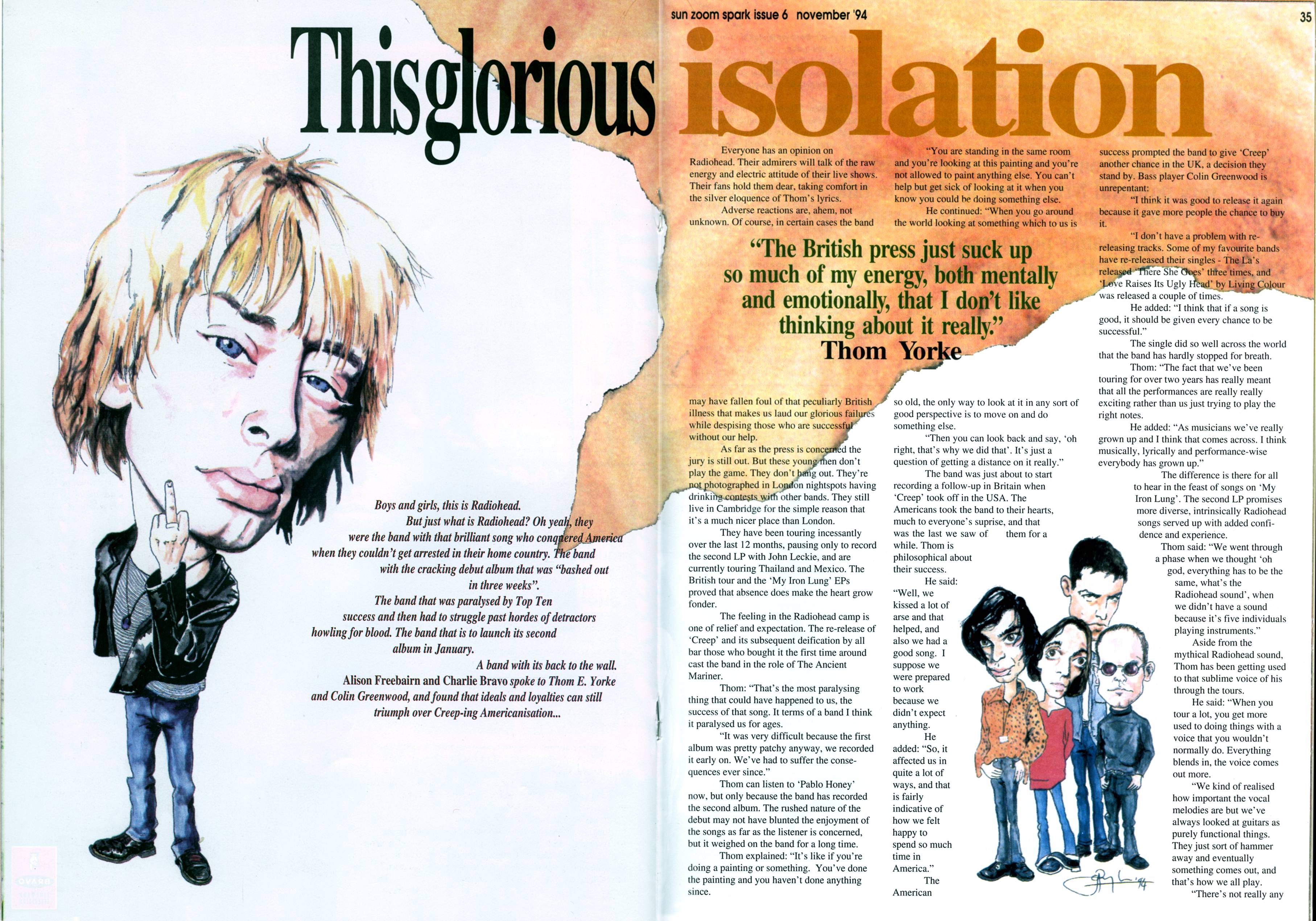

Boy and girls, this is Radiohead.
But just what is Radiohead? Oh yeah, they were the band with that brilliant song who conquered America when they couldn’t get arrested in their home country. The band with the cracking debut album that was “bashed out in three weeks”.
The band that was paralysed by Top Ten success and then had to struggle past hordes of detractors howling for blood. The band that is to launch its second album in January.
A band with its back to the wall. Alison Freebairn and Charlie Bravo spoke to Thom E. Yorke and Colin Greenwood, and found that ideals and loyalties can still triumph over Creep-ing Americanisation…
Everyone has an opinion on Radiohead. Their admirers will talk of the raw energy and electric attitude of their live shows. Their fans hold them dear, taking comfort in the silver eloquence of Thom’s lyrics.
Adverse reaction are, ahem, not unknown. Of course, in certain cases the band may have fallen foul of that peculiarly British illness that makes us land our glorious failures while despising those who are successful without our help.
As far as the press is concerned the jury is still out. But these young men don’t play the game. They don’t hang out. They’re not photographed in London nightspots having drinking contests with other bands. They still live in Cambridge for the simple reason that it’s a much nicer place than London.
They have been touring incessantly over the last 12 months, pausing only to record the second LP with John Leckie, and are currently touring Thailand and Mexico. The British tour and the ‘My Iron Lung’ EPs proved that absence does make the heart grow fonder.
The feeling in the Radiohead camp is one of relief and expectation. The re-release of ‘Creep’ and its subsequent deification by all bar those who bought it the first time around cast the band in the role of The Ancient Mariner.
Thom: “That’s the most paralysing thing that could have happened to us, the success of that song. In terms of a band I think it paralysed us for ages.
“It was very difficult because the first album was pretty patchy anyway, we recorded it early on. We’ve had to suffer the consequences ever since.”
Thom can listen to ‘Pablo Honey’ now, but only because the band has recorded the second album. The rushed nature of the debut may not have blunted the enjoyment of the songs as far as the listener is concerned, but it weighed on the band for a long time.
Thom explained: “It’s like if you’re doing a painting or something. You’ve done the painting and you haven’t done anything since.
“You are standing in the same room and you’re looking at this painting and you’re not allowed to paint anything else. You can’t help but get sick of looking at it when you know you could be doing something else.
He continued: “When you go around the world looking at something which to us is so old, the only way to look at it in any sort of good perspective is to move on and do something else.
“Then you can look back and say, ‘oh right, that’s why we did that’. It’s just a question of getting a distance on it really.”
The band was just about to start recording a follow-up in Britain when ‘Creep’ took off in the USA. The Americans took the band to their hearts, much to everyone’s surprise, and that was the last we saw of them for a while. Thom is philosophical about their success.
He said: “Well. We kissed a lot of arse and that helped, and also we had a good song. I suppose we were prepared to work because we didn’t expect anything.
He added: “So, it affected us in quite a lot of ways, and that is fairly indicative of how we felt happy to spend so much time in America.”
The American success prompted the band to give ‘Creep’ another chance in the UK, a decision they stand by. Bass player Colin Greenwood is unrepentant:
“I think it was good to release it again because it gave more people the chance to buy it.”
“I don’t have a problem with re-releasing tracks. Some of my favourite bands have re-released their singles – The La’s released ‘There She Goes’ three times, and ‘Love Raises Its Ugly Head’ by Living Colour was released a couple of times.
He added: “I think that if a song is good, it should be given every chance to be successful.”
The single did so well across the world that the band has hardly stopped for breath.
Thom: “The fact that we’ve been touring for over two years has really meant that all the performances are really really exciting rather than us just trying to play the right notes.
He added: “As musicians we’ve really grown up and I think that comes across. I think musically, lyrically and performance-wise everybody has grown up.”
The difference is there for all to hear in the feast of songs on ‘My Iron Lung’. The second LP promises more diverse, intrinsically Radiohead songs served up with added confidence and experience.
Thom said: “We went through a phase when we thought ‘oh god, everything has to be the same, what’s the Radiohead sound’, when we didn’t have a sound because it’s five individuals playing instruments.”
Aside from the mythical Radiohead sound, Thom has been getting used to that sublime voice of his through the tours.
He said: “When you tour a lot, you get more used to doing things with a voice that you wouldn’t normally do. Everything blends in, the voice comes out more.
“We kind of realised how important the vocal melodies are but we’ve always looked at guitars as purely functional things. They just sort of hammer away and eventually something comes out, and that’s how we all play.
“There’s not really any virtuoso guitar playing, it’s always been that kind of brutal guitar thing and the voice has always been a contrast to that. As we were recording the album we started to realise that and I really think it’s made the record just sort of come out of itself.
“On the first record I was desperately trying to bury the voice for a lot of songs. I was thinking that’s what I should do because we are a guitar band, rather than actually listening to the songs. I’m quite proud of my voice. I quite like it.
“It is really difficult to hear your voice soft and mellow because it just sounds really kind of polite and you think ‘no, I can’t do that, I’m in a band, I’ve got to be hard’.
He added: “I often feel like that. I often listen to vocal takes and think ‘oh, but it’s so bloody polite’ and I suppose growing up with a band I’m kind of getting used to that. You get used to the idiosyncrasies available and just sort of use them.”
With so much to prove, it’s understandable that the second album was a tense experience. As Colin explained, the band didn’t really give themselves an easy time:
“We need to go through certain crisis points – we don’t lurch from crisis to crisis – but there’s no growth without change and a certain pain.
“There was quite a lot of tension when we started to record because we set ourselves up. We set ourselves a schedule and were trying to record the first couple of singles in the first couple of weeks which was stupid.
He added: “We should have recorded the whole album and chosen the singles from there. Out of that, and from the experiences on the tour, and coming back to finish the record, we’ve got a lot stronger. The fact that the press has not been positive has helped. It’s the old ‘back against the wall’ thing.”
‘My Iron Lung’ is the only track from the recent EPs that will be included on the record. Radiohead recorded more than 20 tracks with former Stone Roses, Magazine and Ride producer John Leckie and they didn’t want to see the extra tracks going to waste.
‘Trickster’, ‘Punch Drunk Lovesick Singalong’; ‘Lozenge of Love’; ‘Lewis’; ‘Permanent Daylight’ and ‘You Never Wash Up’ are among the tracks that didn’t get away. The band would always choose to release new material over old or live tracks; no dodgy CD fillers for this lot.
Thom: “The EPs, rather than being a taster for the album, are more like the tracks that didn’t get on the album because they were slightly too diverse.
“At the end of the day we were trying to get a creative flow to the album and they were the ones that didn’t really go with that. It was all pretty convenient really, because we had quite a few tracks left over.
He added: “The extra tracks are for Radiohead people who bought the other records and are waiting for the album. It’s been such a long time. We know that certain people will just listen to the A-sides and that’s fine.”
The as-yet untitled LP is not being released until the end of January, because it is being launched all over the world at the same time. This will make life easier for the band who can do one world tour rather than lots of small-scale ones.
Colin: “That’s why there’s such a big gap between this record and Pablo Honey. It’s not that we haven’t been doing anything, it’s because we’ve been so busy.
“We recorded much of the album with John Leckie in February, March and April and then we went away and did some touring in Japan, Hong Kong, Australia and New Zealand, which was wonderful.
“Before that, we went to Spain, Switzerland, Germany and Italy. Then we came back and did Glastonbury and Reading. We’ve been very busy, but we finished the record in June when we came back.
He added: “Obviously, I’m going to say the new album is a lot better. Pablo Honey was bashed out in three weeks and there’s lots of noisy guitars, and this album has that side of it but it’s also got better songs. There isn’t a Creep on the record, there couldn’t be, because that was just a one-off.”
Thom spent a lot of time working on songs by himself, as well as working closely with Colin’s guitarist brother, Jonathan, while on the road. Radiohead spent some time working on arrangements as a group back in January which Colin feels did everyone a lot of good.
“You need to get the best out of everyone in a group, but you need someone leading it as well. We’re still learning how to do that but it’s getting really good.
“There’s nothing better sometimes than to get into a massive argument about a song because it shows that everyone cares about it rather than just standing there like dummies.
He continued: “Every song is a statement of some kind, a statement about the external world or a statement of ambiguity.
“The last deliberate statement we made was with ‘Pop is Dead’, but that goes back to Thom getting letters from people who were quite upset.
He added: “Thom is trying to externalize a bit more. He’s not just singing about himself all the time but he adopts a persona that works really well. I really like that – telling stories – but that makes us sound like a prog rock band.”
Part of Radiohead’s problem, according to Colin, is that the press have rushed to place the band – and especially Thom - in a little black box marked “Miserable”.
“To a certain extent we couldn’t have avoided that really because too much happened to us too soon with ‘Creep’. That’s been half the problem with how we are perceived.
“Nobody knows what box to put us in, which is the mark of a great band I hope. Either that or the mark of a terrible band.”
Thom is less restrained on this subject:
“The British press just suck up so much of my energy, mentally and emotionally, that I don’t like thinking about if really. He added: “I’m quite happy to talk to them if they want to talk to me. If they don’t want to talk to me then I don’t want to talk to them. I’ve always seen them as the school bullies...”
Colin: “We are quite disappointed sometimes with what we see as the press’ decision to be reactive towards us. They’ll only write about us if we’re successful or if they find us doing something they like. They don’t want to put us forward as any good at anything.
“On the other side, I think it’s quite a healthy thing. People have an adverse reaction to being force-fed what’s good and what’s bad. The big lesson about Suede in America really is that the Americans did not take kindly to being told that Suede were going to be massive.
“Certain people we know want us to become a U2 kind of stadium band – the next REM type of band to come along. But that’s done us no harm at all because we haven’t been subjected to the British press imperialism. Every place we’ve played, we’ve sold records and every time we play, we sell more records. It’s not just a case of people hearing the single and buying the album.
He continued: “I won’t pretend that we’re not upset or irritated by the press. We are. They’ve broken quite a few promises to us and let us down – I thought they would support us in quite a few areas where they haven’t. There’s been a lot of bitchiness. But there’s nothing we can do about it and at the end of the day all they are doing is expressing their opinions.”
The band and its frontman get stacks of mail from fans who have been touched by their music and the sentiments expressed, and each letter gets a personal, hand-written reply. Colin: “Thom’s had some letters that have been quite disturbing but he corresponds with them privately.
“Some letters are deeply affecting, but Thom will write back and say that he’s not a counsellor, he’s just expressing the way he feels. If somebody really gets off on what he’s doing, then that’s great. He wishes he could do more but he can’t. He’s just singing, and that’s the limiting thing and the great thing at the end of the day.
He continued: “If people are being honest with themselves, they know that Thom can’t solve their problems because there will always be a detachment and a distance between the ‘hero’ and the listener. This is a necessary distance for the person who loves the music.
“I’m a fan of Joy Division and American Music Club, but I don’t fucking want Mark Eitzel or Ian Curtis telling me exactly what their lyrics mean. I decide what the songs I like mean to me and my life. I don’t want anyone to say ‘oh no, it actually means this’. Sod that.
“Music is a very private, personal thing. People should respect the privacy of the music fans as well as the privacy of the musicians. At the same time I understand why people want to know and I think it’s all right for people to know after a period of time has passed.
“Music is such a powerful, evocative thing. It reminds you of a place and a time when you first heard it, the people you were with or the people you weren’t with. I think Thom’s a really good lyricist, a very powerful lyricist, but it’s hard to talk about it without sounding like a surly, wanky pop person.
“The way that things stay the same makes us angry. Feelings of not being valued or of being valued after the event. We’re going to lose the attitude of putting ourselves down and selling ourselves short.
He added: “But at the same time we’re all very fortunate and we all love what we’re doing and you can’t survive on anger all the time. Anger is not my favourite emotion in a lyric. It’s more like melancholy and sadness, and I think a lot of Thom’s lyrics are not so much about anger as him kicking off against something that’s made him down. A lot of things he writes are a reaction to a melancholy state of mind, and dealing with it, which is a positive thing.”
Colin, who has been likeable, charming and distinctly non-miserable throughout, suddenly looks a bit edgy. Running his fingers through his fringe and drawing on a Silk Cut, he has the appearance of a man about to say something he really believes, in the certain knowledge that it will sound trite regardless of his sentiment.
He takes a deep breath.
“We’ve realised that we are doing music for ourselves. We’re not doing it for EMI or anyone else. We’re doing it because we care about it. The best thing you can do is to do something you really believe in and then find that people are really enjoying getting into it.” He stubs out his cigarette and picks at a hole in his jeans, giving a lop-sided grin.
“But we hope the kids will see us alright because we want to see them alright. When we were touring with Belly we’d toast drinks to The Kids. It was a bit jokey but completely serious in one way. We’re not slagging off our fans and we don’t want it to sound schmoozey either, but that’s why we’re doing this.
“We couldn’t do this if people didn’t buy the bloody records.
“If you’ve got that kind of support you can forget worrying about the press and stuff like that. That’s why we’re led by the people who come to see us and no-one else.”