Deadeye Video Magazine, early october 1994
[Interviews with Thom & Jonny]
On september 23rd 1994, the day that Radiohead played at the Oxford Mail Rwanda benefit show at the Old Gaol in Abingdon, Simon Gill interviewed Thom and Jonny seperately. Sections of this were used in the first issue of Deadeye Video Magazine, where it was intercut with some live footage from the day's gig. Given here first is a transcript from an audio recording of the video feature. Below this there is also the transcript that was published by Deadeye in 1996, which is not fully accurate but included nonetheless.


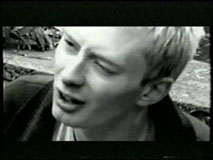

Simon Gill: "You’re all set?
Thom: "Yep.
Simon: "Okay.
[unknown third person]: "Am I recording?
Simon: "Yep.
Thom: "You are.
Simon: "Right. What myth, you think, would you most like to shatter, that there are around Radiohead?
Thom: "There’s one apparently, about me...
Simon: "[off] No, we don’t want that. Wait, sorry.
Thom: "There’s one myth about me being an angry young man with no cause to be angry. Whatever that means. ‘Sulky little git’. I am a sulky little git whenever the press is around, because I hate the press; I think that’s fair enough. Therefore, the myth is reinforced. But that’s their problem.
[lots of background noise]
Simon: "Sorry.
Thom: "You’re gonna have to shut that door.
Simon: "Yeah, have to shut that door...
Thom: "But I don’t think it’ll make any difference, do they? Uh, yeah, I dunno. I don’t mind, I mean, they’re all right. Just like school bullies, aren’t they? They decide on something and that’s it. It’s one of the very good reasons to leave Britain, I think.
Simon: "Leave Britain? So, do you find... do you think your music is completely British, though? To what extent is it about coming from here and the sort of record business stuff that, unless you’re growing up with it, the American kids [indecipherable]?
Thom: "I wonder what Jonny said to that.
Simon: "This isn’t... it’s not...?
Thom: "No, no, it’s all right. [pause] I think...
Simon: "I’m just getting really bad sound on the tape.
Thom: "Just start from the top?
Simon: "Start from there... okay. [indecipherable] read that you described your album as ‘flawed’... first album as ‘flawed’.
Thom: "Ha!
Simon: "To what extent is the new one a reaction against each fault in the first one, the ‘flawed’?
Thom: "Oh, we were just really, really young when we did it. Really sort of, hardly playing as a band, never really been in a studio, just got signed to a huge label, completely freaked out and hadn’t done the gigs, you know? Basically.
[loads of background noise]
Simon: "Sorry about this, mate.
Thom: "[laughs] It’s like a really old-fashioned thing to say, but we’d like to be making records as far as 10 years from now. Whether anyone buys them or not... No obviously they have to buy them, otherwise we can’t make them.
Simon: "Yeah, fair enough. You’ve criticised ‘compartmentalised pop’. Don’t you feel that the fact that you strived not to be compartmentalised is the reason why people in this country and in the music press were so slow to pick up on you?
Thom: "Maybe. Maybe we it’s just [that] we were crap to begin with, as well.
Simon: "That’s very honest.
Thom: "Also... [pause] Well, no, I don’t think that anymore because I suppose they have to have something to write about and if they don’t have the language in which to write it and a way, somewhere, to put something, they can’t write about it. I suppose it’s the nature of the business.
Simon: "Right.
Thom: "But I still don’t understand why it has to happen. I don’t understand why music can’t be music. Why it has to be all this other shit.
Simon: "Yeah, I mean, we did someone once who said ‘Music is lovely, it’s just the business that’s horrible.”
Thom: "It’s not that horrible. It is horrible, but it’s exactly the same as everything else, exactly the same as every other business. It’s just the people that work within it, the people that desperately want to get away from the fact that they have to deal with the business. Does that make sense? No, probably not...
Simon: "What I meant earlier about the philosophies, you were saying that you were complete control freaks. Is there any sort of ideology behind the control, guiding you?
Thom: "Yeah... [pause] The ideology, really... there’s a lot of stuff wrapped up in it that I’m realising now. A lot of stuff I have a problem with, in terms of the media... and I mean the media in the looser sense of the term. I think half the reason we ended up calling ourselves Radiohead is because we see a lot of people who just receive. Everybody just receives information and there’s a huge gap between just receiving the information and suddenly partaking in the creative process and being a creative person. I’ve always thought that there shouldn’t be any link; that the two should just flow into each other. But they don’t because of the way that the media is set up. They’re on high and they condescend to tell you what’s new and what you should listen to. Whereas I think the total opposite should be the case. People should be exposed to as much as possible and then make their own choice, and then it gets written about... a cyclical process. I think that the thing that kills popular culture is the fact that certain people, with a lot of power or cash, are able to tell other people what to go out and buy. You can go into HMV and Our Price and you’re told what to buy. You don’t have a choice. Like, ten years ago, you could go into a record shop, probably not HMV and Our Price, you go up to the counter and say “What’s this one like?” and they play you a track, whatever. You can actually have an active part in choosing your record. Nowadays, you don’t get that and we think that’s complete bullshit. I think... For some reason, that’s what’s been going through my head in the past two or three weeks, and I think, actually, that has quite a lot to do with what we’re about, because on the one hand we just make music, but we don’t just make music because we’ve all been involved in other things. Like Colin...
[mic slips]
Simon: "It’s all right, carry on.
Thom: "Oh, did I..? Sorry!
Simon: "Stuck it onto the edge... carry on.
Thom: "Colin worked in Our Price for a year and Ed was, when he was at college, he was doing loads of promotion and stuff like that, for bands and things, and I was DJing at college. I don’t know, I just think it could be a lot better. I think the reason that we keep going and we have a sort of real work ethic, as Ed would put it, about what we do, that we work our nuts off because we see so many bands who don’t and we think “why?”. You’re given this amazing opportunity to share what you’re doing, and people just sort of skin up and fall over and don’t do anything. Which is fine sometimes, but we’re almost the extreme opposite. We’re the highly stressed executives in the board meeting who’ve been up for three weeks drinking too much coffee. That’s how we approach what we do, I think.
Simon: "You’re right, okay, that was a very good answer.
Thom: "Took a while, didn’t it? [laughs]
Simon: "Well, no, you covered quite a lot of questions. I was going to ask you actually, whether you felt that the press should... their job was to create or to observe and report, and you answered that. What is it... to what extent is it therapy for you, actually - song-writing?
Thom: "I think that certain things I put in songs because that’s the only place I can put them. There are other things that I’ve put in songs and actually regret that I’ve done it, because it’s so personal that I can’t actually look at it again. It’s like, in the eye. I think, actually, sometimes it’s too much like therapy, but everybody else tells me “no, no, it’s great, wow, it’s really upsetting” and really I’m thinking “yeah but, it’s me, eeugh!”
Simon: "Don’t you think that’s one of the jobs of a rock star? So that other people can live out aspects of their lives through you?
Thom: "I hope not! Maybe. No, because I think everyone who’s creative is doing that anyway. I’ve always sort of put certain things on the edge of my sleeve for people to pick at, because that’s what I’m like. It wouldn’t matter if I wasn’t a creative person, I would still be doing that. Ever since I was a kid, that’s kind of what I’ve been doing. When I was five or six, I was making models out of Lego and exhibiting them on the front of the television for people to say what they thought and say how wonderful they were, and things like that. And I’ve kind of been doing that ever since and I suppose I kind of need it, now. So, I think songs are therapy in a sense that I’ve always had it to prop me up. So, in a sense they’re therapy, because I’ve lived with them, lived with the idea of being able to be creative, to express myself. Without that I’d be in the loony bin, definitely.
Simon: "Right. Do you have strange dreams?
Thom: "I never remember my dreams. Hardly at all... unfortunately.
Simon: "Shame.
Thom: "Yeah, I know.
Simon: "Well, probably a shame for you, your dreams. Big shame for me, because they’re probably worth hearing.
Thom: "[laughs]
Simon: "So I wondered, writing something about catharsis... well, I’ve got a saying that it’s therapy writing, but you also say that dreams are sort of somewhere where we’ve been, somewhere we’ll go. I’m not articulating myself, at all, am I?
Thom: "No, no, I think that, probably, if I was that in-tune with my dreams then I wouldn’t write the way I write, you see what I mean? I tend to use every-day objects and every-day things that happen, rather than anything that could be cosmic, because that’s kind of the way I am. It doesn’t mean that the emotions behind choosing these things are any less relevant. It’s just, I can’t write about green people and fluffy clouds and things, ‘cause a) it’d sound ridiculous if I said it (certain people could get away with it), and b) it wouldn’t make any sense, at all.
Simon: "But I mean that’s what people like about your music - it’s actually appealing to them. You’re saying it in a way that other people would say “oh, yeah, I can relate to that”.
Thom: "I think, it’s funny, maybe it’s because... yeah, it’s to do with the fact that the songs that I write and the words that I use are quite commonplace, but the fact that I put them in a song is something people relate to. I think that’s part of it. I’ve always just used common things... like, rubbish, picking up people’s phrases... stuff off TV.
Simon: "It’s like those pop artists using photographic cut-ups...
Thom: "Yes, it’s like a photomontage. Kind of pretentious? Yes, really!
Simon: "I did lead you onto it... You said you’d done the record cover... are you interested in doing art and things?
Thom: "Well, yeah, I did a degree in it.
Simon: "Really?
Thom: "Yeah. Polytechnic Southwest. It was a combined course with Exeter University. I was doing English at Exeter University and I was doing Fine Art, as they called it, at Poly[technic] Southwest.
Simon: "By that... it wasn’t fine art?
Thom: "I like the phrase ‘fine art’, ‘cause it’s so ridiculous.
Simon: "Okay,
Thom: "Yeah, just a little.
Simon: "What is it that pushes you to adopt the position of an outsider? Is it that you’ve never fitted in, or...?
Thom: "No, it’s ‘cause the people inside are jerks.
Simon: "All right, then. [pause] If pop music can change the world, what changes would you like to come round to?
Thom: "Pop music can’t change the world. Pop music changing the world is Live Aid, and Live Aid got tacked by the British government. But that doesn’t change anything, does it? I have a real fucking problem with pop stars who think they can change the world with their music. It’s a real 80s thing anyway, it never really happened until the 80s. A lot of bands, a lot of artists, with failing careers and failing back catalogues... Sorry, I’m really, really cynical about that. Doing work for charity is fine, but things like Live Aid... there was... [sighs] The trouble with doing charity gigs, or doing... this is why we were kind of hesitant about doing the charity gig we were doing today for a while, because I have a real problem with pop stars who do work for charity and say, “here we are, we’re gonna change the world” or whatever. And places like Rwanda, where, you know, a military government or whatever is wiping out all these millions of people... and where did they get the arms from? They got them from the West! We sell these poor little countries all these armaments; make shit-loads of money out of them. They blow each other away, then we send them little bits of money to sort of ‘feed the starving’. I’ve never once heard a pop star say, “Well, hang on. All we’re doing is selling them arms so they can blow themselves away. Surely that’s what we should be worried about”. I mean, obviously someone’s got to [indecipherable], but every citizen of every Western country knows full well, that if they had a responsible government they’d do it anyway. They wouldn’t be selling them arms, but they’d be helping... bullshit. It’s all fucking bullshit. It’s all just putting plasters over huge, great wounds. That’s why I hate it. I think, pop stars changing the world is just pop stars with a bad conscience and pure ignorance. That’s what I think.
Simon: "Okay. Are you against...
Thom: "I would never get involved in politics, because I don’t believe in politics as something to get involved in. Politics should be chiefly about the individual, which is why I sort of scratched my head when R.E.M. were making speeches at Clinton’s inauguration and stuff, I thought, “eh? That makes no sense to me at all!” Clinton is ultimately working within a set power structure and he’s licking a certain set amount of arses in order to do so! Eh, I don’t know. My politics are about the individual as a responsible citizen and I think that... [sighs] Being a person in Britain and sending money to charity or getting involved in politics is... no one talks about anything to do with collective responsibility, that our government goes out and does all these fucking ridiculous things. And we are ultimately responsible, we can’t say “oh, it’s politics”. You can’t put politics in a corner and say “let’s go talk about politics now” and then walk away like that. Doesn’t work like that. We’re human beings, we don’t work like that. But over the past 50 years the media has created this thing called ‘politics’, and its intellectual establishments which... you walk there and you talk about politics then you settle things and you leave, then you on with your life. It doesn’t make any sense to me. It’s just... sorry, I’m talking crap.
Simon: "No, no, you’ve [indecipherable] well. But you don’t... all right, so [indecipherable] they’re all kind of political in terms of, relationships... human relationships, basically?
Thom: "Yeah, well done!
Simon: "That’s where I thought we were going. All right, then. Do you think – we were talking about the media – do you think that – say, something like that 60s - all these revivals that are coming in at the moment are to do with the fact that the media didn’t over-expose things much in the 60s? Like a mob thing, supposed to be happening now. There’s very few [?] or The Beetles around that people get to see. It’s a lot more, sort of, mysterious, and people’s imagination is going wild.
Thom: "Yeah, I’m sure the imagination is, really... but I think, also... [pause] I think it’s really weird that people our age, people who are in bands, everyone always refers to this.... You’re constantly up against the 60s, and now the 70s and the 80s, it’s sort of... You’re bombarded by these things. You not allowed to just say “we’re a band in 1994, playing this music and it might have this reference or this reference or this references, everything has references! Why do we have to be mods, why do we have to be any of these things? But Woodstock was classic. The Woodstock was a classic example of a generation being told “the 60s were great! You’d have love the 60s! You weren’t actually there, but now you’re walking around in exactly the same clothes as your parents wore, listening to exactly the same albums! Don’t you think that’s a little bit sad? Just a little bit sad?” I think it is. But I do it. But I think it’s sad. It’s because people don’t have as much money now. People our age don’t have the spending power. The spending power is with the over-thirty’s, and the over-thirty’s are in their fifties or seventies! That’s the bottom line. People who have got the money are over thirty! Therefore, our culture’s fucked!
Simon: "Yeah? Maybe. Do you think... I think I was going to come back to this... before you said money, what did you say..?
Thom: "Woodstock.
Simon: "Yeah, you were talking about Woodstock. While you toured, were there any interesting anecdotes, things that happened? Like the bloke from Pavement who took loads of acid and used to run over band members and jump from planes? I was wondering, were there any interesting things that happened that were like that while you were touring?
Thom: "[snorts] Well, not many people we know take acid!
Simon: "Well, no, didn’t have to be that, it was just one of those things that happened to come up with the conversation.
Thom: "No, I know, but... There are a few, but our anecdotes... I think they tend to be pretty boring, if we sat down. We all get asked this a lot, but can never really think of anything. I mean, there’s kind of a million things... every day you’re in the US is another anecdote. But to actually come up with an example...
Simon: "Weird things happen when you travel, anyway, don’t they?
Thom: "Well yeah, every day. That’s one of the best things about it, I think.
Simon: "But do you think you live a particularly rock ‘n’ roll lifestyle?
Thom: "I don’t think I... I think it exists for certain people, still. They tend to be the people still dressing up in their parents’ clothes and still taking acid thinking it’s really cool. Acid probably is fairly cool. I don’t know. But I don’t see why I have to take it to be part of it, part of whatever this is. I don’t want to be in Primal Scream anyway, they’re crap!
Simon: "[laughs] Erm... I haven’t gone through my question in order so hang on a sec... um... Do you... Yes, that’s what I was gonna say, about the Woodstock thing!
Thom: "Ah! Shit.
Simon: "Do you think that... what you were saying about clothes and music, do you think they're actually redundant as forms of expression?
Thom: "No, no, not at all! No way! I mean, how can they possibly not be? It’s just not possible, it’s always been like that, I think, hasn’t it?
Simon: "I was gonna say they were legitimate forms of expression but all right then, it won’t work then – you said no!
Thom: "Well, no, ‘cause... for a start... I think clothes always are but... it’s funny now because you walk down your high street, and everything is recycled so fast now, nowadays you can wear whatever – I think it’s really good, I think it’s much better now. The clothes that people wear now are fucking great! I think people look brilliant, they’ve never looked as they do now. We don’t have that many people wearing flares, we don’t have... I quite like flares actually, why am I saying that? But every fashion has the ridiculous element you always go about afterwards but it doesn’t matter now because everyone’s allowed to wear what they want now. I think that’s really good. I think that also kind of reflects itself in music – everyone can buy what they want now. It’s just, you’re told to buy certain things and it doesn’t make any sense! Because everything is at your hand now, everything is recycled so fast it’s just going into a hole. Which I think is great, if people looked at it positively rather than thinking “Oh my God, pop’s dying!” blah blah blah...
Simon: "Right, okay. How in touch do you feel you are with your feminine side?
Thom: "[hesitates] Sometimes, I’m... I can be really, really aggressive, though. But I can also be very feminine.
Simon: "Do you think, when ask the question, do you feel the feminine is the nice aspects of you?
Thom: "Yeah, pretty much.
Simon: "Right. I’d just be interested...
Thom: "Yeah, definitely. My mum always wanted me to be a girl anyway... although she won’t admit it.
Simon: "What motivates you to write into form? Is there anything particularly...?
Thom: "I don’t know actually. [laughs] I really don’t know! I really do have... your battery’s running out.
Simon: "Right! What have we got... yeah, just about to.
Thom: "I really do have...
Simon: "Is there anything you want to say before the battery runs out? Because that’s going to be it.
Thom: "Uh... no.
Simon: "No. Can you say ‘hi’... or can you do a trailer for us? “I’m appearing on Deadeye Video Magazine, blah blah blah”
Thom: "Yeah, okay.
Simon: "“Hi, I’m Thom from Radiohead, I’m appearing on Deadeye Video Magazine.”
Thom: "Yeah. Hi, I’m Thom from Radiohead. I’m appearing on Deadeye Video Magazine.
Simon: "Right, thank you very much, and that’s it!
Thom: "That’s it, isn’t it?
Simon Gill: "What myth would you most like to shatter about Radiohead?"
Thom: "There's one myth about me being an angry young man with no cause to be angry. Whatever that means - a sulky little git. I am a sulky little git whenever the press are around, because I hate the press, so I think that's fair enough, therefore the myth is reinforced. But that's their problem. They're just like school bullies, aren't they, really? They decide on something and that's it."
Simon: "You described your first album as flawed. To what extent is The Bends a reaction to these flaws?"
Thom: "Well, we were just really, really young when we did it. We'd hardly been playing as a band, never really been in a studio. We'd just signed to a huge label, were a bit freaked out and hadn't done the gigs, basically. We'd like to be making records five or ten years from now, wether anyone buys them... Obviously they have to buy them otherwise we can't make them."
Simon: "You've criticised 'compartmentalised pop'. Do you think the fact that you strive not to be compartmentalised is the reason people in this country, and the music press, were slow to pick up on you?"
Thom: "Maybe. Maybe because we were crap to begin with, as well. I don't think that anymore, because they have to have something to write about, and if they don't have the language in which to write it, and somewhere to put something, they can't write about ut. I suppose it's the nature of the business, but I still don't understand why it has to happen. I don't understand why music can't be music, why there has to be all this other shit."
Simon: "We did someone once who said 'Music is lovely, it's just the business is horrible'."
Thom: "Its not THAT horrible. It is horrible, but it's exactly the same as every other business, it's just the people that work within it are the people that desperately want to get away from the fact that they have to deal with the business. Does that make sense? Probably not!"
Simon: "You were saying that you are complete control freaks. Is there any ideology behind the control, guiding you?"
Thom: "Yeah, there's a lot of stuff wrapped up in it that I'm realising now, the stuff I have a problem with in terms of the media, media in the loose sense of the term. I think half the reason we ended up calling ourselves Radiohead was because we see a lot of people who just receive information and ther's a huge gap between this recieving information and suddenly partaking in the creative process and, being a creative person, I've always thought that there shoulden't be any link, the two should just flow into each other, but they don't because of the way the media is set up. They're on high and they condescend to tell you what's new, and what to listen to, whereas I think the total opposite should be the case, that people should be exposed to as much as possible and then make their own choice and then it would get written about.
I think the thing that kills popular culture is that certain people with a lot of power, or cash, are able to tell people what to buy. You can go in HMV or Our Price and you are told what to buy, you don't have a choice. Like, ten years ago, you could go into a record shop, probably not HMV or Our Price and go through the records, then go up to the counter and say 'What's this one like?' and they'd play you a track. You know, you can actually have an active part in choosing your records. Nowadays you don't get that and we think that's complete bullshit.
For some reason that's what's been going through my head in the past two or three weeks and I think, actually, that has quite a lot to do with what we're on about. Because on the one hand, we just make music, but we don't just make music because we've all been involved in other things. Well, Colin worked in Our Price for a year and Ed, when he was at college, he was doing loads of promotions for bands and things, and I was DJing at college. I just think it could be a lot better.
We've a real work ethic, as Ed would put it, about what we do. We work our nuts off because we see so many bands who don't and we think 'Why?' You're given this amazing oppurtunity to share what you're doing and people just skin up and fall over and don't do anything, which is fine sometimes, but we're almost the exact opposite. We're highly stressed executives in a board meeting that has been up for three weeks drinking too much coffee. that's how we approach what we do."
Simon: "That was a very good answer."
Thom: "It took a while, didn't it!"
Simon: "To what extent is your song-writing therapy for you?"
Thom: "Certain things I put in songs, because that's the only place I can put them, and other things I put in songs and actually regreat that I've done it, because it's so personal that I can't look at it straight in the eye again. So I think sometimes it's too much like therapy, but everyone else tells me 'No, no, it's great. Wow! It's really upsetting', and I'm going 'Yeah, but it's me! Eeurgh!'"
Simon: "Do you think that's one of the jobs of being a rock star, so that other people can live out their lives through you?"
Thom: "I hope not! Maybe - I think everyone who's creative is doing that anyway. I think I've always done it. I've always but certain things on the edge of my sleeve for people to pick at, because that's what I'm like. It woulden't matter if I wasn't a creative person, I would still be doing that. Ever since I was a kid, five or six, I was making models from lego, and exhibiting them on the television for people to say what they thought, say how wonderful they were, and I've been doing it ever since and I suppose I kind of need it now."
I think of songs as therapy in the sense that I've always had it to prop me up. So I suppose they are therapy because I've lived with them, and lived with the idea of being creative and expressing myself. Without it I'd be in the loony bin, definitely."
Simon: "Do you have strange dreams?"
Thom: "I never remember my dreams, hardly at all, unfortunately."
Simon: "It's a shame.
Thom: "Yeah, I know!I think that if I was that intune with my dreams, then I woulden't write the way I write. I tend to use everyday objects and everyday things that happen, rather than anything desperately cosmic. Because it's the way I am, it doesn't mean that the emotions behind choosing these things are any less relevant, it's just I can't write about green people and fluffy clouds because, not only would it sound ridiulous if I said it, although certain people could get away with it, but also, it woulden't make any sense to me."
Simon: "That's what people like about your music, it actually appeals to them."
Thom: "I think it's to do with the fact that the songs I write and the words I use are quite commonplace, but the fact that I put them in a song is something people relate to. i think that's part of it, I've always used common things, just picking up rubbish, people's phrases and stuff on TV."
Simon: "It's like those pop artists using photographs or something."
Thom: "Yeah, it's like photo-montage. How pretentious! Yes, really!"
Simon: "Are you interested in visual arts?"
Thom: "Well, I did a degree in it! Polytechnic Southwest. It was a combined course - English at Exeter University and Fine Art at Polytecnic Southwest. I like the phrase 'fine art', because it's so ridiculous."
Simon: "What is it that pushes you to adopt the posistion of an outsider? Is it because you've never fitted in?"
Thom: "No, it's because the people inside are jerks."
Simon: "All these revivals are coming. Is it to do with media under-exposure in the 60's?"
Thom: "Yes, I think its really wierd that people our age who are in bands... You're constantly up against the 60's, 70's and 80's, you're bombarded by these things. You're not allowed to just say, 'Well, we're a band playing THIS music, and ok, it might have this reference and that reference - everything has references. Why do we have to be mods? Why do we have to be any of those things?' Woodstock was a classic example of a generation being told 'The 60's were great. You'd've loved the 60's.' You weren't actually there, but now you're walking around in the exact same clothes your parents wore, listening to exactly the same albums" Don't you think that's just a little bit sad? Just a little bit? I think it is, but I still do it, but I think it's sad. It's because people don't have much money now, no spending power. The spending power is with the over-thirty's, that's the bottom line, so our culture's fucked."
Simon: "Any interesting tour anecdotes? Like the bloke from Pavement who took loads of acid and used to run over band members and jump from planes?"
Thom: "Well, not many people we know take acid. There are a few, but I think our anecdotes tend to be really boring. I mean, every day in America is an anecdote."
Simon: "So, do you think you lead a rock'n'roll lifestle, then?"
Thom: "I think it exists for certain people still. They tend to be the ones still dressing up in their parents clothes and taking acid and thinking it's really cool, I don't know, it probably is really cool to take acid, but I don't see why I have to be a part of it."
Simon: "What you were saying about clothes and music, do you think they're redundant as forms of expression?"
Thom: "Oh, no, not at all. How could they possibly be? It's alwyas been like that, hasn't it? It's funny now, because you walk down your high street, and everything is recycled so fast now, nowadays you can wear whatever - I think it's really cool. the clothes that people wear now are fucking great. they've never looked as good as they do now. We don't have that many people wearing flares! I quite like flares actually. Why am I saying that! Every fashion has the ridiculous element, but it doesn't make any sense, because everything is in your hands now. everything is recycled so fast, it's just going into a hole, which I think is great."
Simon: "How in touch with your feminine side? When I ask the question, do you see feminine as being the nice side of you?"
Thom: "Yeah, pretty much. My mum always wanted me to be a girl, although she won't admit it."
Simon: "Is there anything you want to say before the battery runs out?"
Thom: "Er.. no."
Thom: "There's one myth about me being an angry young man with no cause to be angry. Whatever that means - a sulky little git. I am a sulky little git whenever the press are around, because I hate the press, so I think that's fair enough, therefore the myth is reinforced. But that's their problem. They're just like school bullies, aren't they, really? They decide on something and that's it."
Simon: "You described your first album as flawed. To what extent is The Bends a reaction to these flaws?"
Thom: "Well, we were just really, really young when we did it. We'd hardly been playing as a band, never really been in a studio. We'd just signed to a huge label, were a bit freaked out and hadn't done the gigs, basically. We'd like to be making records five or ten years from now, wether anyone buys them... Obviously they have to buy them otherwise we can't make them."
Simon: "You've criticised 'compartmentalised pop'. Do you think the fact that you strive not to be compartmentalised is the reason people in this country, and the music press, were slow to pick up on you?"
Thom: "Maybe. Maybe because we were crap to begin with, as well. I don't think that anymore, because they have to have something to write about, and if they don't have the language in which to write it, and somewhere to put something, they can't write about ut. I suppose it's the nature of the business, but I still don't understand why it has to happen. I don't understand why music can't be music, why there has to be all this other shit."
Simon: "We did someone once who said 'Music is lovely, it's just the business is horrible'."
Thom: "Its not THAT horrible. It is horrible, but it's exactly the same as every other business, it's just the people that work within it are the people that desperately want to get away from the fact that they have to deal with the business. Does that make sense? Probably not!"
Simon: "You were saying that you are complete control freaks. Is there any ideology behind the control, guiding you?"
Thom: "Yeah, there's a lot of stuff wrapped up in it that I'm realising now, the stuff I have a problem with in terms of the media, media in the loose sense of the term. I think half the reason we ended up calling ourselves Radiohead was because we see a lot of people who just receive information and ther's a huge gap between this recieving information and suddenly partaking in the creative process and, being a creative person, I've always thought that there shoulden't be any link, the two should just flow into each other, but they don't because of the way the media is set up. They're on high and they condescend to tell you what's new, and what to listen to, whereas I think the total opposite should be the case, that people should be exposed to as much as possible and then make their own choice and then it would get written about.
I think the thing that kills popular culture is that certain people with a lot of power, or cash, are able to tell people what to buy. You can go in HMV or Our Price and you are told what to buy, you don't have a choice. Like, ten years ago, you could go into a record shop, probably not HMV or Our Price and go through the records, then go up to the counter and say 'What's this one like?' and they'd play you a track. You know, you can actually have an active part in choosing your records. Nowadays you don't get that and we think that's complete bullshit.
For some reason that's what's been going through my head in the past two or three weeks and I think, actually, that has quite a lot to do with what we're on about. Because on the one hand, we just make music, but we don't just make music because we've all been involved in other things. Well, Colin worked in Our Price for a year and Ed, when he was at college, he was doing loads of promotions for bands and things, and I was DJing at college. I just think it could be a lot better.
We've a real work ethic, as Ed would put it, about what we do. We work our nuts off because we see so many bands who don't and we think 'Why?' You're given this amazing oppurtunity to share what you're doing and people just skin up and fall over and don't do anything, which is fine sometimes, but we're almost the exact opposite. We're highly stressed executives in a board meeting that has been up for three weeks drinking too much coffee. that's how we approach what we do."
Simon: "That was a very good answer."
Thom: "It took a while, didn't it!"
Simon: "To what extent is your song-writing therapy for you?"
Thom: "Certain things I put in songs, because that's the only place I can put them, and other things I put in songs and actually regreat that I've done it, because it's so personal that I can't look at it straight in the eye again. So I think sometimes it's too much like therapy, but everyone else tells me 'No, no, it's great. Wow! It's really upsetting', and I'm going 'Yeah, but it's me! Eeurgh!'"
Simon: "Do you think that's one of the jobs of being a rock star, so that other people can live out their lives through you?"
Thom: "I hope not! Maybe - I think everyone who's creative is doing that anyway. I think I've always done it. I've always but certain things on the edge of my sleeve for people to pick at, because that's what I'm like. It woulden't matter if I wasn't a creative person, I would still be doing that. Ever since I was a kid, five or six, I was making models from lego, and exhibiting them on the television for people to say what they thought, say how wonderful they were, and I've been doing it ever since and I suppose I kind of need it now."
I think of songs as therapy in the sense that I've always had it to prop me up. So I suppose they are therapy because I've lived with them, and lived with the idea of being creative and expressing myself. Without it I'd be in the loony bin, definitely."
Simon: "Do you have strange dreams?"
Thom: "I never remember my dreams, hardly at all, unfortunately."
Simon: "It's a shame.
Thom: "Yeah, I know!I think that if I was that intune with my dreams, then I woulden't write the way I write. I tend to use everyday objects and everyday things that happen, rather than anything desperately cosmic. Because it's the way I am, it doesn't mean that the emotions behind choosing these things are any less relevant, it's just I can't write about green people and fluffy clouds because, not only would it sound ridiulous if I said it, although certain people could get away with it, but also, it woulden't make any sense to me."
Simon: "That's what people like about your music, it actually appeals to them."
Thom: "I think it's to do with the fact that the songs I write and the words I use are quite commonplace, but the fact that I put them in a song is something people relate to. i think that's part of it, I've always used common things, just picking up rubbish, people's phrases and stuff on TV."
Simon: "It's like those pop artists using photographs or something."
Thom: "Yeah, it's like photo-montage. How pretentious! Yes, really!"
Simon: "Are you interested in visual arts?"
Thom: "Well, I did a degree in it! Polytechnic Southwest. It was a combined course - English at Exeter University and Fine Art at Polytecnic Southwest. I like the phrase 'fine art', because it's so ridiculous."
Simon: "What is it that pushes you to adopt the posistion of an outsider? Is it because you've never fitted in?"
Thom: "No, it's because the people inside are jerks."
Simon: "All these revivals are coming. Is it to do with media under-exposure in the 60's?"
Thom: "Yes, I think its really wierd that people our age who are in bands... You're constantly up against the 60's, 70's and 80's, you're bombarded by these things. You're not allowed to just say, 'Well, we're a band playing THIS music, and ok, it might have this reference and that reference - everything has references. Why do we have to be mods? Why do we have to be any of those things?' Woodstock was a classic example of a generation being told 'The 60's were great. You'd've loved the 60's.' You weren't actually there, but now you're walking around in the exact same clothes your parents wore, listening to exactly the same albums" Don't you think that's just a little bit sad? Just a little bit? I think it is, but I still do it, but I think it's sad. It's because people don't have much money now, no spending power. The spending power is with the over-thirty's, that's the bottom line, so our culture's fucked."
Simon: "Any interesting tour anecdotes? Like the bloke from Pavement who took loads of acid and used to run over band members and jump from planes?"
Thom: "Well, not many people we know take acid. There are a few, but I think our anecdotes tend to be really boring. I mean, every day in America is an anecdote."
Simon: "So, do you think you lead a rock'n'roll lifestle, then?"
Thom: "I think it exists for certain people still. They tend to be the ones still dressing up in their parents clothes and taking acid and thinking it's really cool, I don't know, it probably is really cool to take acid, but I don't see why I have to be a part of it."
Simon: "What you were saying about clothes and music, do you think they're redundant as forms of expression?"
Thom: "Oh, no, not at all. How could they possibly be? It's alwyas been like that, hasn't it? It's funny now, because you walk down your high street, and everything is recycled so fast now, nowadays you can wear whatever - I think it's really cool. the clothes that people wear now are fucking great. they've never looked as good as they do now. We don't have that many people wearing flares! I quite like flares actually. Why am I saying that! Every fashion has the ridiculous element, but it doesn't make any sense, because everything is in your hands now. everything is recycled so fast, it's just going into a hole, which I think is great."
Simon: "How in touch with your feminine side? When I ask the question, do you see feminine as being the nice side of you?"
Thom: "Yeah, pretty much. My mum always wanted me to be a girl, although she won't admit it."
Simon: "Is there anything you want to say before the battery runs out?"
Thom: "Er.. no."