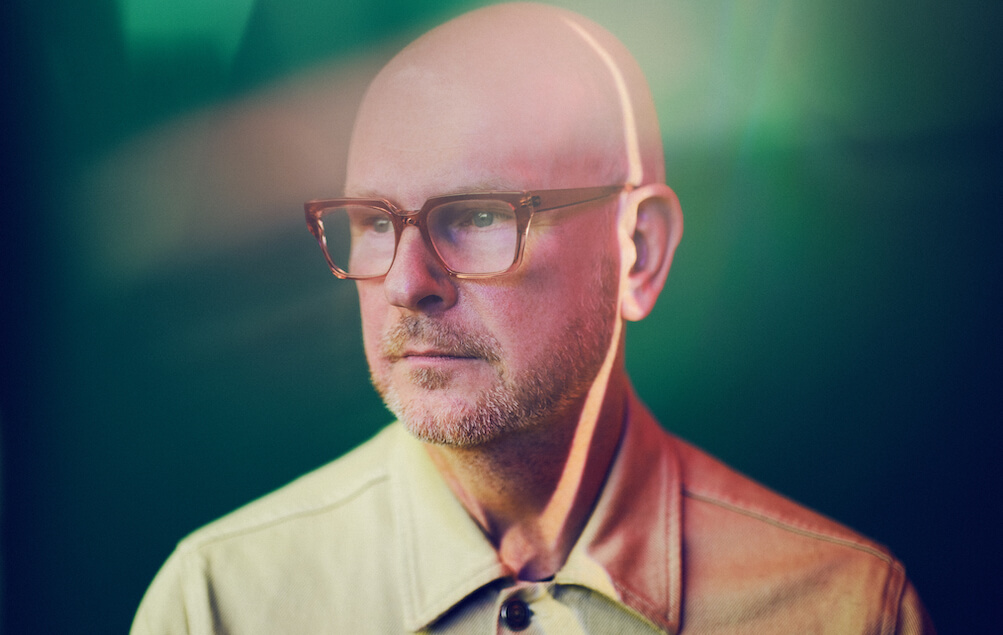
If you recognize Philip Selway’s name immediately, that probably has something to do with the band he’s been playing drums in since the mid-1980s. You know the one: Its other members are named Thom, Jonny, Ed and Colin; together they’ve produced one instant classic after another, including The Bends, OK Computer, Kid A and In Rainbows.
But unless you’re a rabid Radiohead fan, you may not be so aware of the parallel solo career Selway’s been pursuing for more than a decade. To date, he’s released four albums (one of them a movie soundtrack), the most recent being 2023’s Strange Dance. The music Selway makes on his own doesn’t exactly sound like Radiohead, but it draws on a similar pool of influences and characteristics: folkish fragility and introspection, melodic pop in the Beatles/Beach Boys tradition, arty electronic experimentalism, and an approach to instrumentation and arrangement that’s heavily informed by the contemporary classical world.
“When I first started making music, about 15, before I had my own drum kit, I had a guitar,” says Selway, 56, reached via Zoom at his father’s house in Oxfordshire. “And I felt drawn to songwriting. Joining Radiohead — well, On a Friday, as we were at the time — we all pitched in a bit with material in the earlier days. But then it became very clear that Thom [Yorke]’s material was giving the artistic character to what we were doing, and when we were signed [to EMI in 1991], I realized that I wanted my drumming to develop; I felt it needed that full-time attention. So my songwriting seriously went on a back burner for a while, but it was always kind of bubbling away there. And I just reached a point where I felt that I had enough to make a record.”
Selway’s solo debut, 2010’s Familial, was very — for want of a better word — singer-songwriter-y: stripped-down, inward-looking, predominantly acoustic. In the years since, his ambitions have grown, along with his budgets, as he’s indulged his fondness for mallet percussion instruments and lots of strings. To truly replicate the songs on Strange Dance live, you’d need a full orchestra.
“Over the past decade of doing solo stuff, it’s been a steep learning curve,” Selway acknowledges. “I mean, it’s not like I come into anything thinking, ‘I have all these different musical skills at my fingertips, I’ll just employ that one and that one.’ Each song that I work on, I’m trying to find some new aspect in my playing, trying to extend my ability. So you always feel like you’re working a bit beyond yourself. Which is, on the whole, a good place to be.”
Although the focus of this article is on the Selway solo catalog, it seemed ridiculous to omit, you know, that band entirely. And so a pair of Radiohead albums found their way into the discussion, too: one that looms largest in Selway’s personal estimation and another that celebrates its 20th anniversary this year.
The conversation has been edited for length and clarity.
Radiohead
Hail to the Thief (2003)
There’s a lot of tracks on there. Blimey. It was like two records in one. You had one side of it that was very much a band record. We did a lot of the band sessions at Ocean Way in Los Angeles, which was a departure for us, working in that kind of environment. But the other side of it is very much an electronic record. And so I guess it’s a natural midway point going from Kid A [2000] and Amnesiac [2001] into In Rainbows. Two very distinctive characters of Radiohead in that one record — that’s what was lovely about it.
When Hail to the Thief came out, it seemed to confuse some listeners because it had received advance media billing as a “Radiohead returns to guitar rock” album, and it wasn’t entirely that. But of course you hadn’t completely abandoned guitar rock on Kid A or Amnesiac either. People were only beginning to realize that you weren’t ever going to do just rock or just electronic music; instead, you’d go back and forth, cross-pollinating between the two.
You know, you can write a song like “The Gloaming” or “Idioteque” [on Kid A] because you’re in the studio, and there’s a lot of freedom in that. But then you have to take that and figure out how you can play it live. And that is such an interesting process. How are you going to get that spirit across? Trying to give that sense of the electronic in the piece but doing it through your “normal” instrument playing — that naturally develops your own musical voice. It brings different strands to it. Performing those songs live definitely affected how I sounded and how I would approach drum parts.
I love “2 + 2 = 5” because it’s such a blast to play. And I love “The Gloaming” as well, because it’s always been a real challenge to play. It sounds great on the record but it’s been very hit-and-miss live. From a drumming point of view, there isn’t anything too distinct to anchor yourself around, and from a singing point of view, it can be difficult to pitch against. But it’s so satisfying when it does all come together. Quite a unique piece.
Radiohead
In Rainbows (2007)
My personal favorite of our records is In Rainbows. That felt very accomplished. I thought it threw together everything that we’d been learning over two decades, and it seemed to land in quite a concise way. Thom’s songwriting on there is exceptional. And the sound of the five of us … you know, it feels like a band that have learned to play their instruments together but have been able to spend long enough doing that so the playing reaches a new level. Colin [Greenwood]’s bass playing over that whole album is out of this world. So yeah, I’m very proud of that record.
7 Worlds Collide
The Sun Came Out (2009)
The first record I wrote songs and sang on was a project with Neil Finn called 7 Worlds Collide. At that point I’d been starting to work on solo material, but it was still finding its feet. I’d gone to be part of that project as a drummer, but then I started playing my own material to people. It was pretty undeveloped. But Neil, who’s an incredible musician and person, was very encouraging that I should do something and that we should record it there. And that was the first instance where I’d heard my material played by other people.
The group included [Wilco drummer-percussionist] Glenn Kotche and [violinist-singer] Lisa Germano and [bassist] Sebastian Steinberg. To my ears, they elevated what I was doing, and that was really exciting. So I started off in a very fortunate place with that first record and with that collection of musicians.
Philip Selway
Familial (2010)
When I first started thinking about doing solo material, I set myself a target of making three albums and seeing where I could go musically in that time. For the first one, it felt appropriate to keep it intimate and quiet. It’s not small-scale; there’s a lot of instrumentation on there. But it’s rather more acoustic than what people would have associated me with because of Radiohead.
The opening track, “By Some Miracle,” always makes me think of Neil Finn. Is that just me making too much of the 7 Worlds Collide connection?
Well, lordy, if there are songwriters to aspire to being like, Neil’s definitely one. His back catalog is incredible. He writes these harmonically complex pieces but without that being the [main takeaway] of it. What you have are these beautiful melodies leading you through those harmonies, and very affecting lyrics as well. He’s one of the best around. To have been able to work up close to Neil during that [7 Worlds Collide] time — yes, it’s going to have its influence on you. It sets the bar for you.
Philip Selway
Weatherhouse (2014)
I bought a vibraphone and a marimba about 15 years ago, and I have to justify having spent all that money on them [laughs]. That’s where a lot of the mood of Weatherhouse comes from. Radiohead had a big studio then and we acquired a lot of gear because, well, we had the space. And there was just that interest there. I do find I’m drawn to tuned percussion; it’s a natural place for me, that combination of the percussive and that access to the overall harmony of a piece.
“It Will End in Tears” has more than a touch of Harry Nilsson to it. I presume that’s a piano song?
Actually, it started off as a guitar song and then it shifted to piano. And that was about the first time I’d gotten my head around playing piano and singing at the same time. I mean, I was only playing in a very rudimentary way. But that then extended into me writing a lot more on piano. It felt like quite a departure for me.
Philip Selway
Let Me Go Original Soundtrack (2017)
By the time Let Me Go came along, I’d composed a couple of things for dancers. I’d worked with the Merce Cunningham Dance Company, and then I did a piece for Rambert Dance Company. Maybe [director] Polly [Steele] and [producer] Lizzie [Pickering] recognized something in what I was doing there that chimed with where they wanted to take the film. I’d been talking with them about it from quite early on. Originally I was involved as a kind of musical curator, and that’s where I felt comfortable. The idea of doing a soundtrack just felt incredibly ambitious. But they asked me a couple of times whether I’d consider writing it, and the more involved I became, the more I was hearing musical textures, tunes, the kind of stuff that I felt was appropriate to the characters and themes in the film. And so I was eased into that process, and I found that I loved it.
I love that way of working as well, when you’re part of a bigger artistic team, working with the director, working with a production designer, responding to the performances, getting all of those inputs. It’s really inspiring. It’s also a relief, because the narratives and so many of the artistic textures are already there. When you make your own record, that all comes from you, which is exciting but also slightly daunting. Sometimes it’s nice to just give yourself over to somebody else’s vision and find your way through that.
Philip Selway
Strange Dance (2023)
This album is pulling in all those experiences I’ve gained from working on soundtracks and working with dance and drawing on the relationships that I’ve built up through those experiences, like with [multi-instrumentalist/producer/Portishead member] Adrian Utley and Laura Moody, who’s done all the incredible string arrangements. I was starting to explore larger, more orchestral textures; I wanted to develop that for this record, give it that big soundscape. For quite some time I thought that was beyond me and my music, but it’s something I’ve become far more comfortable with. Seeing how orchestral arrangements have worked in Radiohead material has, I think, helped us all to develop a sensibility for them. And I felt that this group of songs that became Strange Dance really lent themselves to that kind of expansiveness. When Laura and I started working together, on Weatherhouse, it was all done fairly cheaply for quartet, and then that fed into the soundtrack work, and bit by bit we’ve expanded the palette.
On the second track, “What Keeps You Awake at Night,” there’s an instrumental outro that goes on for quite a while, and that arrangement that Laura wrote, it’s kind of soul strings double-plus, really. I listen to that now and think, “Yeah, that took the song to a different level.” And there’s this incredible vibes part from Valentina Magaletti, and Adrian does that Robert Fripp kind of guitar as well. That song in its original demo form — which is still in there; you strip all the layers of the recording back and you get down to my original demo — it’s a very different song. It’s just so exciting hearing all these different ideas and musical directions all coming together and playing off each other and meshing.
The junkyard rhythm of the album’s title song sounds like something off a Tom Waits album.
Coming into the sessions, that was a piano ballad, and I realized I wanted to explore the lower register of my voice. My initial reference point was Closing Time-era Tom Waits. And then when we got into the studio, I had a conversation with Valentina about it. I guess I wanted to try and take some of the prettiness out of the song, so the Closing Time era extended to Bone Machine. We took the piano out, and that opened things up harmonically. Valentina works very quickly, and within about six or seven takes she had built up the most incredible rhythm track: very nuanced, very layered, and it suddenly suggested this whole other world. Then there’s what Adrian’s doing on guitar; he’s got clips on the strings, and there’s a lobster fork in there somewhere. What started out as a pretty, wholesome piano song became this unsettling soundscape, but there’s real beauty in there as well.
You mentioned exploring your lower vocal register, which leads me to note that your singing is consistently quiet, even when the music gets loud.
That was one of the conversations I had with [producer] Marta [Salogni] early on. I wanted the vocals almost to be like pillow talk. It’s very up close because I wanted that intimacy in there, I wanted the warmth. But I also wanted a big soundscape, which could wrap around that but still allow for that intimacy at the core. A lot of that approach came from very early on when I was doing solo stuff. I guess I was quite self-conscious about it, and so when I was writing, [whispers] I’d be singing very quietly in my room, and since that’s how the songs came about, to go beyond that felt like it wasn’t being true to the songs. But that approach doesn’t translate so well live. You want to keep that warmth there, you want to keep that intimacy, but it has to project a lot more. Playing around with that brings a whole other aspect to what you can do with your voice, and I think that will play into when I make another record. But for this one it felt appropriate to keep it up close.